NDA Current Affairs | 13 Sep Exam
Practice Now

Gravitation – NDA Physics Notes
Exam Relevance: High Frequency | Newton’s Law · g Comparisons · Kepler’s Laws · Satellites · Escape Velocity · Variation of g · Weightlessness
Reading Time: 30–35 minutes | Last Updated: 2026
Drop a stone and it falls. Throw it sideways and it curves. Hurl it fast enough and it orbits. The same force governs all three outcomes: gravity. Gravity pulls every object in the universe toward every other object. It holds you on the ground, keeps the Moon circling Earth, and holds our entire galaxy together.
Gravity is the weakest of nature’s four fundamental forces, yet it is the force that shapes the universe at the largest scales. At the atomic level, gravity is negligible compared to electromagnetic and nuclear forces. But for planets, stars, and galaxies, gravity is the dominant architect of structure.
1. Why Do Objects Fall?
The ancient answer was: because that is the nature of heavy objects. They seek their natural place on the ground. This was satisfying until Newton asked a different question.
Newton watched an apple fall and asked: what pulls it? His answer was revolutionary: the Earth pulls the apple. But the apple also pulls the Earth, with exactly the same force in the opposite direction. Every mass attracts every other mass.
This is not a special property of Earth. Every object in the universe (every star, every planet, every grain of sand) attracts every other object. The same force that makes an apple fall keeps the Moon in orbit and holds galaxies together. Gravity is universal. Newton’s insight was to see that the force governing a falling apple and the force governing planetary orbits are one and the same.
2. Newton’s Universal Law of Gravitation
Newton’s Law of Universal Gravitation gives us the precise formula for the gravitational force between any two masses.
F = G m₁ m₂ / r²
F = gravitational force between the two masses (N). G = universal gravitational constant = 6.674 × 10⁻¹¹ N m² kg⁻². m₁ and m₂ = the two masses (kg). r = distance between their centres (m). The force is always attractive. It pulls the two masses toward each other. By Newton’s Third Law, both masses experience equal and opposite forces.
Scaling the Gravitational Force
When each of two equal masses is doubled while keeping the separation unchanged:
F’ = G(2m)(2m)/r² = 4Gm²/r² = 4F
Doubling both masses quadruples the gravitational force. [NDA 2016-I]
System 1: two masses M each at distance R. Force = GM²/R² = F. System 2: two masses 2M each at distance R/2. Force = G(2M)(2M)/(R/2)² = 4GM²/(R²/4) = 16F. [NDA 2019-II] Halving the distance multiplies force by 4; doubling both masses multiplies by 4, for a combined effect of 16×.
Two planets with mass ratio 1:7 and diameter ratio 2:1 exert gravitational forces on each other. By Newton’s Third Law, the force planet A exerts on planet B equals the force planet B exerts on planet A, always. Force ratio = 1:1, regardless of mass or size difference. [NDA 2024-II]
3. Properties of Gravitational Force
Gravitational force has several distinctive properties that separate it from other forces.
Universal: It acts between all massive objects in the universe, with no exceptions.
Always attractive: Unlike electric force (which can repel), gravity only pulls. Two masses always attract each other.
Long-range: Gravity obeys an inverse-square law (1/r²). It weakens with distance but never completely vanishes. This long-range nature is shared with the electromagnetic force. [NDA 2013-I]
Acts at a distance: No medium or contact is needed. Earth and Moon attract each other across 384,000 km of empty space.
Dominant at large scales: Gravity is the weakest fundamental force but dominates at astronomical scales because all masses contribute and because gravity cannot be shielded or cancelled.
Negligible at atomic scales: The masses of atoms and molecules are so tiny that gravitational force between them is negligible compared to electromagnetic and nuclear forces. [NDA 2018-I]
Gravitational force is NOT the same for all pairs of bodies. F = Gm₁m₂/r², so force depends specifically on each pair’s masses and separation. Different pairs have different forces. [NDA 2018-I]
4. The Gravitational Constant G
The letter G in Newton’s law is called the universal gravitational constant. It is one of the most important constants in Physics.
G = 6.674 × 10⁻¹¹ N m² kg⁻²
G is truly universal. It has exactly the same value everywhere in the universe, for all masses, at all distances, at all times. G does not depend on the local value of g. G is not greatest at Earth’s surface. G is not restricted to Earth-involving calculations. [NDA 2017-I]
G is so small (10⁻¹¹) that gravitational forces between ordinary everyday objects are negligible. You do not feel attracted to a table beside you because the force is unmeasurably small. But Earth’s enormous mass (6 × 10²⁴ kg) makes its gravity very large.
| Property | G: Universal Gravitational Constant | g: Acceleration Due to Gravity |
| What it is | A universal constant of nature | Local acceleration caused by gravity |
| Value | 6.674 × 10⁻¹¹ N m² kg⁻² | ≈ 9.8 m s⁻² on Earth’s surface |
| SI unit | N m² kg⁻² | m s⁻² |
| Varies with location? | NO: same everywhere in universe | YES: varies with altitude, depth, latitude, planet |
| Formula role | Appears in F = Gm₁m₂/r² | Appears in W = mg and g = GM/R² |
| NDA Confusion | G does NOT depend on local g; not restricted to Earth | g = 9.8 (not 8.9, not 98) on Earth surface |
5. Acceleration Due to Gravity (g)
Drop any object near Earth’s surface (ignoring air resistance) and it accelerates downward at the same rate. This rate is called the acceleration due to gravity, denoted g. We can derive g from Newton’s Law. At Earth’s surface, the gravitational force on a mass m is F = GMm/R². By Newton’s Second Law, this force causes acceleration a = F/m = GM/R². Since this acceleration is caused by gravity, we label it g:
g = GM/R²
g = acceleration due to gravity at the planet’s surface (m s⁻²). G = universal gravitational constant (N m² kg⁻²). M = mass of the planet (kg). R = radius of the planet (m). The correct relation is g = G(M/R²). [NDA 2015-II]
The gravitational force on a 1 kg body at Earth’s surface = mg = 1 × 9.8 = 9.8 N. [NDA 2011-II] Values of 8.9 N, 89 N, or 98 N are wrong distractor options.
Notice that the falling object’s mass m cancelled out completely. This tells us something profound: all objects fall at the same rate g, regardless of their mass. A feather and a cannonball, dropped together in a vacuum, reach the ground at the same time.
6. Mass and Weight
Mass
Mass is the quantity of matter in an object. It is the measure of an object’s inertia, meaning its resistance to acceleration. Mass is a scalar quantity, measured in kilograms (kg). Mass does not change with location. Your mass is the same on Earth, on the Moon, and in deep space.
Weight
Weight is the gravitational force acting on a mass. It is what a spring balance measures.
W = mg
W = weight (N). m = mass (kg). g = local acceleration due to gravity (m s⁻²). Weight is a vector quantity directed downward. It varies with location because g varies.
A body that weighs 10 kg on Earth is taken to a planet where gravity is half that of Earth. The spring balance reads 5 kg-force on that planet, because it measures weight (F = mg) and g is halved. The mass of the body remains 10 kg unchanged. [NDA 2012-I]
| Property | Mass | Weight |
| Definition | Quantity of matter; measure of inertia | Gravitational force on the body |
| Formula | — | W = mg |
| SI unit | kilogram (kg) | Newton (N) |
| Scalar or Vector? | Scalar | Vector (directed downward) |
| Varies with location? | No: constant everywhere | Yes: depends on local g |
| Instrument | Beam balance (mass comparison) | Spring balance (force measurement) |
| In space (zero g) | Unchanged | Zero (weightless) |
7. Comparing g Across Planets
The formula g = GM/R² lets us compare surface gravity across different planets. Three standard cases appear repeatedly in NDA.
Case 1: Mass Quadrupled, Radius Doubled (g unchanged)
Planet A has mass 4M and radius 2R. Planet B has mass M and radius R.
g_A = G(4M)/(2R)² = 4GM/4R² = GM/R² = g_B
The quadrupled mass and quadrupled area (from doubled radius) cancel exactly. An object weighs the same on both planets. [NDA 2014-I]
Case 2: Mass Doubled, Radius Doubled (g halved)
Planet 2 has mass 2M₁ and radius 2R₁. Planet 1 has mass M₁ and radius R₁.
g₂ = G(2M₁)/(2R₁)² = 2GM₁/4R₁² = GM₁/2R₁² = g₁/2
Doubling both mass and radius halves the surface gravity. [NDA 2018-II]
Case 3: Same Density, Different Radii (g ∝ R)
Two planets have the same density ρ but different radii R₁ > R₂. Mass M = (4/3)πR³ρ, so:
g = GM/R² = G(4/3)πR³ρ/R² = (4/3)πGρR
For same density, g is directly proportional to radius. Therefore, g₁ > g₂ when R₁ > R₂ and density is the same. [NDA 2019-I]
Earth–Moon Mass Ratio
Since g = GM/R², we get M = gR²/G. Therefore:
M_Earth/M_Moon = (g_Earth × R_Earth²) / (g_Moon × R_Moon²)
With g_Earth/g_Moon = 6 and R_Earth/R_Moon = 4: M_Earth/M_Moon = 6 × 16 = 96 ≈ 100. Earth is approximately 100 times more massive than the Moon. [NDA 2015-I]
8. Variation of g with Altitude
As you move upward from Earth’s surface, you are getting farther from Earth’s centre. The gravitational force weakens. So, g decreases with altitude. At height h above the surface, the distance from Earth’s centre becomes (R + h):
g_h = GM/(R + h)² = gR²/(R + h)²
For small heights (h << R), this simplifies to:
g_h ≈ g(1 − 2h/R)
g_h = acceleration at height h. g = surface value. R = Earth’s radius (≈ 6400 km). As h increases, g_h decreases. At very great distances (h → ∞), g → 0.
| ★ IMPORTANT g does not become zero at any finite altitude above Earth. It approaches zero only at infinite distance. Earth’s atmosphere ends at ~100 km, but gravity continues far beyond, all the way to the Moon and beyond. |
9. Variation of g with Depth
As you go below Earth’s surface, only the mass of Earth below your position contributes to the gravitational pull. The mass in the spherical shell above you pulls in all directions and cancels out. At depth d below the surface, for a uniform-density Earth:
g_d = g(1 − d/R)
g_d = acceleration at depth d. g = surface value. d = depth below surface. R = Earth’s radius. As depth d increases, g_d decreases. At the centre of the Earth (d = R): g = 0. At the centre, gravitational pulls from all directions cancel. Net gravitational force is zero.
Key distinction from altitude: With depth, g decreases linearly and reaches exactly zero at the centre. With altitude, g decreases as 1/(R+h)² and approaches zero only at infinite distance.
10. Variation of g with Latitude
Earth is not a perfect sphere. It is an oblate spheroid, slightly flattened at the poles and bulging at the equator. The equatorial radius is about 21 km greater than the polar radius.
g is maximum at the poles and minimum at the equator.
It is the shape of the Earth (the equatorial bulge) that drives this effect. It is not a variation in Earth’s density at different latitudes. [NDA 2012-II | NDA 2016-II]
Earth’s rotation also contributes slightly to the latitude variation. At the equator, a body moves in a circle of large radius. A small component of Earth’s gravity provides centripetal acceleration, reducing the effective g. At the poles, the rotation axis passes through. There is no centripetal effect. This reinforces the same trend: g_poles > g_equator.
A body weighing 5 kg at the equator will weigh slightly more than 5 kg at the poles, not less, not the same. [NDA 2012-II] The poles have stronger g, so weight = mg is larger there.
11. Gravitational Potential
Gravitational potential is the gravitational potential energy per unit mass at a point in a gravitational field. It tells you how much energy it takes (per kilogram) to bring an object from infinity to that point.
φ = −GM/r
φ = gravitational potential at distance r from the centre (J kg⁻¹). G = gravitational constant. M = mass of the source body. r = distance from the centre of the source. The potential is always negative because gravity is attractive. You must do work to pull a mass away from a gravitating body. At infinity, φ = 0.
| Property | Gravitational Field (g) | Gravitational Potential (φ) |
| Definition | Force per unit mass at a point | Potential energy per unit mass at a point |
| Scalar or Vector? | Vector (has direction) | Scalar (no direction) |
| Formula | g = GM/r² (magnitude) | φ = −GM/r |
| SI unit | m s⁻² (or N kg⁻¹) | J kg⁻¹ |
| Sign | Always positive magnitude (directed inward) | Always negative (becomes less negative at larger r) |
| At surface | g = GM/R² | φ = −GM/R |
| Physical meaning | Acceleration a mass would experience | Energy needed per kg to move to infinity |
| NDA Confusion | Field can be non-zero on equipotential surface | Equal potential ≠ equal field; work on equipotential = 0 |
Equipotential Surfaces
An equipotential surface is a surface on which the gravitational potential has the same value everywhere. For a spherical planet, equipotential surfaces are concentric spheres. The work done by gravity in moving an object along an equipotential surface is zero, because the potential does not change, so ΔPE = 0 and W = 0.
When gravitational potential is identical at two points A and B, moving an object from A to B requires zero work by gravity. [NDA 2026-I]
Importantly: the gravitational field (the force per unit mass) need not be zero on an equipotential surface. The field can be non-zero even where the potential is constant. The field lines are always perpendicular to equipotential surfaces.
12. Gravitational Potential Energy
If gravitational potential is energy per unit mass, then the gravitational potential energy of a mass m at distance r from the centre of a planet of mass M is:
U = mφ = −GMm/r
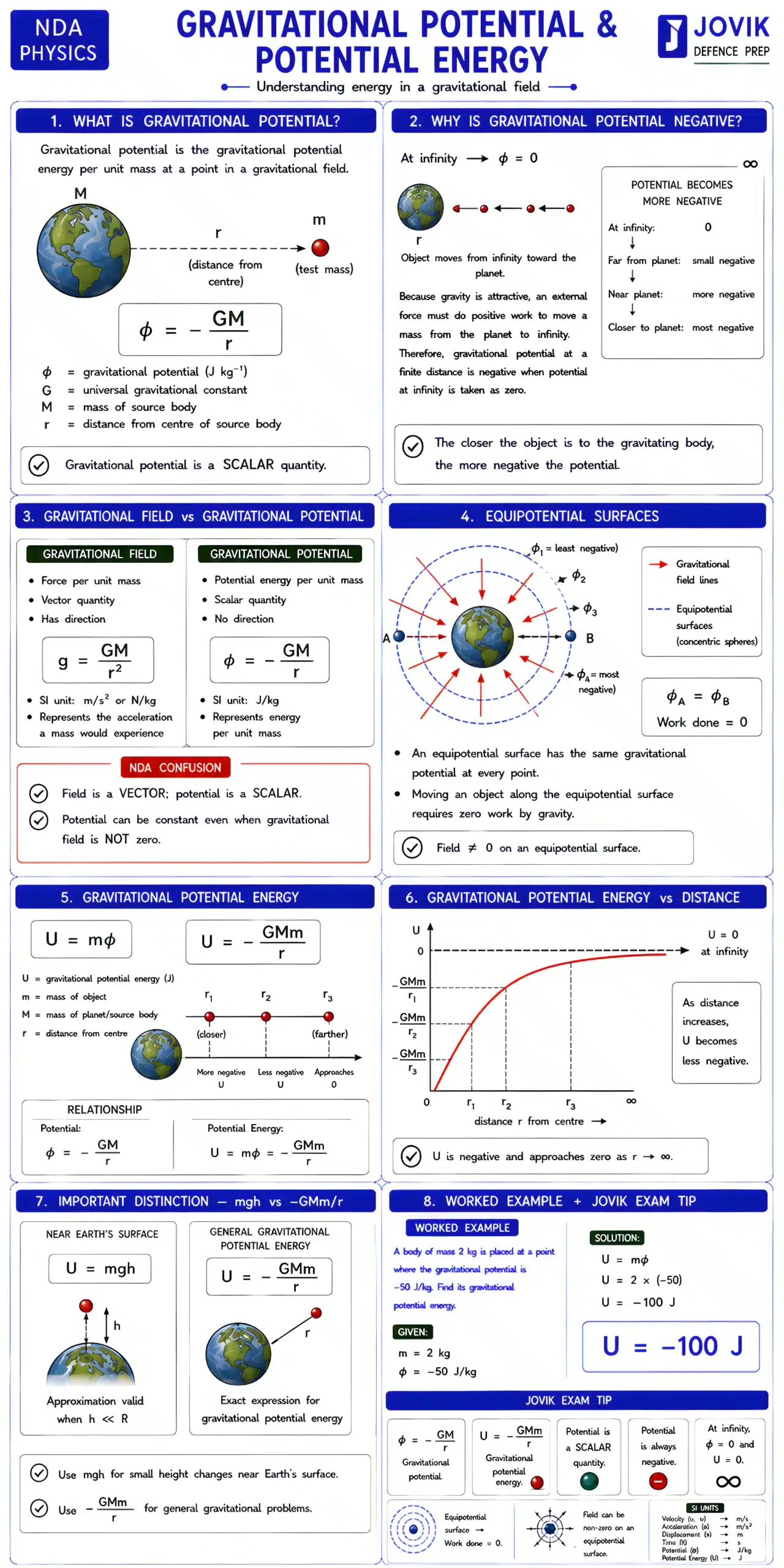
U = gravitational potential energy (J). m = mass of the object. M = mass of the planet. r = distance from the planet’s centre. U is always negative. It is zero at infinity. The more negative U is, the more tightly bound the object is to the planet. Increasing r makes U less negative. You must do work to increase separation.
Note: The formula U = mgh used in earlier chapters is an approximation valid only near Earth’s surface where h << R. The exact formula is U = −GMm/r, which applies at all distances.
13. Escape Velocity
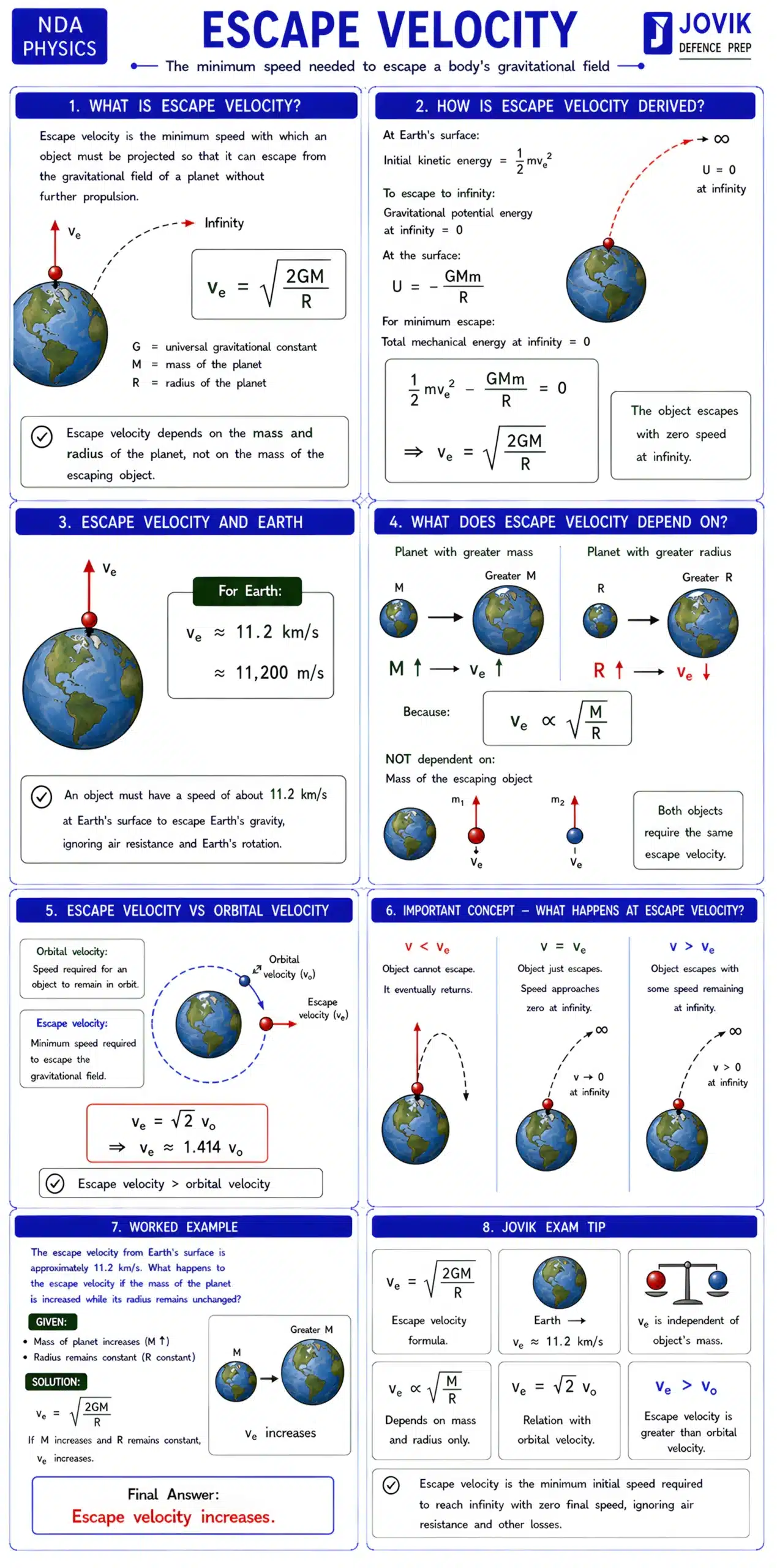
To escape a planet’s gravity, an object must travel fast enough to never fall back. It must reach infinity. The minimum speed required to do this is called the escape velocity. Deriving it using energy conservation: at the surface, the object has KE = ½mv_e² and PE = −GMm/R. At infinity (escaped), both KE and PE are zero.
½mv_e² + (−GMm/R) = 0
v_e = √(2GM/R) = √(2gR)
v_e = escape velocity (m s⁻¹). G = gravitational constant. M = planet mass (kg). R = planet radius (m). g = surface gravity (m s⁻²). For Earth: v_e = √(2 × 9.8 × 6.4 × 10⁶) ≈ 11.2 km s⁻¹. Escape velocity does not depend on the mass of the escaping object. A feather and a rocket need the same launch speed.
Escape Speed from a Density-Scaled Planet
A planet has radius R/2 and density 4ρ_Earth. Mass = (4/3)π(R/2)³ × 4ρ = M_Earth/2.
v_e = √(2G × M_Earth/2 ÷ R/2) = √(2GM_Earth/R) = 11.2 km s⁻¹
The escape speed equals Earth’s escape speed. The density increase (×4) exactly compensates the radius decrease (×½) when combined. [NDA 2024-I]
14. Orbital Velocity
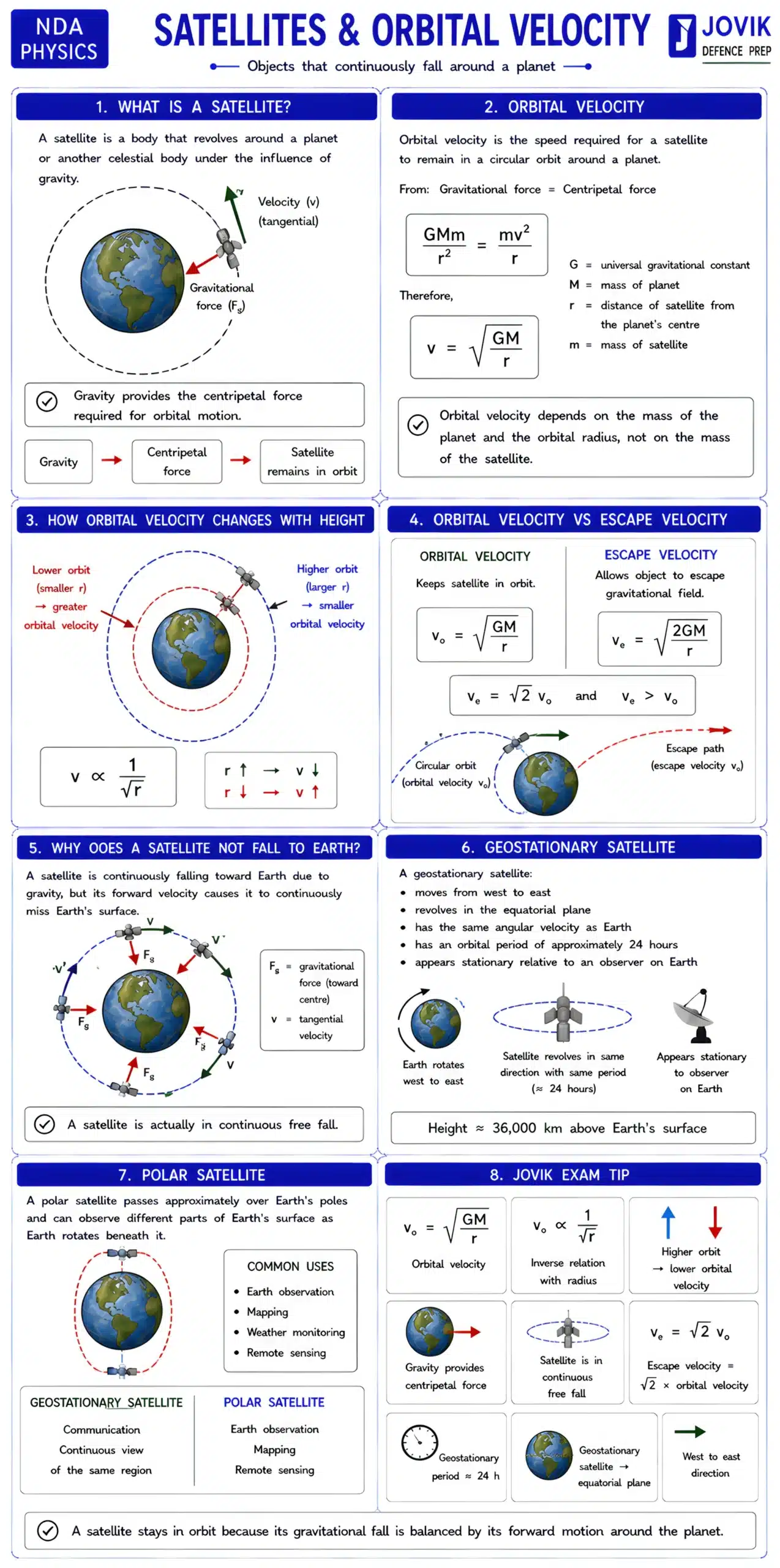
For a satellite to orbit a planet in a circular path, the gravitational force must provide exactly the centripetal force needed to keep it moving in that circle. Setting gravitational force equal to centripetal force:
GMm/R² = mv₀²/R
v₀ = √(GM/R) = √(gR)
v₀ = orbital velocity at the surface (m s⁻¹). For Earth: v₀ = √(9.8 × 6.4 × 10⁶) ≈ 7.9 km s⁻¹. For a satellite orbiting at height h above the surface, replace R with (R + h): v₀ = √(GM/(R + h)).
Relationship: Escape Velocity vs Orbital Velocity
From the two formulas: v_e = √(2GM/R) and v₀ = √(GM/R):
v_e = √2 × v₀ ≈ 1.414 × v₀
Escape velocity is √2 times greater than orbital velocity at the same radius. To escape, you need about 41% more speed than to orbit.
15. Why Planets Do Not Fall into the Sun
Mentor’s Concept Builder: Read This Carefully
Gravity pulls every planet toward the Sun. So why don’t planets spiral inward and crash into the Sun? The answer is that planets are also moving sideways at just the right speed.
Imagine throwing a ball horizontally from a very tall mountain. Throw it slowly and it falls to the ground nearby. Throw it faster and it lands farther away. Throw it fast enough, and the curve of its fall matches the curve of Earth itself. The ball keeps falling but keeps missing the ground. It is in orbit.
This is exactly what a planet does. Gravity pulls the planet toward the Sun. At the same time, the planet’s sideways (tangential) velocity carries it forward. These two effects combine so that the planet continuously falls toward the Sun but continuously misses it. A planet is in permanent free fall around the Sun. It never actually reaches the Sun because its sideways speed is too high.
This is also how artificial satellites work. They are launched at orbital velocity, fast enough that they continuously fall around Earth without reaching the ground. Satellites require no fuel to maintain their orbit. They are in free fall. Energy is only needed to change the orbit or overcome atmospheric drag. [NDA 2017-II]
16. Kepler’s Laws of Planetary Motion
Before Newton, Johannes Kepler discovered three mathematical laws that describe how planets move. Newton later showed these laws follow directly from his Universal Law of Gravitation.
First Law: Elliptical Orbits
Every planet moves in an elliptical orbit with the Sun at one of the two foci (not at the centre). Most planetary orbits are nearly circular, but not perfectly so.
Second Law: Equal Areas in Equal Times
A line joining a planet to the Sun sweeps out equal areas in equal intervals of time. When a planet is closer to the Sun, it moves faster. When it is farther, it moves more slowly. This law is a statement of conservation of angular momentum. In the absence of torque, the planet’s angular momentum is constant.
Third Law: Period and Orbital Radius
The square of the orbital period is proportional to the cube of the semi-major axis (orbital radius for circular orbits):
T² ∝ R³ or T₁²/T₂² = R₁³/R₂³
Two planets orbit the Sun with radii R and 4R. Find T₁/T₂:
(T₁/T₂)² = (R₁/R₂)³ = (1/4)³ = 1/64
T₁/T₂ = 1/8 [NDA 2020-I & II]
A planet’s year is 8 times Earth’s year: T_planet/T_Earth = 8. By Kepler’s Third Law:
(a_planet/a_Earth)³ = (T_planet/T_Earth)² = 64
a_planet/a_Earth = 4 [NDA 2026-I]
The planet’s semi-major axis is 4 times Earth’s orbital radius.
Prediction of Celestial Events
Newton’s theory of gravitation, which explains Kepler’s Laws, allows precise prediction of celestial events over centuries. The 2010 annular solar eclipse and its predicted recurrence in 3043 illustrate this extraordinary predictive power. [NDA 2010-II]
17. Types of Satellites
Satellites are objects that orbit a planet. The Moon is Earth’s only natural satellite. Humans have launched thousands of artificial satellites for communication, navigation, weather, and scientific research.
Geostationary Satellites
Geostationary satellites orbit Earth in the equatorial plane at an altitude of about 35,786 km. Their orbital period is exactly 24 hours, matching Earth’s rotation. From the ground, they appear completely stationary in the sky. Because they appear stationary, a single dish antenna can point to the same spot in the sky permanently, making geostationary satellites ideal for communication.
Polar Satellites
Polar satellites orbit from pole to pole at low altitudes (typically 500–800 km). Each orbit takes about 90–100 minutes. As the satellite orbits, Earth rotates beneath it, so each orbit passes over a different strip of Earth. Over time, the entire Earth’s surface is covered.
Satellite Applications
| Satellite Type | Orbital Altitude | Period | Key Applications |
| Geostationary | 35,786 km | 24 hours | TV broadcast, weather monitoring, communication, internet |
| Polar (Low Earth Orbit) | 500–800 km | 90–100 minutes | Earth mapping, remote sensing, reconnaissance, weather |
| Navigation (MEO) | ~20,000 km | 12 hours | GPS, NavIC, GLONASS, Galileo: position and timing |
18. Weightlessness
Astronauts on the International Space Station float freely. They appear to have no weight. This phenomenon is called weightlessness. Understanding it requires careful thinking about what weight actually means.
Weightlessness does not mean zero gravity. Gravity still acts on the astronaut. It is, in fact, what keeps the space station in orbit. At the ISS altitude of about 400 km, g ≈ 8.7 m s⁻², only slightly less than Earth’s surface value.
Weight is the normal reaction force; the force the floor exerts back on you. In orbit, both the astronaut and the space station are in free fall. They are both accelerating toward Earth at the same rate. The astronaut does not press on the floor. The floor exerts no normal reaction.
Weightlessness means: normal reaction = 0. It does not mean: zero gravity, zero gravitational force, or zero acceleration.
19. Measuring Mass in Space
In a space station orbiting Earth, all objects experience weightlessness. This creates a measurement challenge: how do you find the mass of an object when there is no weight?
Method 1: Spring Extension (does NOT work in orbit): On Earth, a spring balance measures mass by measuring how much the spring stretches under the weight of the object. In orbit, weight = 0, so the spring does not stretch at all. This method fails.
Method 2: Oscillation Period (WORKS in orbit): Attach the mass to a spring and let it oscillate back and forth. The period of oscillation T = 2π√(m/k) depends on the mass m and spring constant k, but not on gravity. This method works in orbit because it relies on inertia (resistance to acceleration), not weight.
| ★ IMPORTANT Only the oscillation method can measure mass in a space station. [NDA 2015-I] T = 2π√(m/k) depends on inertia, not on gravity. Spring extension fails because weight = 0 in orbit. The spring does not stretch. |
Buoyancy on an Accelerating Spaceship
A spaceship in outer space accelerates at a < g. A sphere that floats on Earth (density less than water) with fraction f₁ submerged is placed in water inside the spaceship. Both weight (ρ_sphere × V × a) and buoyancy (ρ_water × f₂V × a) scale with the same effective acceleration a. The fractions cancel: f₂ = ρ_sphere/ρ_water = f₁. The submerged fraction is unchanged regardless of a (as long as a ≠ 0). [NDA 2023-I]
20. Black Holes and Gravitational Waves
Black Holes
A black hole is the remnant of a massive star that has collapsed under its own gravity. The collapse concentrates an enormous amount of mass into an extremely small volume, creating an extraordinarily strong gravitational field.
The boundary around a black hole from which nothing (not even light) can escape is called the event horizon. At the event horizon, the escape velocity equals the speed of light (c ≈ 3 × 10⁸ m s⁻¹). Since nothing can travel faster than light, nothing can escape from inside the event horizon.
A black hole has maximum gravitational field strength, not zero. It does not have zero acceleration due to gravity on its surface. It has collapsed into itself with enormous gravity, the opposite of zero gravity. [NDA 2019-I]
Gravitational Waves and LIGO
When massive objects (like two black holes or neutron stars) accelerate rapidly, they create ripples in spacetime itself. These ripples are called gravitational waves.
LIGO stands for Laser Interferometer Gravitational-wave Observatory. [NDA 2019-I] LIGO detects gravitational waves using laser light in two perpendicular tunnels several kilometres long. Gravitational waves passing through cause tiny changes in the length of the tunnels, which the laser detects. LIGO uses lasers. It is a Laser instrument. The L stands for Laser.
21. Advanced Applications
Spring Extension on the Moon
A spring extends 6 cm when a mass is hung from it on Earth. On the Moon, g_Moon = g_Earth/6. The spring extension depends on weight (kx = mg). Since g is six times smaller:
x_Moon = mg_Moon/k = x_Earth/6 = 6/6 = 1 cm [NDA 2023-I]
The spring extends only 1 cm on the Moon, compared to 6 cm on Earth.
Inertial Mass vs Gravitational Mass
Inertial mass is the mass that resists acceleration (appears in F = ma). Gravitational mass is the mass that creates and responds to gravitational fields (appears in F = Gm₁m₂/r²). These appear to be completely different concepts, yet all experiments show they are always exactly equal. This equality, called the equivalence principle, is the foundation of Einstein’s General Theory of Relativity.
Tidal Forces
The Moon’s gravity is slightly stronger on the side of Earth facing the Moon, and slightly weaker on the far side. This difference in gravitational pull across Earth’s diameter is called a tidal force. The ocean on the near side is pulled toward the Moon more than Earth’s centre. The ocean on the far side is pulled less. This creates two ocean bulges (one facing the Moon, one on the opposite side) and the twice-daily tides.
The Sun also exerts tidal forces. When Sun, Moon, and Earth align (during new and full Moon), the combined tidal effect creates spring tides (highest tides). When they are at right angles (quarter Moon), weaker neap tides result.
Important Distinctions
G vs g
G is the universal gravitational constant, the same everywhere in the universe, for all masses, at all times (6.674 × 10⁻¹¹ N m² kg⁻²). g is the local acceleration due to gravity. It depends on the planet, altitude, depth, and latitude. G is a fixed property of nature; g is a location-dependent quantity.
Mass vs Weight
Mass is the amount of matter, constant everywhere, measured in kg. Weight is the gravitational force. It varies with g and is measured in Newtons. A spring balance measures weight; a beam balance measures mass. In space (weightless environment), mass is unchanged; weight is zero.
Gravitational Field vs Gravitational Potential
Gravitational field (g) is the force per unit mass at a point, a vector pointing toward the attracting body. Gravitational potential (φ) is the potential energy per unit mass, a scalar, always negative, becoming less negative as distance increases. On an equipotential surface, the potential is constant but the field is not zero.
Escape Velocity vs Orbital Velocity
Orbital velocity (≈ 7.9 km s⁻¹ for Earth) is the speed needed to maintain a circular orbit at the surface. Escape velocity (≈ 11.2 km s⁻¹) is the minimum speed to escape Earth’s gravity entirely. Escape velocity = √2 × orbital velocity. An object at orbital speed circles; at escape speed it leaves permanently.
Weightlessness vs Zero Gravity
Weightlessness is the condition of zero apparent weight (zero normal reaction). It occurs when everything around you is in the same free fall. Gravity still acts during weightlessness. It provides the centripetal force for orbital motion. True “zero gravity” would mean no gravitational field, which is impossible near any massive body.
Quick Revision
Newton’s Law of Gravitation
- F = Gm₁m₂/r² | G = 6.674 × 10⁻¹¹ N m² kg⁻² | G is universal
- Both masses doubled, distance unchanged → F becomes 4F [NDA 2016-I]
- Both masses doubled, distance halved → F becomes 16F [NDA 2019-II]
- Force between two planets = 1:1 always (Newton’s Third Law) [NDA 2024-II]
- Long-range force; shared property with electromagnetic force [NDA 2013-I]
G vs g
- G = 6.674 × 10⁻¹¹ N m² kg⁻² : universal, never changes [NDA 2017-I]
- g = GM/R² : local, depends on planet, altitude, depth, latitude [NDA 2015-II]
- Gravitational force on 1 kg at Earth’s surface = 9.8 N [NDA 2011-II]
Comparing g Across Planets
- g ∝ M/R² | Same density → g ∝ R [NDA 2019-I]
- 4M, 2R → g same as M, R [NDA 2014-I]
- 2M, 2R → g halved [NDA 2018-II]
- M_Earth/M_Moon ≈ 100 (from g and R ratios) [NDA 2015-I]
Variation of g
- With altitude: g_h = gR²/(R+h)² ≈ g(1−2h/R) for h<<R : decreases, never zero at finite altitude
- With depth: g_d = g(1−d/R): decreases linearly; g = 0 at Earth’s centre
- With latitude: g_pole > g_equator: Earth’s equatorial bulge (larger R at equator) [NDA 2012-II | NDA 2016-II]
- Body weighs more at poles than equator
Gravitational Potential and PE
- φ = −GM/r (J kg⁻¹, scalar, always negative)
- U = −GMm/r (J, always negative)
- On equipotential surface: work by gravity = 0, field ≠ 0 [NDA 2026-I]
Escape and Orbital Velocity
- v_e = √(2GM/R) = √(2gR) ≈ 11.2 km s⁻¹ for Earth [NDA 2024-I]
- v₀ = √(GM/R) = √(gR) ≈ 7.9 km s⁻¹ for Earth
- v_e = √2 × v₀
- Escape from denser smaller planet (R/2, 4ρ): v_e = 11.2 km s⁻¹ (same as Earth) [NDA 2024-I]
Kepler’s Laws
- First: Elliptical orbit: Sun at one focus
- Second: Equal areas in equal times: angular momentum conserved
- Third: T² ∝ R³ | (T₁/T₂)² = (R₁/R₂)³ [NDA 2020-I & II | NDA 2026-I]
- Radii R and 4R → T₁/T₂ = 1/8 [NDA 2020-I & II]
- Year 8× Earth → semi-major axis 4× Earth [NDA 2026-I]
Satellites
- Satellite needs NO energy to maintain circular orbit [NDA 2017-II]
- Geostationary: 35,786 km, 24 h period, equatorial, stationary in sky
- Polar: ~500–800 km, ~90–100 min, covers full Earth
- Navigation (GPS, NavIC): ~20,000 km, 12 h period
Weightlessness and Mass in Space
- Weightlessness = normal reaction = 0; gravity still acts
- Spring extension method fails in orbit (no weight)
- Oscillation method works in orbit (depends on inertia) [NDA 2015-I]
- Spring extends 6 cm on Earth → 1 cm on Moon (g/6) [NDA 2023-I]
- Buoyancy in spaceship (a < g): submerged fraction unchanged f₂ = f₁ [NDA 2023-I]
Black Holes and LIGO
- Black hole = collapsed star, MAXIMUM gravity, escape velocity = c [NDA 2019-I]
- LIGO = Laser Interferometer Gravitational-wave Observatory [NDA 2019-I]
Gravitation Previous Year Questions
Practice NDA previous-year questions from the Gravitation chapter with detailed solutions and important tips.