NDA Current Affairs | 13 Sep Exam
Practice Now

Rotational Motion – NDA Physics Notes
Exam Relevance: Moderate-High Frequency | Angular Momentum · Moment of Inertia · Circular Motion · Centripetal Acceleration · Torque · Rolling Motion
Reading Time: 28–32 minutes | Last Updated: 2026
A spinning top, a rolling wheel, a turning door: all involve a type of motion that linear Physics cannot fully describe.
In Chapters 2 and 3, you learned how forces cause objects to move in straight lines. Now you will learn what happens when forces make objects rotate. Rotational motion governs everything from bicycle wheels to orbiting satellites to a figure skater pulling in her arms mid-spin.
The good news: rotational motion is not new Physics. It is the same ideas you already know (displacement, velocity, acceleration, force, momentum, kinetic energy) applied to rotation. Every linear concept has a rotational twin. Once you see those twins, the entire chapter becomes familiar territory.
The NDA exam has consistently tested rotational motion since 2010. The most-asked concepts are changes in uniform circular motion, moment-of-inertia comparisons, and conservation of angular momentum. This chapter builds all of them from the ground up.
1. Why Study Rotational Motion?
Every machine you use involves rotation. A car engine rotates. A fan rotates. A bicycle wheel rotates. Even Earth itself rotates about its own axis.
Linear mechanics, which describes motion in straight lines, is not enough to fully explain these phenomena. A wheel rolling down a slope has both a centre moving forward (linear motion) and the wheel spinning about that centre (rotational motion). To understand the full picture, we need tools for both.
Rotational mechanics also explains stability. A spinning top does not fall over. A gyroscope maintains its orientation. A satellite orbits steadily. All of these involve rotational principles.
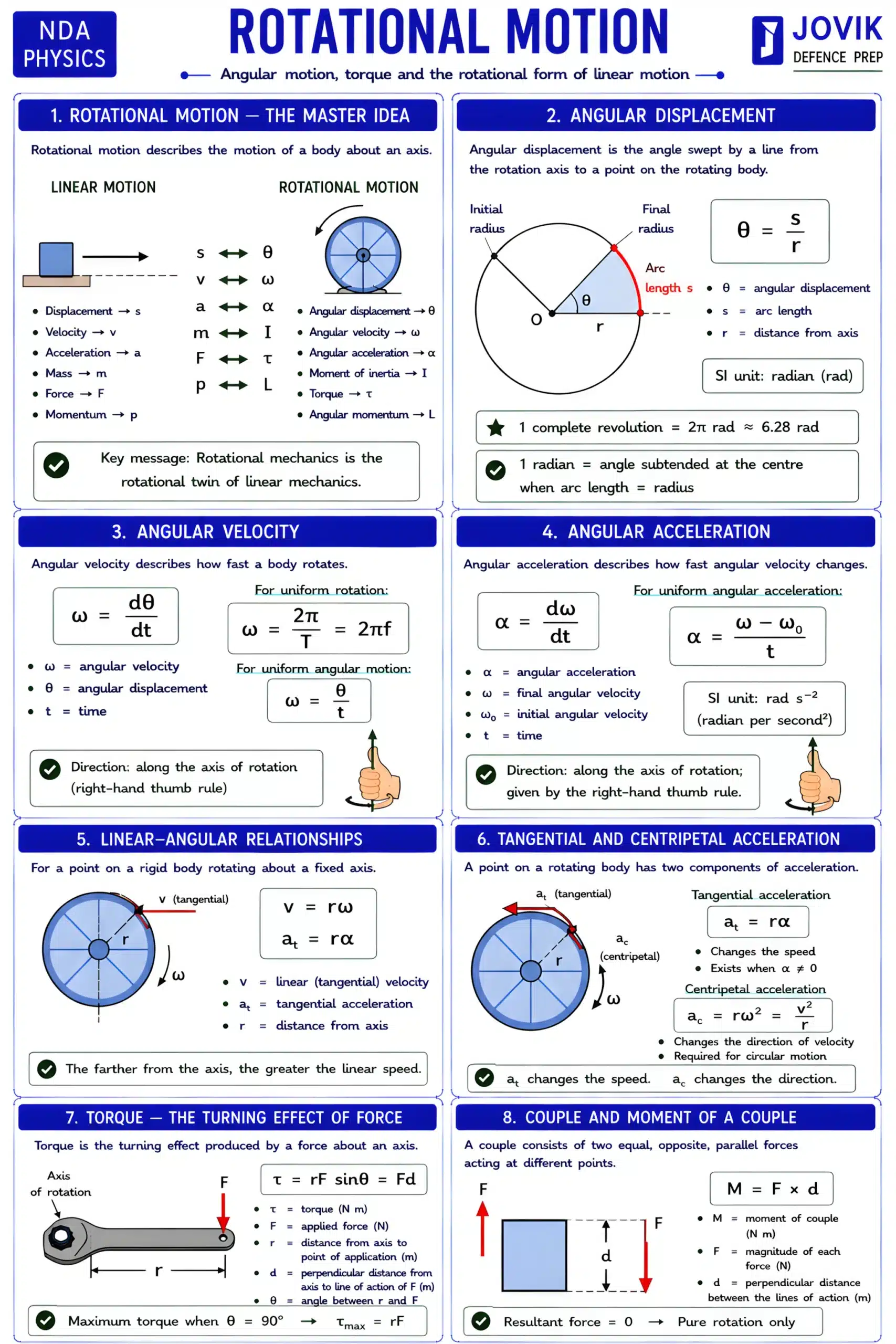
2. Translational vs Rotational Motion: The Master Concept
Before introducing any new equations, understand this fundamental principle: rotational mechanics is the mirror image of linear mechanics.
Every concept, every formula, every principle in linear mechanics has an exact rotational equivalent. The mathematics changes; the logic does not. Learn the linear version and you automatically understand the rotational version.
The Master Comparison Table: Reference This Throughout the Chapter
| Linear Motion | Symbol | Rotational Motion | Symbol |
| Displacement | s (m) | Angular Displacement | θ (rad) |
| Velocity | v (m s⁻¹) | Angular Velocity | ω (rad s⁻¹) |
| Acceleration | a (m s⁻²) | Angular Acceleration | α (rad s⁻²) |
| Mass (resists acceleration) | m (kg) | Moment of Inertia (resists angular acceleration) | I (kg m²) |
| Force (causes acceleration) | F (N) | Torque (causes angular acceleration) | τ (N m) |
| Linear Momentum | p = mv | Angular Momentum | L = Iω |
| Newton’s Second Law | F = ma | Rotational Second Law | τ = Iα |
| Kinetic Energy | KE = ½mv² | Rotational KE | KE = ½Iω² |
| Work | W = Fs | Rotational Work | W = τθ |
| Power | P = Fv | Rotational Power | P = τω |
Return to this table whenever a new rotational concept is introduced. Every new symbol on the right-hand side is simply the rotational twin of the familiar quantity on the left.
3. Angular Displacement
When a wheel turns, every point on it moves through an angle. That angle is called angular displacement. Angular displacement θ is the angle swept by a line from the rotation axis to any point on the body. It is measured in radians (rad).
θ = s / r
θ = angular displacement (rad). s = arc length traced by the point (m). r = distance of the point from the axis of rotation (m). One complete revolution = 2π radians ≈ 6.28 rad. One radian is the angle at the centre of a circle when the arc length equals the radius.
4. Angular Velocity
Angular velocity is the rotational twin of linear velocity. Just as linear velocity describes how fast an object changes its position, angular velocity describes how fast it rotates.
ω = dθ/dt
ω = angular velocity (rad s⁻¹). θ = angular displacement (rad). t = time (s). For uniform rotation, if a body completes one full revolution (2π rad) in time T: ω = 2π/T = 2πf, where f is the frequency in Hz.
Key insight: Every point on a rotating rigid body has the same angular velocity. A point near the rim and a point near the hub both sweep the same angle in the same time. But they have different linear speeds, as the rim point travels farther.
5. Angular Acceleration
When angular velocity changes with time, the body has angular acceleration, which is the rotational twin of linear acceleration.
α = dω/dt
α = angular acceleration (rad s⁻²). ω = angular velocity (rad s⁻¹). t = time (s). Positive α means the body is spinning faster. Negative α means it is slowing down (angular deceleration).
6. Linear and Angular Relationships
A rotating body has both angular quantities (same for all points) and linear quantities (different for each point depending on distance from axis). The connection between them is simple.
Linear Speed and Angular Velocity
v = rω
v = linear speed of a point (m s⁻¹). r = distance of that point from the rotation axis (m). ω = angular velocity (rad s⁻¹). The farther a point is from the axis, the faster it moves linearly, even though ω is the same for all points. This is why the rim of a spinning wheel moves faster than the hub.
Tangential and Centripetal Acceleration
A point on a rotating body can have two types of acceleration:
Tangential acceleration: aₜ = rα. This changes the speed of the point. It exists only when angular acceleration α is non-zero.
Centripetal acceleration: a_c = rω² = v²/r. This changes the direction of the point’s velocity. It exists whenever the body rotates, regardless of whether α is zero or non-zero.
The total linear acceleration of a point on a rotating body combines both: a = √(aₜ² + a_c²), with aₜ tangential and a_c pointing inward toward the centre.
7. Torque: The Turning Effect of Force
In linear mechanics, force causes acceleration. In rotational mechanics, torque causes angular acceleration. Torque is the rotational twin of force. Not every force produces rotation. Whether a force produces rotation depends on three things: the magnitude of the force, the distance from the pivot, and the direction of the force relative to that distance.
The Torque Formula
τ = r × F sin θ = F × d
τ = torque (N m). r = distance from the pivot to the point of application of force (m). F = magnitude of force (N). θ = angle between the force vector and the radius (position vector). d = r sin θ = perpendicular distance from the pivot to the line of action of the force (the “moment arm”).
Torque is maximum when θ = 90°, when the force is perpendicular to the radius. Torque is zero when θ = 0° or 180°, when the force passes through or directly away from the pivot.
Torque is a vector quantity. Its direction is perpendicular to the plane containing r and F (by the right-hand rule). SI unit: Newton-metre (N m).
8. Couple and Moment of a Couple
What Is a Couple?
A couple consists of two equal, opposite, parallel forces acting on a body at different points. The two forces are separated by a perpendicular distance d. Because the two forces are equal and opposite, their resultant is zero. There is no net force, and therefore no translation. But the two forces act at different points, so they produce a net torque, causing rotation.
Moment of a couple = F × d
F = magnitude of each force (N). d = perpendicular distance between the lines of action of the two forces (m). Moment of couple = torque produced (N m).
| Property | Torque | Couple |
| Definition | Turning effect of a single force about a pivot | Two equal, opposite, parallel forces at different points |
| Number of forces | One force about one pivot | Two equal and opposite forces |
| Net (resultant) force | May be non-zero | Always zero: no translation produced |
| Translation produced? | Possibly yes (force has net direction) | No: only rotation |
| Rotation produced? | Yes: if force is not through pivot | Yes: always produces pure rotation |
| Formula | τ = r × F sinθ | M = F × d |
| Example | Pushing a door open at the handle | Steering wheel, turning a tap, screwdriver |
| NDA Confusions | Torque can exist without rotation (static equilibrium) | Couple produces no translation, only rotation |
9. Moment of Inertia
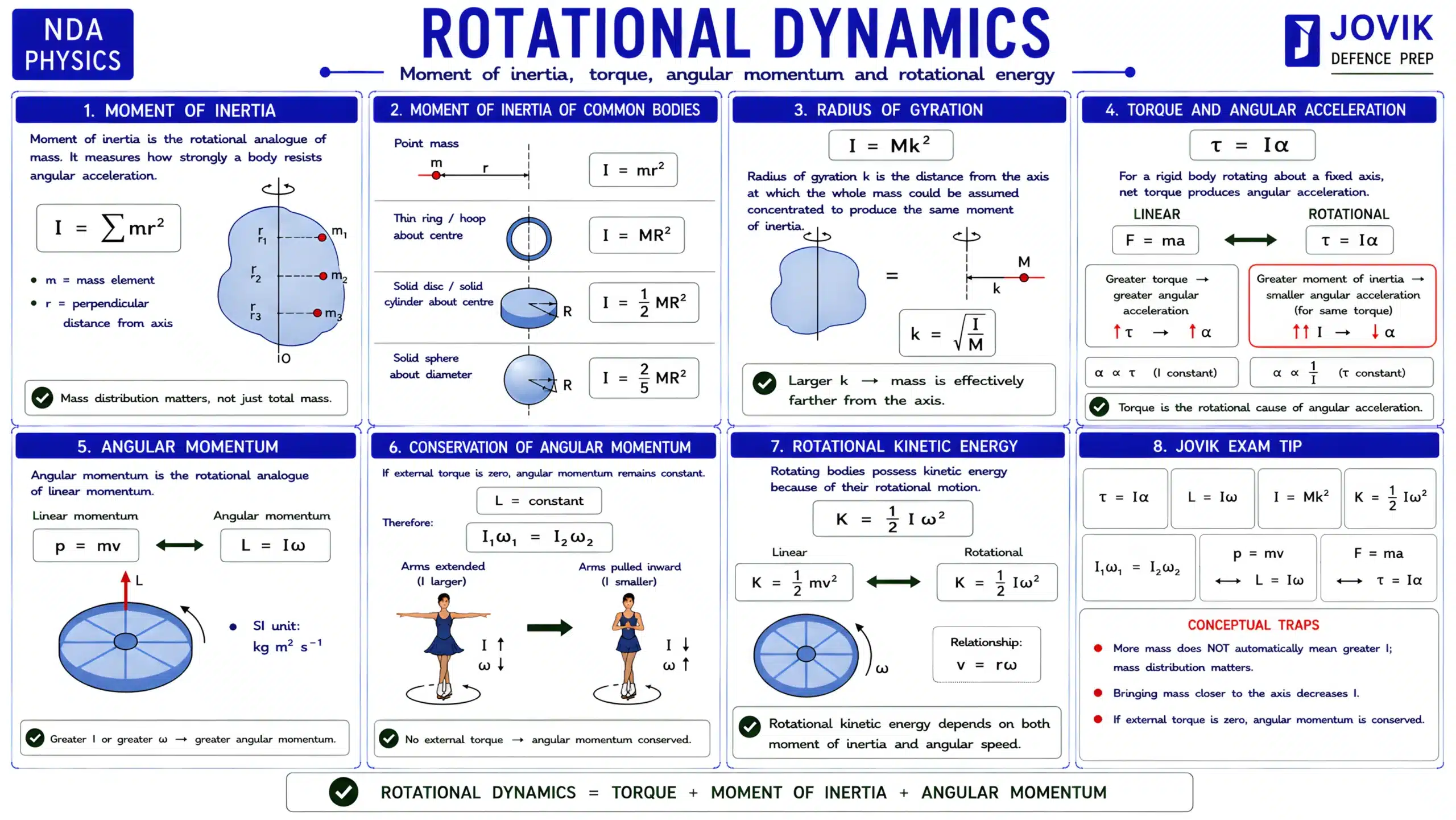
In linear mechanics, mass resists changes in linear motion. More mass means harder to accelerate. In rotational mechanics, moment of inertia resists changes in rotational motion. It is the rotational twin of mass.
But moment of inertia is not just mass. It depends on how that mass is distributed relative to the rotation axis. Mass concentrated far from the axis gives a larger moment of inertia, making it harder to spin up or slow down. Mass concentrated close to the axis gives a smaller moment of inertia, making it easier to rotate.
I = Σmᵢrᵢ²
I = moment of inertia (kg m²). mᵢ = mass of each particle (kg). rᵢ = distance of each particle from the rotation axis (m). SI unit: kg m². The sum is over all particles making up the body.
Standard Moments of Inertia
For common shapes, the integral is already solved. Memorise these standard values. They are directly asked in NDA.
| Shape | Axis | Moment of Inertia I |
| Thin ring / Hollow cylinder | Through centre, perpendicular to plane | MR² |
| Solid disc / Solid cylinder | Through centre, perpendicular to plane | ½MR² |
| Solid sphere | Through centre (any diameter) | (2/5)MR² |
| Hollow sphere | Through centre (any diameter) | (2/3)MR² |
| Thin rod | Through centre, perpendicular to rod | ML²/12 |
| Thin rod | Through one end, perpendicular to rod | ML²/3 |
Disc vs Sphere: Same Mass, Same Radius
Solid disc: I_disc = ½MR² = 0.5MR². Solid sphere: I_sphere = (2/5)MR² = 0.4MR². Since 0.5 > 0.4, the solid disc has a higher moment of inertia than the solid sphere of the same mass and radius. [NDA 2019-II]
Why? The disc concentrates its mass in a flat plane, so more of it is at a larger average radius from the central axis. The sphere distributes mass through its entire volume, with much of the mass near the centre, giving a lower average r² and hence lower I.
Ring vs Disc: Same Mass, Same Radius
Thin ring: I_ring = MR². Thin disc: I_disc = ½MR². The ring has double the moment of inertia of the disc of the same mass and radius. This is because the ring has all its mass at radius R from the axis. The disc has mass spread from the centre outward. Its average distance from the axis is less than R, so its I is smaller.
10. Radius of Gyration
The radius of gyration (k) of a body is the equivalent radius at which all the body’s mass could be concentrated to give the same moment of inertia. It is a useful comparison tool.
I = Mk² → k = √(I/M)
k = radius of gyration (m). I = moment of inertia (kg m²). M = total mass (kg). For a solid disc: k = √(½MR²/M) = R/√2 ≈ 0.707R. For a ring: k = √(MR²/M) = R. The ring’s radius of gyration equals its physical radius, because all mass is at the rim.
Radius of gyration gives a single number that characterises how efficiently a shape uses its mass for rotation. A smaller k means mass is concentrated closer to the axis, making it easier to spin.
11. Parallel Axis Theorem
The moment of inertia of a body depends on which axis it rotates about. The parallel axis theorem lets you calculate I for any axis from the moment of inertia about the centre-of-mass axis.
I = I_cm + Md²
I = moment of inertia about the new axis (kg m²). I_cm = moment of inertia about the centre-of-mass axis (kg m²). M = total mass of the body (kg). d = perpendicular distance between the two parallel axes (m). The two axes must be parallel. I about any axis is always larger than I about the parallel cm axis, by the term Md².
12. Perpendicular Axis Theorem
For any flat (planar) body, the moment of inertia about an axis perpendicular to the plane equals the sum of moments of inertia about any two mutually perpendicular axes in the plane of the body.
Iz = Ix + Iy
Iz = I about the axis perpendicular to the plane (z-axis). Ix = I about the x-axis in the plane. Iy = I about the y-axis in the plane. All three axes must pass through the same point. This theorem applies only to flat (2D) objects: discs, rings, laminar plates. It does not apply to 3D bodies like spheres or cylinders.
13. Rotational Dynamics: τ = Iα
Newton’s Second Law for linear motion states: F = ma. Force causes linear acceleration; mass resists it. The rotational equivalent is:
τ = Iα
τ = net torque acting on the body (N m). I = moment of inertia (kg m²). α = angular acceleration produced (rad s⁻²). Torque causes angular acceleration. Moment of inertia resists angular acceleration. This single equation governs all rotational dynamics: just as F = ma governs all linear dynamics.
| Linear Mechanics | Rotational Mechanics |
| Force causes linear acceleration | Torque causes angular acceleration |
| Mass resists linear acceleration | Moment of Inertia resists angular acceleration |
| F = ma | τ = Iα |
| Larger mass → smaller acceleration (same F) | Larger I → smaller α (same τ) |
| Force is applied to a point | Torque depends on where force is applied (distance from axis) |
Example: A flywheel with moment of inertia 4 kg m² is acted upon by a torque of 8 N m. Angular acceleration = τ/I = 8/4 = 2 rad s⁻². Exactly analogous to F = ma: same logic, same structure.
14. Rotational Equations of Motion
When angular acceleration α is constant, the three kinematic equations of linear motion have direct rotational analogues. Swap s → θ, v → ω, a → α:
| Linear Equation | Rotational Analogue |
| v = u + at | ω = ω₀ + αt |
| s = ut + ½at² | θ = ω₀t + ½αt² |
| v² = u² + 2as | ω² = ω₀² + 2αθ |
ω₀ = initial angular velocity (rad s⁻¹). ω = final angular velocity (rad s⁻¹). α = constant angular acceleration (rad s⁻²). θ = angular displacement (rad). t = time (s). These equations are only valid when α is constant, just as the linear kinematic equations require constant linear acceleration.
15. Uniform Circular Motion: What Changes and What Does Not
Uniform circular motion means moving in a circle at constant speed. This is the most directly tested rotational concept in NDA. The key question: what changes and what stays the same?
| Quantity | Changes in Uniform Circular Motion? | Explanation |
| Speed | NO | Magnitude of velocity is constant: “uniform” speed |
| Velocity | YES | Direction changes continuously: velocity is a vector |
| Direction of motion | YES | Tangential direction changes at every point on the circle |
| Momentum (p = mv) | YES | Momentum is a vector: direction changes with velocity |
| Kinetic Energy (½mv²) | NO | Speed is constant, so ½mv² is unchanged |
| Centripetal Acceleration | Magnitude: NO, Direction: YES | a_c = v²/r is constant in magnitude; always points inward toward centre |
In uniform circular motion, speed is constant but velocity is not. [NDA 2013-I] Velocity is a vector. When its direction changes, velocity changes, even if the magnitude (speed) stays the same.
Since velocity changes, the body is accelerating. Since momentum = mv and velocity changes, momentum changes continuously. [NDA 2013-I] A car moving at uniform speed on a circular path has changing momentum and therefore experiences a net centripetal force.
| ★ IMPORTANT The single most important NDA confusion in this chapter: “Constant speed means no acceleration”: this is WRONG. Acceleration is the rate of change of velocity, a vector. Speed can be constant while velocity changes direction, producing centripetal acceleration. [NDA 2010-II | NDA 2013-I | NDA 2017-II] |
16. Centripetal Acceleration
The acceleration that keeps a body moving in a circle is called centripetal acceleration, meaning centre-seeking acceleration. It is always directed toward the centre of the circular path.
a_c = v²/r = rω²
a_c = centripetal acceleration (m s⁻²). v = speed (m s⁻¹). r = radius of circular path (m). ω = angular velocity (rad s⁻¹). The centripetal acceleration is directed along the radius toward the centre, not along the tangent, not zero, and not along the circumference. [NDA 2010-II]
At constant speed v, centripetal acceleration a_c = v²/r is inversely proportional to the radius. A gentle curve (large r) has smaller a_c than a sharp curve (small r) at the same speed. [NDA 2017-II]
Centripetal acceleration does not slow the object down. It only changes the direction of motion. Speed remains constant. A reduction in speed would require tangential acceleration (opposing the direction of motion).
17. Rotational Kinetic Energy
A rotating body has kinetic energy even if its centre of mass is stationary. This is rotational kinetic energy, the energy of rotation. It is the rotational twin of ½mv².
KE_rot = ½Iω²
KE_rot = rotational kinetic energy (J). I = moment of inertia (kg m²). ω = angular velocity (rad s⁻¹). Rotational kinetic energy is not zero just because the body has no linear motion. A spinning top has no translational KE but has significant rotational KE. [NDA 2019-II]
Ring vs Disc: Rotational KE Comparison
A thin ring (I = MR²) and a thin disc (I = ½MR²) have the same mass M and radius R and rotate at the same angular velocity ω.
KE_ring = ½(MR²)ω² = ½MR²ω²
KE_disc = ½(½MR²)ω² = ¼MR²ω²
Since KE_ring = ½MR²ω² > KE_disc = ¼MR²ω², the ring has higher rotational kinetic energy. [NDA 2019-II] The ring stores more energy because more of its mass is at the rim. Larger I at the same ω means more KE.
18. Angular Momentum
Linear momentum (p = mv) measures “how much linear motion” an object has. Angular momentum measures “how much rotational motion” it has. It is the rotational twin of linear momentum.
Angular Momentum of a Rigid Body
L = Iω
L = angular momentum (kg m² s⁻¹). I = moment of inertia (kg m²). ω = angular velocity (rad s⁻¹). Angular momentum is a vector quantity. Its direction is along the rotation axis, given by the right-hand rule.
Angular Momentum of a Particle
For a single particle of mass m moving at speed v at a distance r from an axis, at angle θ to the radius:
L = mvr sinθ
When θ = 90° (particle moving perpendicular to the radius, as in circular motion): L = mvr.
Newton’s Second Law for Rotation
Just as F = dp/dt (force equals rate of change of linear momentum), for rotation:
τ = dL/dt
Torque equals the rate of change of angular momentum. When torque is zero, angular momentum does not change. This leads to the conservation law.
19. Conservation of Angular Momentum
When no external torque acts on a system, its total angular momentum is conserved.
L = Iω = constant (when τ_ext = 0)
If the moment of inertia I decreases, the angular velocity ω must increase to keep L constant. If I increases, ω decreases.
A man sitting on a rotating stool with arms outstretched suddenly folds his arms. His moment of inertia decreases (mass moves closer to the rotation axis). Since L = Iω = constant and I decreases, ω increases. The man spins faster. [NDA 2010-II] The common wrong answer is that angular velocity decreases. Conservation of angular momentum says the opposite: when I decreases, ω must increase to preserve L.
Diver: A diver pulls limbs in during a somersault to spin faster, then extends them to slow down before entering the water.
Planet: A planet moves faster at perihelion (closest to Sun) where r is small, slower at aphelion (farthest). This is Kepler’s Second Law, which is angular momentum conservation under zero external torque.
Gyroscope: A spinning gyroscope resists changes to its orientation because its angular momentum vector is fixed in direction when no external torque acts.
20. Rolling Motion: Translation Plus Rotation
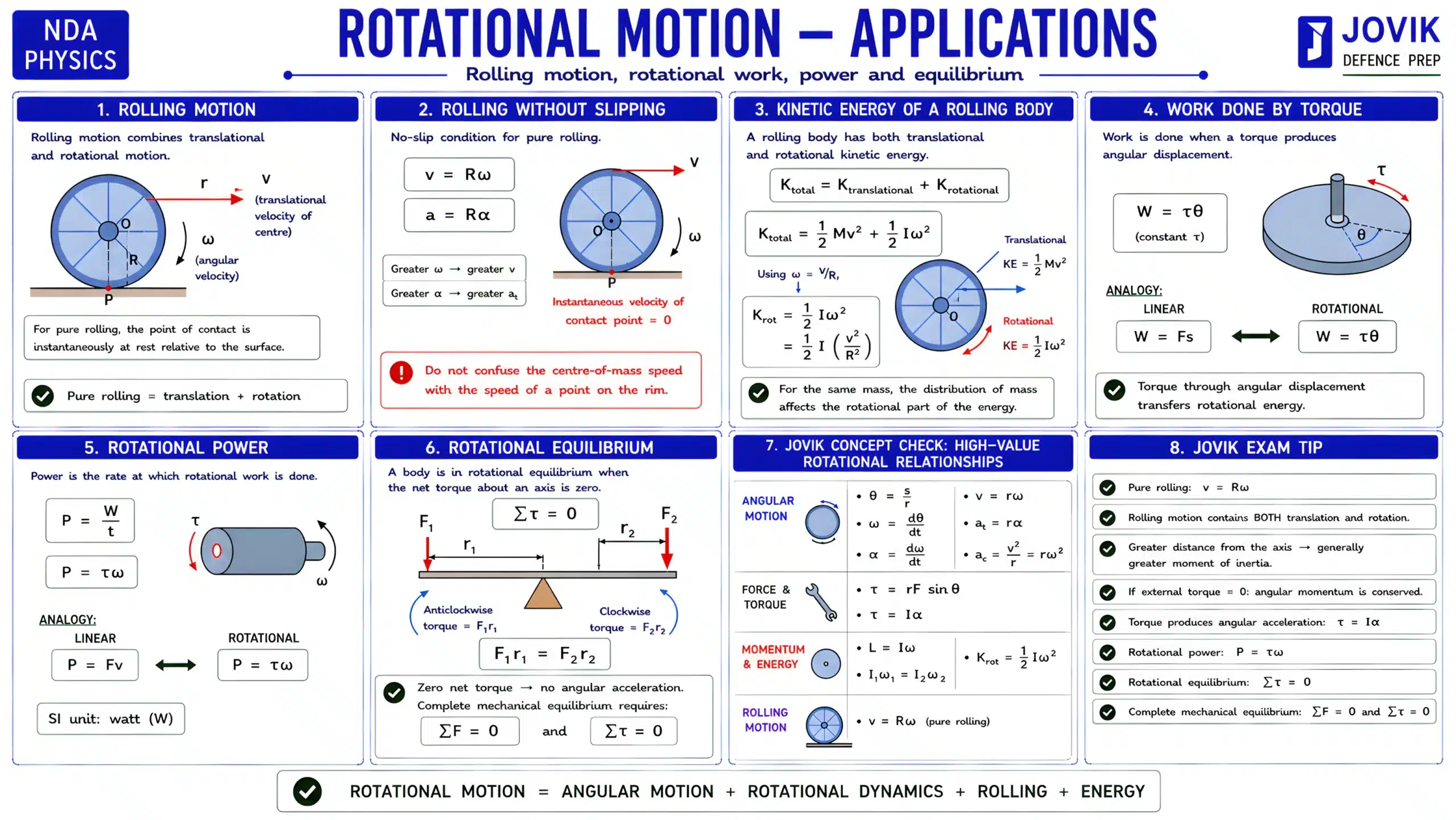
Rolling combines two types of motion simultaneously: the entire wheel moves forward (translation of the centre of mass) while simultaneously spinning about its own axis (rotation). Neither alone describes rolling.
The Rolling Without Slipping Condition
v_cm = Rω
v_cm = speed of the centre of mass (m s⁻¹). R = radius of the wheel (m). ω = angular velocity of the wheel (rad s⁻¹). This condition means the bottom of the wheel (the contact point) has zero velocity relative to the ground at every instant. There is no sliding. This is pure rolling.
Total Kinetic Energy of Rolling
KE_total = ½Mv_cm² + ½Iω²
The first term is translational KE, the energy from the forward motion of the centre of mass. The second term is rotational KE, the energy from spinning. Both together give the total kinetic energy of rolling.
For a solid disc rolling: I = ½MR², so ½Iω² = ½(½MR²)(v/R)² = ¼Mv². Total KE = ½Mv² + ¼Mv² = (3/4)Mv². For a ring rolling: I = MR², so ½Iω² = ½Mv². Total KE = ½Mv² + ½Mv² = Mv². Different shapes store different fractions of their total kinetic energy as rotation: a ring puts 50% in rotation, a solid disc puts 33%, a solid sphere puts 29%.
21. Work and Power in Rotation
The rotational analogues of work and power are:
W = τθ
P = τω
W = work done by torque (J). τ = torque (N m). θ = angle through which the body rotates (rad). P = rotational power (W). ω = angular velocity (rad s⁻¹). These follow directly from the linear analogues W = Fs and P = Fv by replacing F → τ and s → θ, v → ω. The work-energy theorem also holds: total work done = change in rotational KE.
22. Flywheel and Everyday Applications
Flywheel
A flywheel is a heavy disc or wheel with a large moment of inertia, designed to store rotational kinetic energy. In machines, power is delivered in pulses, as a combustion engine fires at intervals. Without a flywheel, the machine would jerk unevenly between power strokes. The flywheel stores energy during each power stroke and releases it smoothly during the intervals between strokes.
The flywheel’s large I means it resists changes in angular velocity. It smooths out speed fluctuations and keeps the machine running evenly. Applications: internal combustion engines, pottery wheels, punching presses (store energy slowly, release it rapidly for each punch), and steam engines.
Everyday Rotational Applications
Ceiling fan: Electric motor provides torque. Fan blades rotate at constant ω once torque matches air resistance torque. Larger blades have larger I, so they take longer to reach full speed but also take longer to stop.
Bicycle wheel: Combined rolling motion. A spinning wheel’s angular momentum makes it resist toppling. The gyroscopic effect keeps the bicycle upright during motion.
Spinning top: Conservation of angular momentum prevents the top from falling immediately. As friction reduces angular momentum, the top precesses and eventually falls.
Figure skater: Classic demonstration of angular momentum conservation: covered in Section 19.
Important Distinctions
Force vs Torque
Force causes linear acceleration (F = ma). Torque causes angular acceleration (τ = Iα). A force applied directly through the rotation axis produces zero torque. The same force applied at a large perpendicular distance produces large torque. Force and torque are not the same. They have different SI units (N vs N m).
Mass vs Moment of Inertia
Mass is an intrinsic property of an object. It is the same regardless of axis or position. Moment of inertia depends on the axis of rotation and how mass is distributed relative to that axis. The same object has different I values for different axes.
Angular Velocity vs Linear Velocity
Every point on a rotating rigid body has the same ω. But linear speed v = rω differs for each point. Larger r means larger v. The rim of a wheel moves faster than the hub, even though both rotate at the same ω.
Angular Momentum Conservation vs Linear Momentum Conservation
Linear momentum is conserved when net external force is zero. Angular momentum is conserved when net external torque is zero. These are independent conditions. One can hold without the other.
Centripetal Acceleration vs Tangential Acceleration
Centripetal acceleration (a_c = v²/r) changes the direction of velocity. It always points toward the centre. Tangential acceleration (aₜ = rα) changes the speed. It points along the tangent to the path. In uniform circular motion, only centripetal acceleration exists (α = 0, so aₜ = 0).
Quick Revision
Master Linear ↔ Rotational Analogy
- s→θ | v→ω | a→α | m→I | F→τ | p→L
- F=ma ↔ τ=Iα | ½mv² ↔ ½Iω² | Fs ↔ τθ | Fv ↔ τω
Angular Kinematics
- θ = s/r (rad) | ω = dθ/dt (rad s⁻¹) | α = dω/dt (rad s⁻²)
- ω = ω₀ + αt | θ = ω₀t + ½αt² | ω² = ω₀² + 2αθ
Linear and Angular Relations
- v = rω | aₜ = rα | a_c = rω² = v²/r
- Same ω for all points; different v depending on r
Uniform Circular Motion
- Speed: constant | Velocity: changes | Momentum: changes | KE: constant [NDA 2013-I]
- Centripetal acceleration: a_c = v²/r, directed toward centre [NDA 2010-II]
- Gentle curve (large r) → smaller a_c at same speed [NDA 2017-II]
- Centripetal acceleration does NOT slow the object down
Torque and Couple
- τ = rF sinθ (N m) | Maximum at θ = 90° | Zero when force through pivot
- Couple = F × d | Produces pure rotation, zero net force
Moment of Inertia: Standard Values
- Ring / Hollow cylinder: I = MR²
- Solid disc / Solid cylinder: I = ½MR²
- Solid sphere: I = (2/5)MR² [NDA 2019-II]
- Hollow sphere: I = (2/3)MR²
- Thin rod (centre): I = ML²/12 | Thin rod (end): I = ML²/3
- Disc has HIGHER I than sphere of same M and R (0.5MR² > 0.4MR²) [NDA 2019-II]
Rotational KE and Angular Momentum
- KE_rot = ½Iω² | Ring > disc at same ω (ring has larger I) [NDA 2019-II]
- L = Iω (rigid body) | L = mvr sinθ (particle) | τ = dL/dt
- Conservation: L = Iω = constant when τ_ext = 0 [NDA 2010-II]
- Fold arms → I decrease → ω increases (not decreases)
Rolling Motion
- Rolling without slipping: v_cm = Rω
- Total KE = ½Mv_cm² + ½Iω² (translation + rotation)
- Contact point instantaneous velocity = 0 | Rim top velocity = 2v_cm
Rotational Motion Previous Year Questions
Practice NDA previous-year questions from the Rotational Motion chapter with detailed solutions and important tips.