NDA Current Affairs | 13 Sep Exam
Practice Now

Work, Energy & Power – NDA Physics Notes
Exam Relevance: High Frequency | Work · Kinetic & Potential Energy · Work–Energy Theorem · Conservation Laws · Power · Electrical Cost · Efficiency
Reading Time: 28–33 minutes | Last Updated: 2026
Everything in Physics connects to energy. When you kick a ball, you transfer energy to it. When a car brakes, it loses energy to heat. When a dam releases water, stored energy becomes electricity. Every process in nature (from a falling raindrop to a rocket launching) involves energy changing form and moving between objects.
Physics needs precise tools to measure and track these transfers. That is where work and power enter the picture. Work measures how much energy is transferred by a force. Power measures how fast that transfer happens.
Chapter 3 taught you that forces cause acceleration. This chapter teaches you what those forces accomplish: how they move energy from one object or form to another. NDA has tested this chapter consistently since 2010, including a new tier of advanced questions from 2023 onwards. Every concept here earns marks.
1. What Is Work?
In everyday language, “work” means any effort: thinking, holding a bag, standing for hours. In Physics, work has a precise meaning that is far more specific.
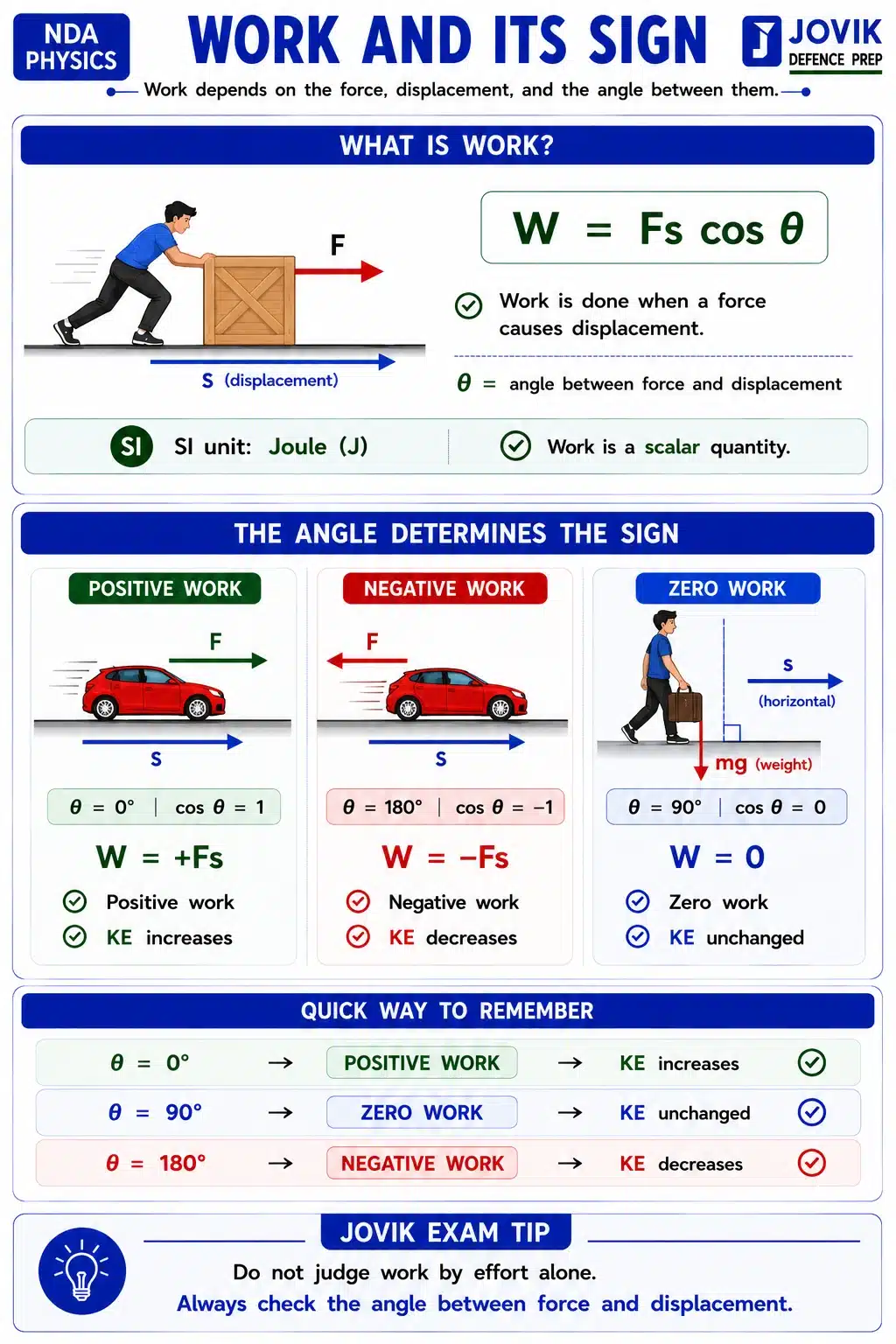
Work is done when a force causes an object to move through a displacement in the direction of the force. Two things must happen for work to be done: there must be a force, and there must be a displacement caused by that force. A force without displacement does no work. A displacement caused by something else does not count.
The Formula for Work
When a constant force F acts on an object and the object moves through displacement s, and the angle between the force and displacement is θ:
W = F × s × cos θ
W = work done (J). F = magnitude of the applied force (N). s = magnitude of displacement (m). θ = angle between the force vector and the displacement vector. Work is a scalar quantity. It has magnitude but no direction. The SI unit of work is the Joule (J). One joule = 1 Newton × 1 metre in the direction of force.
The 1-Joule Benchmark
One joule of work is done when a force of 1 N moves an object through exactly 1 m in the direction of the force. Among these options: 4 N through 25 cm = 4 × 0.25 = 1 J. 2 N through 1 m = 2 J. 1 N through 1 cm = 0.01 J. 1 N through 50 cm = 0.5 J. Only the first equals exactly 1 J. [NDA 2021-II]
2. Sign Convention for Work
The angle θ between force and displacement determines whether work is positive, negative, or zero. This sign tells you what happens to the object’s kinetic energy.
| Condition | θ | cos θ | Work | Effect on KE | Example |
| Force and displacement same direction | 0° | 1 | Positive | KE increases | Pushing a box forward |
| Force and displacement anti-parallel | 180° | −1 | Negative | KE decreases | Brakes on a moving car |
| Force perpendicular to displacement | 90° | 0 | Zero | KE unchanged | Carrying bag horizontally |
Positive work means energy is transferred into the object, so it speeds up. Negative work means energy is taken from the object, so it slows down. Zero work means no energy is transferred. Speed is unchanged. [NDA 2021-II | NDA 2022-I | NDA 2025-II]
When a mass is dragged by a pulley arrangement where the tension force is directed anti-parallel to the displacement of the mass, the work done by that force is negative. The physical act of pulling does not guarantee positive work. The angle between force and displacement determines the sign. [NDA 2022-I]
When net work done on an object is positive, its kinetic energy increases. [NDA 2016-II]
3. Zero Work and Special Cases
Work is zero when the force and displacement are perpendicular. This occurs more often than students realise.
A porter carries a heavy load while walking horizontally on level ground. The load’s weight acts vertically downward. The displacement is horizontal. θ = 90°. Work done by gravity = 0. The porter does work against their own muscles and internal forces, but gravity does no work here.
An object moves in a circle at constant speed. The centripetal force acts toward the centre. The displacement at every instant is tangential (perpendicular to the radius). θ = 90°. Centripetal force does zero work. Speed remains constant.
Work is zero when the displacement of the object is in the perpendicular direction to the force. [NDA 2025-II]
4. Work Done by Gravity: A Complete Example
Gravity always acts vertically downward with force mg. The work gravity does depends entirely on the angle between this downward force and the object’s displacement. Follow a school bag through three stages of a journey:
Stage 1: Lifting the bag. You raise it vertically by height h. The bag moves upward: opposite to gravity. θ = 180°. Work done by gravity = −mgh. Gravity does negative work. The bag gains gravitational potential energy.
Stage 2: Carrying the bag horizontally. Gravity still acts downward. The bag moves horizontally. θ = 90°. Work done by gravity = 0. Gravity does zero work. Height is unchanged, so no PE change occurs.
Stage 3: Lowering the bag to the ground. Gravity acts downward. The bag moves downward: same direction as gravity. θ = 0°. Work done by gravity = +mgh. Gravity does positive work. The bag loses gravitational PE.
Work Done by Gravity Is Path-Independent
The work done by gravity between any two points depends only on the vertical height difference: not on the path taken.
A body that returns to its starting height has zero net work done by gravity over the complete journey. Work done by gravity is zero for any purely horizontal displacement. [NDA 2025-II]
5. Work Done by a Variable Force
The formula W = Fs cos θ assumes the force is constant throughout the displacement. When the force changes as the object moves, as with a spring, we need a different approach.
When force varies with position, the work done equals the area under the force–displacement (F–s) graph.
For a spring with spring constant k compressed or stretched by distance x, the work done against the spring (or work stored as elastic potential energy) = ½kx². This follows from the triangular area under the F = kx graph.
6. Energy: The Capacity to Do Work
Work is the transfer of energy from one object or system to another. Energy is the capacity to do work. An object has energy if it can exert a force that moves another object through a displacement. Like work, energy is a scalar quantity measured in Joules (J).
Forms of Energy
Energy exists in many forms. It can change from one form to another, but it cannot be created or destroyed.
| Form of Energy | Stored or In Transit? | Where It Resides | Example |
| Kinetic energy | Stored in motion | Moving objects | A rolling ball |
| Gravitational PE | Stored | Height above reference | Water in a dam |
| Elastic PE | Stored | Deformed objects (springs, wires) | Compressed spring |
| Chemical energy | Stored in atomic bonds | Between atoms | Food, fuel, batteries |
| Nuclear energy | Stored in nucleus | Inside atomic nuclei | Nuclear reactor |
| Thermal energy | Stored in particle motion | All objects above 0 K | Hot water |
| Electrical energy | In transit | Moving charges in circuits | Current in wire |
Stored Energy vs Energy in Transit
Nuclear energy, gravitational PE, chemical energy, and elastic PE are all forms of stored energy. Electrical energy flowing in a circuit is energy in transit. It is being transferred from one place to another, not stored. [NDA 2016-I]
Chemical energy is stored specifically in the links (bonds) between atoms, not in the nucleus and not in individual atoms. The energy stored between atomic bonds is released in chemical reactions. [NDA 2019-I]
7. Kinetic Energy
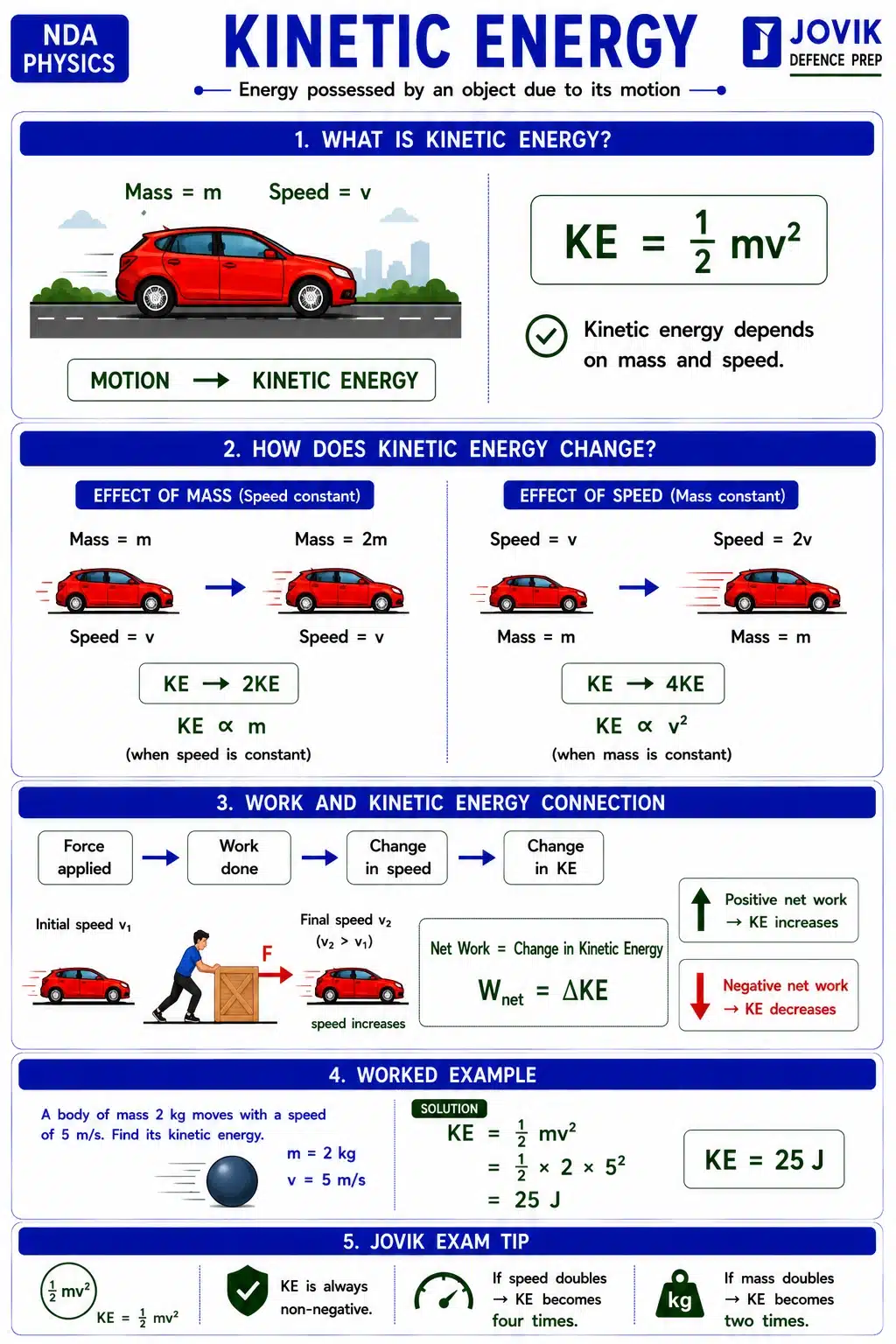
Every moving object has energy by virtue of its motion. This is called kinetic energy.
To derive the formula, consider a net force F acting on a mass m starting from rest (u = 0) over displacement s. From Newton’s Second Law: F = ma. From kinematics: v² = 2as, so s = v²/(2a). Work done by net force = F × s = ma × v²/(2a) = ½mv². This work becomes kinetic energy.
KE = ½mv²
KE = kinetic energy (J). m = mass of the object (kg). v = speed of the object (m s⁻¹). Kinetic energy is always positive or zero. SI unit: Joule.
KE Comparisons Between Bodies
If mass B is four times mass A (m_B = 4m_A) and B move at half A’s speed (v_B = v_A/2):
KE_B = ½(4m_A)(v_A/2)² = ½(4m_A)(v_A²/4) = ½m_Av_A² = KE_A
Despite B being four times heavier, both bodies have equal kinetic energy. The speed penalty (halved, then squared) exactly cancels the mass advantage. [NDA 2011-I]
Finding Speed from Kinetic Energy
A 2000 g (= 2 kg) object has 100 J of kinetic energy. From KE = ½mv²:
100 = ½ × 2 × v² → v² = 100 → v = 10 m/s
The answer is exactly 10 m/s. [NDA 2021-II] Common confusions: forgetting to convert grams to kilograms, or misapplying the formula by using mass without the ½ factor.
Rate of Change of Kinetic Energy Under Constant Force
A body starts from rest (u = 0) under constant force F. Acceleration a = F/m. Velocity after time t: v = at. Kinetic energy: KE = ½mv² = ½m(at)² = ½ma²t². Rate of change of KE: dKE/dt = ma²t. The rate of change of kinetic energy is linear in time. It increases proportionally with t, not with t² or √t. [NDA 2011-I]
8. Potential Energy
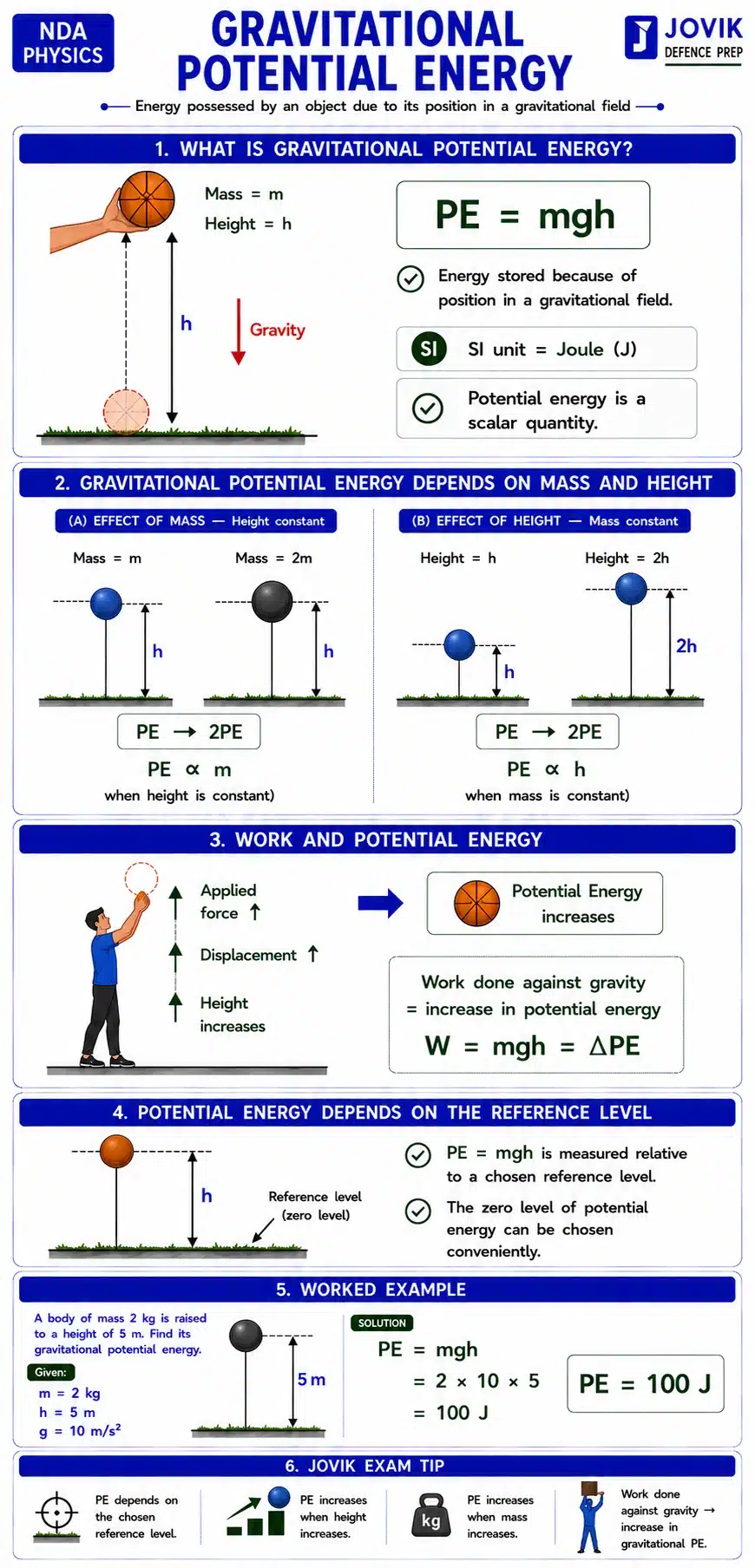
Kinetic energy is energy of motion. Potential energy is energy of position or configuration, meaning energy that is stored and waiting to become kinetic. Potential energy is the energy possessed by a body due to its change in position or shape. [NDA 2022-I]
Gravitational Potential Energy
When you lift an object to height h above a reference level, you do work against gravity. That work is stored as gravitational PE.
PE_grav = mgh
m = mass (kg). g = acceleration due to gravity (≈ 9.8 m s⁻² or 10 m s⁻²). h = height above reference level (m). SI unit: Joule. The reference level is arbitrary. Only changes in PE are physically meaningful. We usually set PE = 0 at the ground level.
For a body thrown vertically upward, gravitational PE is maximum at the highest point where velocity = 0 and all KE has converted to PE. [NDA 2010-I] PE is zero at the reference ground level, not maximum there.
As a swing rises from its rest position, kinetic energy decreases (speed reduces) and potential energy increases (height increases). [NDA 2015-I] At the lowest point: KE is maximum, PE = 0. At the highest point: PE is maximum, KE = 0.
Elastic Potential Energy
A stretched or compressed spring stores elastic potential energy. The more the spring is deformed, the more energy is stored.
PE_elastic = ½kx²
k = spring constant (N m⁻¹), measuring how stiff the spring is. x = displacement from the natural (undeformed) length (m). SI unit: Joule. This formula follows from the triangular area under the F = kx graph.
Liquid Potential Energy: Redistribution
Container X holds liquid to height h; container Y is empty. When a valve connects them, liquid flows until both reach height h/2. Initial PE: mass m, centre of mass at h/2 → P₁ = mg(h/2). Final PE: each container holds m/2 with centre of mass at h/4 → P₂ = 2 × (m/2)g(h/4) = mg(h/4). Therefore, P₁ = 2P₂. [NDA 2023-I] The lost PE (P₁ − P₂) converts to heat through viscous flow in the tube.
9. The Work–Energy Theorem
The work–energy theorem is one of the most powerful tools in classical Physics.
The net work done on an object equals the change in its kinetic energy.
W_net = ΔKE = ½mv² − ½mu²
W_net = total work done by all forces (J). v = final speed (m s⁻¹). u = initial speed (m s⁻¹). m = mass (kg). Derivation: from Newton’s Second Law F = ma and kinematics v² = u² + 2as: W = Fs = mas = m × (v² − u²)/2 = ½mv² − ½mu².
When net work done on an object is positive, kinetic energy increases: the object speeds up. [NDA 2016-II] When net work is negative: kinetic energy decreases. When net work is zero: kinetic energy is unchanged; speed stays constant.
The Theorem Applies to All Forces
The work–energy theorem holds for all forces, conservative (gravity, spring) and non-conservative (friction, applied force). It is universal. However, net work = ΔKE does not by itself prove that the acting force is conservative. The proof of a conservative force requires path-independence of work, not merely speed-dependence of the result. [NDA 2026-I]
10. Conservation of Mechanical Energy
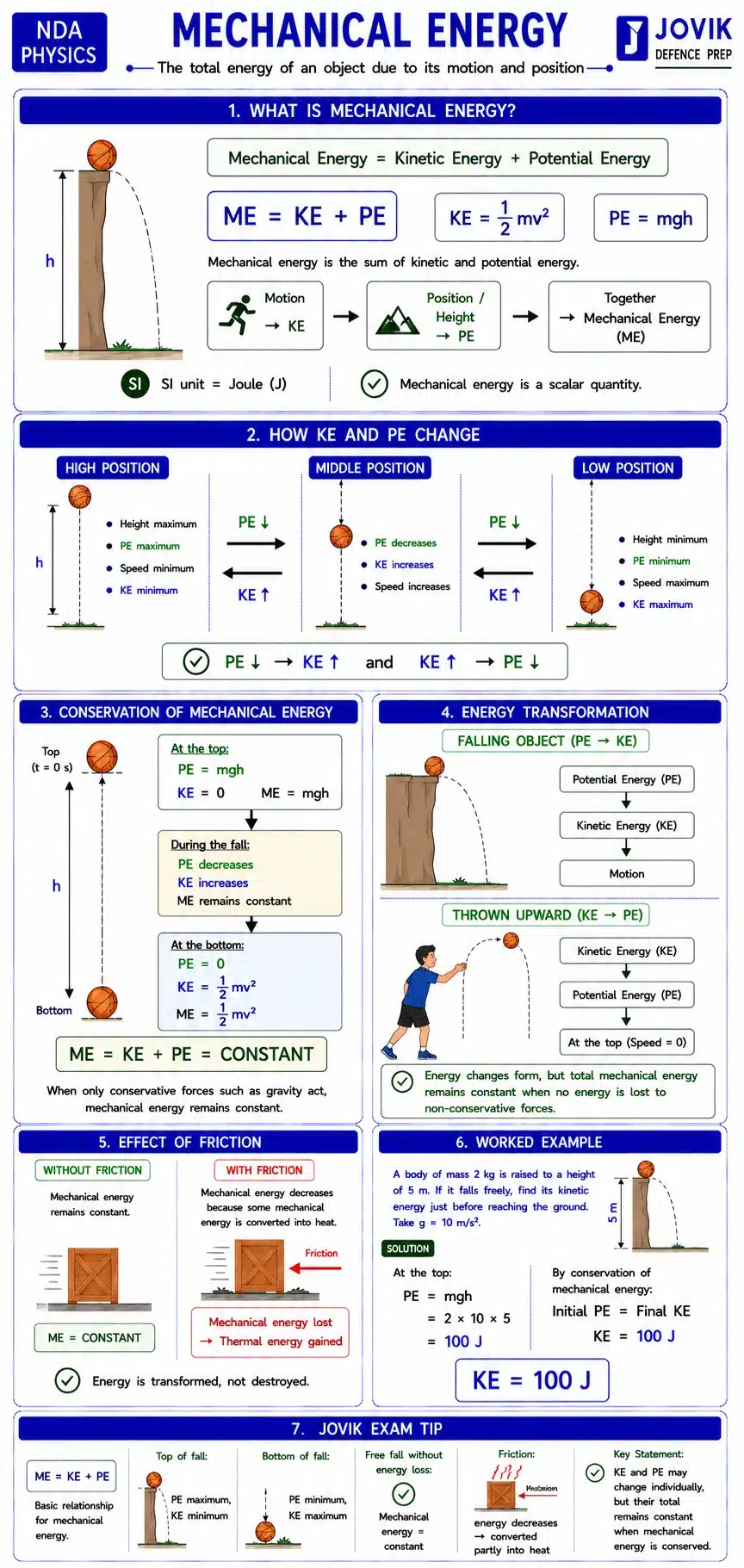
When only conservative forces (like gravity and spring force) act on a system, the total mechanical energy is constant throughout the motion.
KE + PE = constant (when only conservative forces act)
½mv² + mgh = constant
Mechanical energy is the sum of kinetic energy and potential energy. When one increases, the other decreases by the same amount. Energy simply changes form between KE and PE.
Free Fall: Numerical Examples
A 2 kg body is dropped from a stationary balloon at height 50 m (g = 9.8 m s⁻²). Total mechanical energy at release = PE = mgh = 2 × 9.8 × 50 = 980 J. All energy at height; no KE (released from rest). On reaching the ground: all PE → KE. ½mv² = 980 → v² = 980 → v = √980 m s⁻¹ ≈ 31.3 m s⁻¹. Total energy at any point during fall = 980 J (constant). [NDA 2019-II] Speed is √980 m/s, not 980 m/s.
A 320 g ball released with PE = 625 J. At the ground: KE = 625 J. ½mv² = 625 → v² = 2 × 625 / 0.32 = 3906.25 → v = 62.5 m s⁻¹. [NDA 2024-II]
After Falling Part of the Way
A body falls from 20 m. After falling 5 m (one-quarter of total height), it has lost one-quarter of its initial PE. That lost PE has become kinetic energy. Total mechanical energy is unchanged. [NDA 2016-I] The body has not lost total energy. Only energy form has changed from PE to KE.
Pendulum: Energy Conversion
A frictionless pendulum swings continuously. KE and PE exchange at every swing. At the lowest point, all PE has become KE, giving maximum speed. At the highest points, all KE has become PE, giving zero speed. Total mechanical energy never changes.
If friction or air resistance acts, mechanical energy is not conserved. Some energy converts to heat. The work done by friction reduces total mechanical energy. This is why real pendulums eventually stop and balls dropped on Earth never bounce back to original height.
KE at Launch Equals PE at Maximum Height
A ball of mass M is thrown upward from point A to maximum height B. At A: all energy is kinetic (KE = ½Mv²). At B: velocity = 0, all energy is potential (PE = Mgh). Since no energy is lost in vacuum: KE at A = PE at B. [NDA 2025-II] At point B, KE = 0. Therefore KE at B ≠ PE at B. And KE at A ≠ KE at B because the ball decelerates continuously during the upward journey.
| ★ IMPORTANT KE at launch point A = PE at maximum height B. [NDA 2025-II] At B: velocity = 0, KE = 0. KE at B ≠ PE at B (PE at B is non-zero). KE at A ≠ KE at B, as the ball decelerates continuously throughout the upward journey. |
11. Conservative and Non-Conservative Forces
Not all forces preserve mechanical energy. The behaviour of a force depends on whether its work is path-dependent or path-independent.
| Property | Conservative Force | Non-Conservative Force |
| Path dependence | Work depends only on initial and final positions | Work depends on the path taken |
| Round-trip work | Net work = 0 for any closed path | Net work ≠ 0 for a closed path |
| Energy storage | Energy can be stored as PE | Energy dissipated as heat : not recoverable |
| Potential energy | PE is defined for conservative forces | No PE is associated with them |
| Examples | Gravity, spring force, electric force | Friction, air resistance, viscosity |
| Mechanical energy | Conserved when only conservative forces act | NOT conserved : some converts to heat |
Gravity does the same work on any path between two heights. A spring stores and releases the same energy. But friction on a longer path does more negative work than on a shorter path. It is path-dependent and non-conservative.
Work done by gravity is path-independent. It depends only on the vertical height difference. Work done by gravity is zero for any horizontal displacement (gravity is vertical, displacement is horizontal, θ = 90°). [NDA 2025-II]
12. Conservation of Energy: The Universal Law
Energy can neither be created nor destroyed. It can only be transformed from one form to another.
Total energy of the universe is constant. This law has never been found to fail in any experiment in all of Physics history.
| Property | Conservation of Mechanical Energy | Conservation of Energy (Universal) |
| What is conserved | KE + PE = constant | Total energy of all forms |
| Applicability | Only when conservative forces act | Always: for all systems, all forces |
| Condition required | No friction, no air resistance | None: it always holds |
| System requirement | Conservative system | Any system: isolated or non-isolated |
| When it fails | Fails when friction or air resistance acts | Never fails |
| What replaces lost ME | — | Lost ME converts to heat, sound, etc. |
| Example | Pendulum in vacuum | Pendulum in air: ME lost → heat produced |
| NDA Confusion | Loss of PE ≠ loss of total energy in free fall | Conservation holds for ALL systems, not just isolated |
For a body in free fall with no air resistance: total mechanical energy is conserved. Losing PE means gaining equal KE. Total energy is unchanged. [NDA 2016-I]
For the same body falling through air, mechanical energy is not conserved, because friction converts some to heat. But total energy (KE + PE + heat) is still conserved. The universal law holds in all cases.
Energy Is Conserved for All Systems
A common misconception: energy conservation only applies to isolated systems. This is wrong. Energy is conserved for both isolated and non-isolated systems. [NDA 2025-II] In an isolated system: total energy inside remains constant. In a non-isolated system: any energy lost by the system is gained by its surroundings. Total energy of system + surroundings is always conserved. Energy can neither be created nor destroyed. [NDA 2017-II]
The Falling Apple: Energy Cascade
The sequence is: gravitational PE → kinetic energy → heat (air resistance, during fall) → heat in ground and apple + sound (at impact). [NDA 2019-I] Sound is produced at impact, not during the fall. Air resistance converts some KE to heat continuously during descent.
13. Power
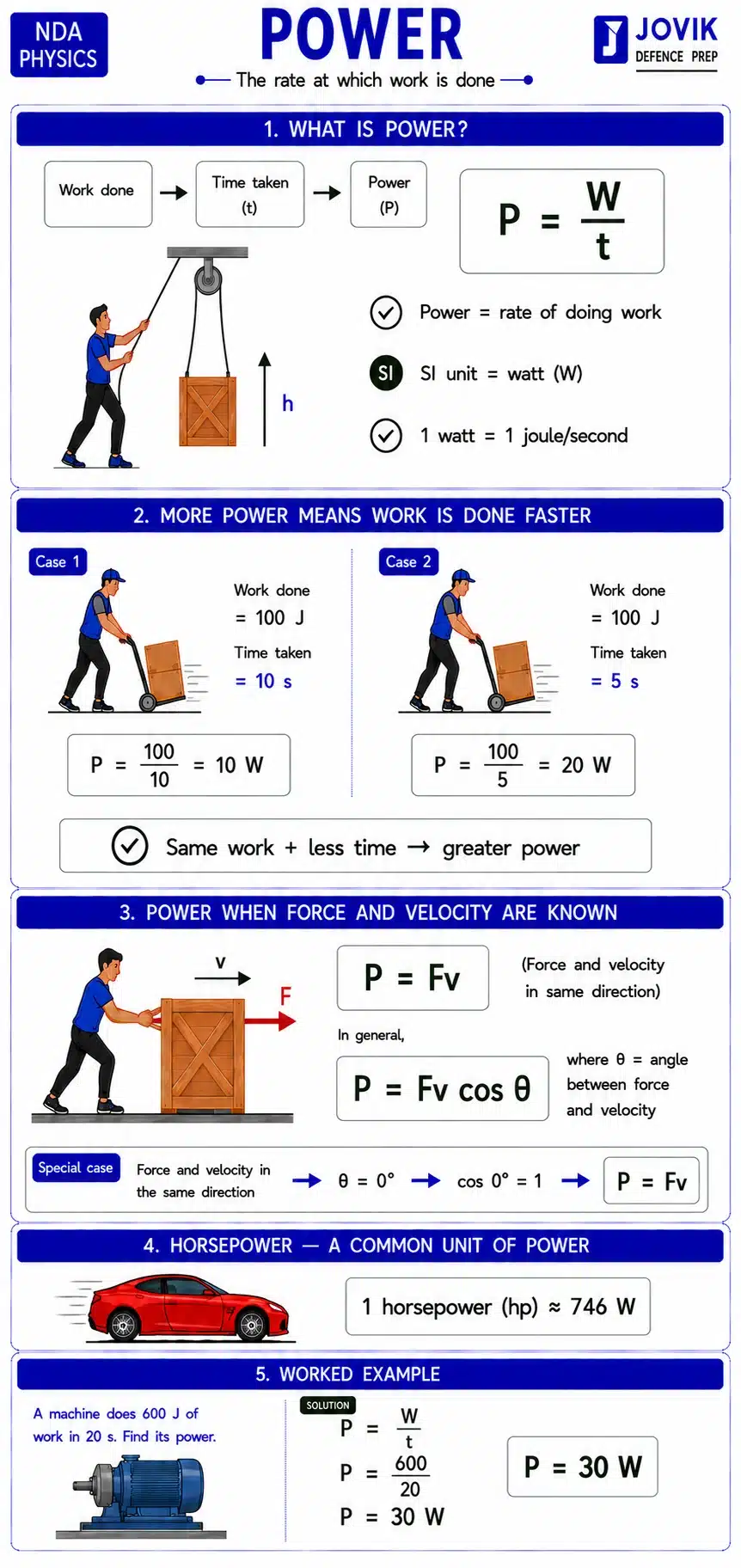
Two workers carry the same load up the same flight of stairs. Worker A does it in 1 minute. Worker B takes 5 minutes. Both do the same total work, but Worker A works five times faster. That difference in rate is power.
Power is the rate of doing work, or the rate of energy transfer.
P = W / t
P = power (W). W = work done (J). t = time taken (s). The SI unit of power is the Watt (W) = 1 Joule per second.
Power as Force Times Velocity
When a force F is applied to an object moving at velocity v, power can also be written as:
P = F × v
This is instantaneous power, useful when velocity is changing. If v is constant, P is constant. If v changes, P changes even if F is constant.
Lifting Example: Worked Calculation
Power required to lift 8.0 kg through 4 m in 2 s (g = 10 m s⁻²):
W = mgh = 8 × 10 × 4 = 320 J
P = W/t = 320/2 = 160 W [NDA 2023-I]
Constant Power → Speed Varies as √t
A machine operates at constant power P on a smooth surface. From P = Fv = mav: P = mv(dv/dt). Rearranging: mv dv = P dt. Integrating: ½mv² = Pt → v² = 2Pt/m → v ∝ √t. When power is constant, speed grows as the square root of time, not linearly. [NDA 2026-I] This is why a car accelerating at constant engine power gains speed less rapidly as it gets faster.
14. Electrical Energy and Cost Calculations
Electricity companies charge you for the energy your appliances consume, not for their power rating. The commercial unit of electrical energy is the kilowatt-hour (kWh), already introduced in Chapter 1.
1 kWh = 1000 W × 3600 s = 3.6 × 10⁶ J = 3.6 MJ
Cost = Power (kW) × Time (hours) × Rate (₹ per kWh)
Industrial Refrigerator: Worked Example
An industrial refrigerator consumes 5 kW, runs 10 hours per day for 30 days. Rate = ₹4 per kWh.
Energy used = 5 × 10 × 30 = 1500 kWh
Cost = 1500 × ₹4 = ₹6,000 [NDA 2020-I & II]
Incandescent Bulb Efficiency: Worked Example
A bulb has filament resistance 200 Ω, carries current 2 A, converts only 20% of input power into light. It runs for 10 hours. Rate = ₹5 per kWh.
Power consumed = I²R = 4 × 200 = 800 W = 0.8 kW
Useful power (light) = 20% of 0.8 kW = 0.16 kW
Energy for light = 0.16 × 10 = 1.6 kWh
Cost = 1.6 × ₹5 = ₹8 [NDA 2024-II]
15. Efficiency and Energy Loss
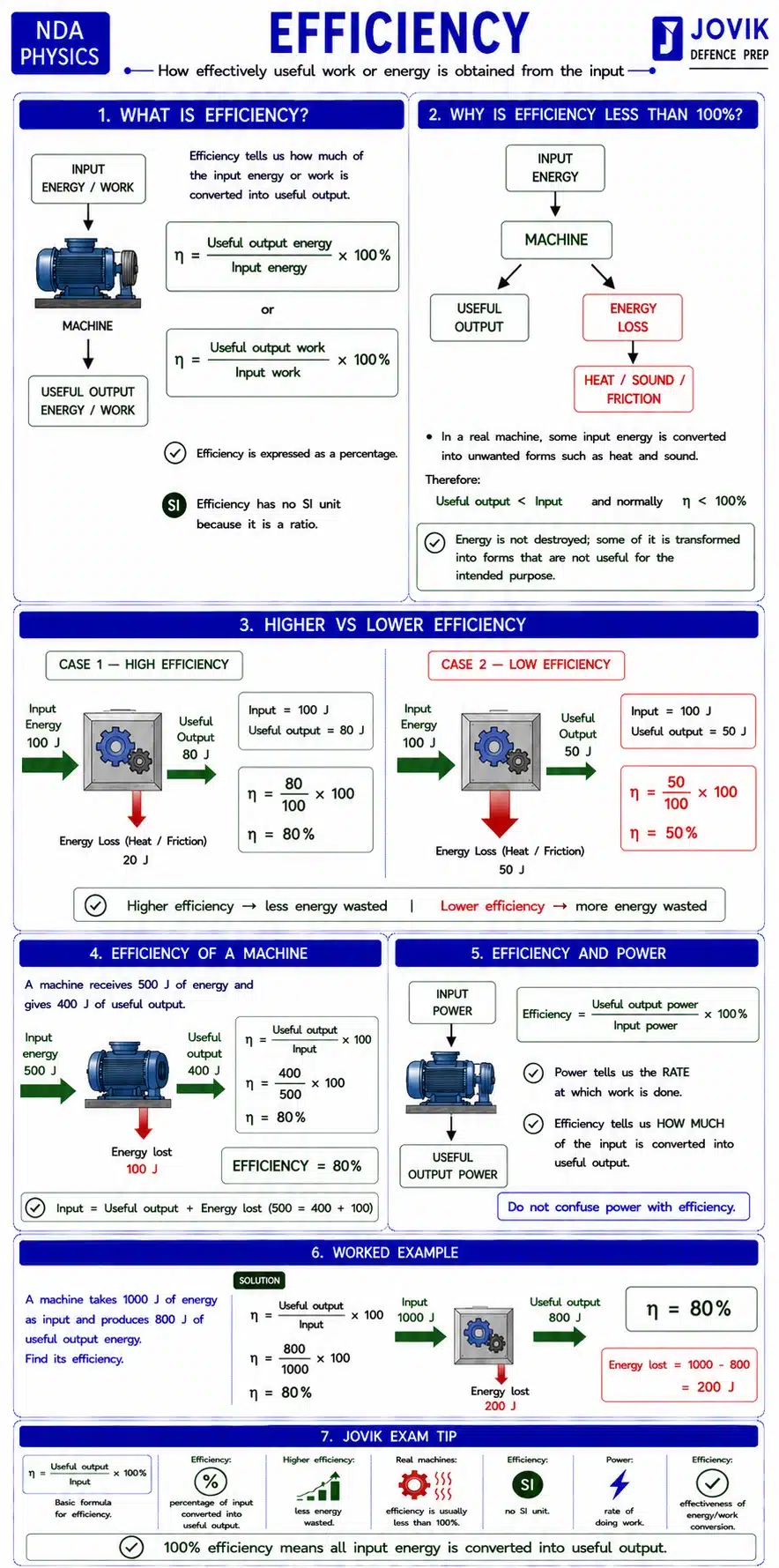
No machine converts all input energy into useful output. Some energy always becomes heat, sound, or is wasted through friction. The fraction of input energy that becomes useful output is called efficiency.
Efficiency (η) = (Useful output energy / Total input energy) × 100%
η is dimensionless, expressed as a percentage. Efficiency is always less than 100% for any real device. This is a consequence of the second law of thermodynamics. No real process is perfectly efficient.
Types of Energy Loss: In any real machine or device, energy is lost to friction between moving parts (becomes heat), electrical resistance (becomes heat), air resistance (becomes heat and sound), and sound produced during operation. Engineers design more efficient machines by reducing these losses, using lubricants to reduce friction, better conductors to reduce electrical resistance, and aerodynamic shapes to reduce air drag.
16. Advanced Applications
Frame-Dependent Change in Kinetic Energy
Kinetic energy and its changes are not the same in different reference frames. This is because KE depends on velocity, and velocity is frame-dependent.
A ball dropped from rest at height h in the Earth’s frame (S): ΔKE = mgh (by energy conservation). In a frame S′ moving upward at constant speed u relative to Earth, the ball has initial downward speed u and final speed √(2gh) + u. In S′: ΔKE = ½m(√(2gh) + u)² − ½mu² = mgh + mu√(2gh) > mgh. The change in KE is larger in the upward-moving frame S′. [NDA 2026-I] Kinetic energy changes are frame-dependent.
Elastic and Inelastic Collisions
In an elastic collision, both momentum and kinetic energy are conserved. The coefficient of restitution = 1. Balls collide and bounce back to their original heights.
In a perfectly inelastic collision, the two objects stick together. Momentum is conserved but kinetic energy is not. Some converts to heat and deformation energy. The coefficient of restitution = 0.
KE lost in a perfectly inelastic collision: ΔKE_lost = ½μv_rel², where μ = m₁m₂/(m₁ + m₂) is the reduced mass and v_rel is the relative velocity before collision. This lost energy becomes internal energy (heat, sound, deformation).
Work Done Against Friction on an Inclined Plane
On a rough inclined plane at angle θ, the friction force on a sliding block is f = μₖN = μₖmg cos θ. If the block slides distance s along the plane, work done by friction = −μₖmg cos θ × s (negative because friction opposes motion). The mechanical energy decreases by this amount: ΔME = −μₖmgs cos θ. This lost ME becomes heat.
Work and Conservative Forces: A Precise Distinction
If a particle moves from X to Y and the work done depends only on the initial and final speeds, this directly gives ΔKE by the work–energy theorem. But this does not by itself prove the force is conservative. The work–energy theorem (W_net = ΔKE) holds universally. A force is conservative only when its work is path-independent, depending only on initial and final positions, not speeds. [NDA 2026-I]
Important Distinctions
Work vs Energy
Work is a process: it describes the transfer of energy through force over displacement. Energy is a property: it is what an object possesses. Work is always done by or on something; energy is stored in something.
Power vs Energy
Energy is the total amount of work done or transferred (Joules). Power is the rate at which that work is done (Watts = J s⁻¹). Two machines doing the same work in different times use the same energy, but the faster one has higher power.
Conservative Force and Work–Energy Theorem
The work–energy theorem (W_net = ΔKE) applies to all forces. It does not distinguish conservative from non-conservative. A force is conservative if work is path-independent. These are related but distinct conditions. Do not confuse them.
Mechanical Energy vs Total Energy
Mechanical energy = KE + PE. In the presence of friction, mechanical energy decreases, but the lost energy becomes heat. Total energy (KE + PE + heat + …) is always conserved. Loss of PE in free fall ≠ loss of total energy.
Quick Revision
Work
- W = Fs cos θ | SI unit: Joule (J) | Scalar quantity
- Positive work: θ = 0°, force and displacement same direction
- Negative work: θ = 180°, force and displacement anti–parallel [NDA 2021-II | NDA 2022-I]
- Zero work: θ = 90°, force perpendicular to displacement [NDA 2025-II]
- Work by gravity = path-independent, depends only on vertical height change [NDA 2025-II]
- 1 J = 4 N through 25 cm = 1 N through 1 m [NDA 2021-II]
Kinetic Energy
- KE = ½mv² | SI unit: Joule | Always positive
- m_B = 4m_A, v_B = ½v_A → KE_B = KE_A (equal KE despite different mass/speed) [NDA 2011-I]
- 2 kg, KE = 100 J → v = 10 m/s (not 11.1 or 11.2) [NDA 2021-II]
- Rate of change of KE under constant force ∝ t (linear in time) [NDA 2011-I]
Potential Energy
- Gravitational PE = mgh | Elastic PE = ½kx²
- PE maximum at highest point of vertical throw (velocity = 0) [NDA 2010-I]
- Swing rising: KE decreases, PE increases [NDA 2015-I]
- KE at A = PE at B for vertical throw (all KE converts to PE at top) [NDA 2025-II]
- Liquid redistribution: P₁ = 2P₂ when equal containers reach equal levels [NDA 2023-I]
- Chemical energy = stored in BONDS BETWEEN atoms (not nucleus) [NDA 2019-I]
- Electrical energy in circuit = energy in TRANSIT, not stored [NDA 2016-I]
Work–Energy Theorem
- W_net = ΔKE = ½mv² − ½mu² [NDA 2016-II | NDA 2026-I]
- Positive W_net → KE increases | Negative W_net → KE decreases
- Applies to ALL forces : conservative and non-conservative
- Does NOT prove force is conservative : that requires path-independence [NDA 2026-I]
Conservation of Mechanical Energy
- KE + PE = constant (conservative forces only, no friction)
- Free fall: 2 kg from 50 m → speed = √980 m/s, total energy = 980 J [NDA 2019-II]
- 320 g ball, PE = 625 J → speed = 62.5 m/s [NDA 2024-II]
- After falling 5 m from 20 m: gained ¼ PE as KE, total energy unchanged [NDA 2016-I]
Conservation of Energy: Universal
- Energy can neither be created nor destroyed: only transformed [NDA 2017-II]
- Holds for ALL systems: isolated AND non-isolated [NDA 2025-II]
- Apple falling: Gravitational PE → KE → Heat (air) → Heat + Sound (impact) [NDA 2019-I]
- ΔKE is frame-dependent: larger in upward-moving frame S′ [NDA 2026-I]
Power
- P = W/t = Fv | SI unit: Watt (W) = J s⁻¹
- 8 kg, 4 m, 2 s, g = 10 → P = 160 W [NDA 2023-I]
- Constant power → v ∝ √t (not v ∝ t) [NDA 2026-I]
Electrical Energy and Cost
- 1 kWh = 3.6 × 10⁶ J | Cost = P(kW) × t(h) × rate(₹/kWh)
- 5 kW × 10 h/day × 30 days × ₹4/kWh = ₹6,000 [NDA 2020-I & II]
- Bulb: I²R = 800 W, 20% light → 0.16 kW × 10 h × ₹5 = ₹8 [NDA 2024-II]
Work, Energy & Power Previous Year Questions
Practice NDA previous-year questions from the Work, Energy & Power chapter with detailed solutions and important tips.