NDA Current Affairs | 13 Sep Exam
Practice Now

Laws of Motion – NDA Physics Notes
Exam Relevance: High Frequency | Newton’s Laws · Momentum · Impulse · Friction · Apparent Weight · Circular Motion · Conservation of Momentum
Reading Time: 30–35 minutes | Last Updated: 2026
Kinematics described how things move. This chapter explains why.
Something must cause a stationary object to start moving. Something must make a moving object slow down, speed up, or change direction. That something is force.
Every motion you observe in the physical world (a ball rolling, a rocket launching, a car skidding) is explained by three laws written by Isaac Newton in 1687. These three laws connect force, mass, and motion into a single coherent framework.
1. What Is Force?
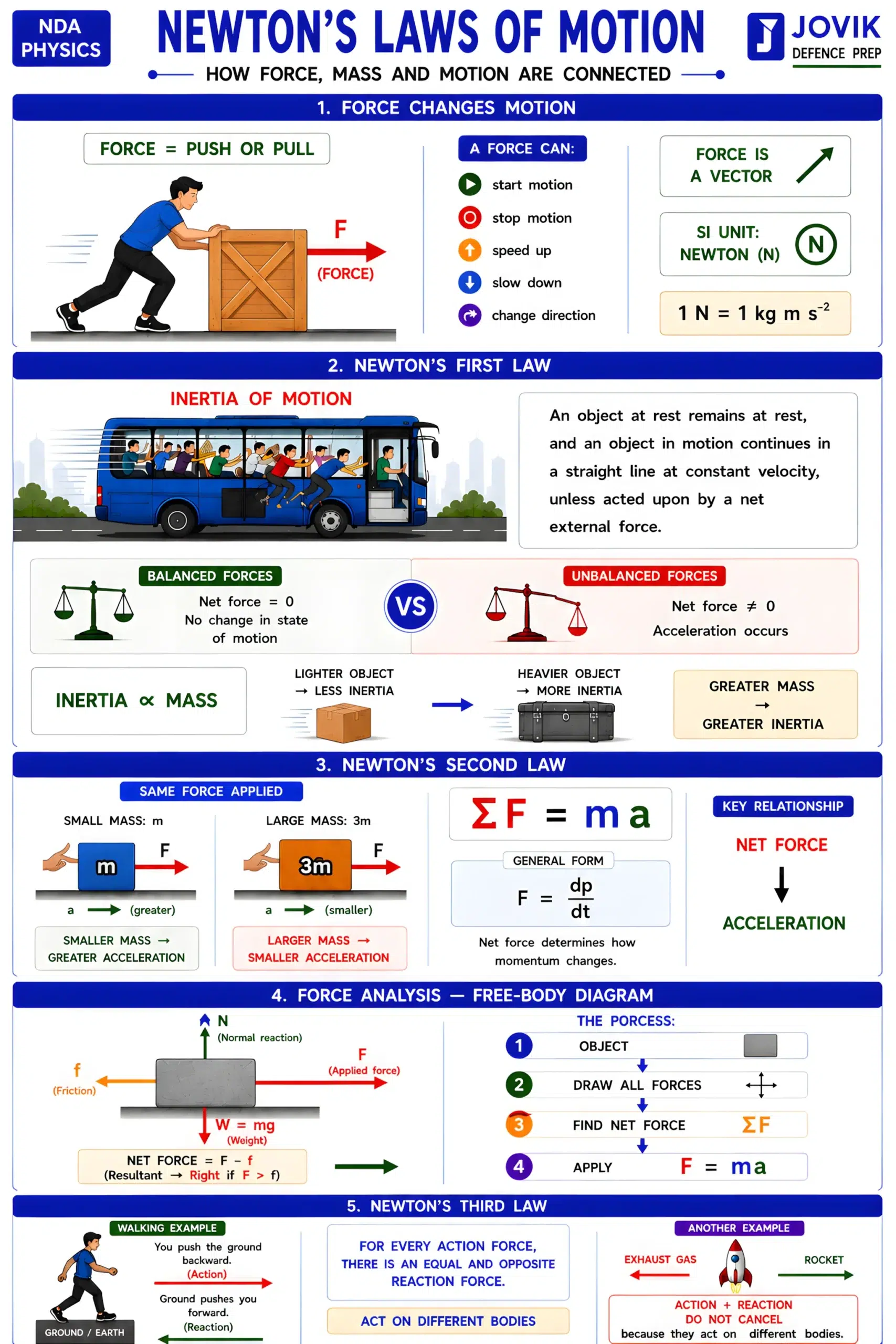
A force is a push or pull that one object exerts on another. A force can start motion, stop motion, speed it up, slow it down, or change its direction. A force can also change the shape of an object, like stretching a rubber band or compressing a spring.
Force is a vector quantity. It has both magnitude and direction. The SI unit of force is the Newton (N). One Newton is defined as the force that gives a mass of 1 kg an acceleration of 1 m s⁻²: 1 N = 1 kg m s⁻².
Force is not something an object possesses. It is something an object experiences when another object acts on it. A stationary football has no force inside it. When you kick it, your foot exerts a force on it.
2. Types of Forces
All forces in nature fall into two categories based on whether the interacting objects need to be in physical contact.
Contact Forces
A contact force requires direct physical contact between two objects. The force appears only at the interface where they touch. Examples: push force (applied force), friction, tension in a string, normal reaction, air drag. Contact forces satisfy Newton’s Third Law: every contact force has an equal and opposite reaction force on the other object. [NDA 2024-II]
Non-Contact Forces
A non-contact force acts between objects that are not physically touching. These forces act at a distance through fields. Examples: gravitational force, electric force, magnetic force. [NDA 2016-II | NDA 2021-I]
Gravitational force and electric force are central and conservative. They act along the line joining two bodies, and the work done is recoverable. Friction is non-central and non-conservative. It does not act along the line joining bodies, and work done against it generates heat, which is not recoverable. [NDA 2019-I]
| Property | Contact Forces | Non-Contact Forces |
| Physical contact needed? | Yes — objects must touch | No — acts at a distance |
| Examples | Push, friction, tension, normal reaction | Gravity, electric force, magnetic force |
| Obeys Newton’s Third Law? | Yes | Yes |
| Conservative? | Friction: No Tension/Normal: Yes | Gravity and electric: Yes |
| NDA tested examples | Friction [2019-I], Tension [2010-II] | Gravity [2023-I], Magnetic [2021-I] |
3. Balanced and Unbalanced Forces
Forces rarely act alone on an object. Most objects have several forces acting on them simultaneously. The key question is always: what is the net result of all those forces together?
Balanced Forces
Forces are balanced when all the forces acting on an object add up to zero. The net force is zero. A balanced set of forces produces no change in the state of motion. A stationary object stays stationary, and a moving object continues at constant velocity.
A book resting on a table: gravity pulls it downward; the table pushes it upward with an equal normal reaction. Net force = zero. A body at rest on Earth’s surface has weight acting downward and normal reaction acting upward. Two forces act on it, not zero. [NDA 2010-II]
Unbalanced Forces
Forces are unbalanced when they do not add up to zero. The net force is non-zero. An unbalanced force produces acceleration. The object speeds up, slows down, or changes direction. The acceleration is always in the direction of the net force.
The Resultant Force
The resultant force is the single equivalent force that produces the same effect as all the individual forces combined. If forces act in the same direction, they add. If they act in opposite directions, the smaller subtracts from the larger. If the resultant force is zero, the object is in equilibrium. If the resultant force is non-zero, the object accelerates.
This is the bridge between Kinematics and Dynamics: unbalanced forces cause the accelerations that Kinematics describes.
4. Inertia and Newton’s First Law
What Is Inertia?
Every object resists changes to its state of motion. This resistance is called inertia. A stationary cricket ball does not start rolling on its own. A moving train does not stop the instant the engine cuts. Both objects resist the change. They have inertia.
Inertia is directly proportional to mass. A more massive object has more inertia and is harder to accelerate or decelerate. Among an atom, a molecule, a one-rupee coin, and a cricket ball, the cricket ball has the greatest inertia because it has the greatest mass. [NDA 2018-I]
Newton’s First Law of Motion
Newton’s First Law: An object at rest remains at rest, and an object in motion continues in a straight line at constant velocity, unless acted upon by a net external force.
This law has two parts. The first part covers inertia of rest: a stationary object will not move unless something pushes or pulls it. The second part covers inertia of motion: a moving object will not slow down, speed up, or turn unless a force acts on it.
The First Law defines what we mean by “no net force”. It establishes the concept of an inertial frame of reference. It is not simply the Second Law with a = 0. The two laws are logically independent.
Newton’s First Law in Everyday Life
When a moving bus brakes suddenly, passengers lurch forward. Their bodies were moving forward at the bus’s speed. The bus decelerates, but the passengers’ bodies try to continue at the original speed. This is inertia of motion in action. [NDA 2011-I]
A quick jerk on the lower string of a suspended heavy ball breaks the lower string. A slow sustained pull breaks the upper string. The jerk creates a large impulsive force in the lower string faster than the ball’s inertia can transmit it upward. The slow pull accumulates tension through the ball’s weight into the upper string. Both outcomes are explained by inertia, a First Law effect. [NDA 2010-II]
5. Newton’s Second Law
Newton’s First Law tells us that a net force is needed to change motion. Newton’s Second Law tells us exactly how much change a given force produces.
The Law: Stated Correctly
Newton’s Second Law: The net force on a body equals the rate of change of its linear momentum. When mass is constant, net force equals mass multiplied by acceleration.
F = ma (when mass is constant)
F = dp/dt (general form)
F = net force (N). m = mass (kg). a = acceleration (m s⁻²). p = momentum (kg m s⁻¹). t = time (s).
Force is proportional to acceleration: not to velocity, and not to momentum. A body can have enormous momentum with zero net force (uniform motion). Force determines how momentum changes, not how large it is. [NDA 2025-II]
The Newton Defined
From F = ma with F = 1 N, m = 1 kg: a = 1 m s⁻². A force of 1 Newton acting on a freely moving 1 kg mass produces an acceleration of exactly 1 m s⁻², not a constant speed, not 1 km/s, but an acceleration of 1 m s⁻². [NDA 2016-II]
Applying the Second Law: Worked Examples
A 5 N force acts on a 10 kg mass. From F = ma: a = F/m = 5/10 = 0.5 m s⁻². [NDA 2022-I] Always use SI units throughout the calculation to get the correct result.
When a particle’s position is described by y = ut − ½gt², differentiating once gives velocity dy/dt = u − gt. Differentiating again gives acceleration d²y/dt² = −g. By Newton’s Second Law: F = m × (−g) = −mg. The negative sign shows the force acts downward, opposite to the assumed positive y-direction. [NDA 2023-II]
Free-Body Diagram for Newton’s Second Law
A free-body diagram (FBD) shows all forces acting on a single object as arrows. It is the essential tool for applying Newton’s Second Law. Draw the object. Draw every force as a labelled arrow. Find the net force. Apply F = ma.
6. Mass and Weight
Mass
Mass is the quantity of matter in an object. It is the measure of an object’s inertia and the constant of proportionality in Newton’s Second Law (F = ma). It is mass: not weight: that resists acceleration. [NDA 2021-II]
Mass is a scalar quantity. It does not vary from place to place. A 70 kg person has mass 70 kg on Earth, on the Moon, and in space. [NDA 2016-I]
Weight
Weight is the gravitational force on a body.
W = mg
W = weight (N). m = mass (kg). g = acceleration due to gravity (≈ 9.8 m s⁻² on Earth’s surface). Weight is a vector quantity, directed downward toward the centre of Earth. It varies with location because g varies. On the Moon, g is about one-sixth of Earth’s value, so your weight is one-sixth, but your mass is unchanged.
| Property | Mass | Weight |
| Definition | Quantity of matter; measure of inertia | Gravitational force on the body |
| Formula | — | W = mg |
| SI Unit | kilogram (kg) | Newton (N) |
| Scalar or Vector? | Scalar | Vector (directed downward) |
| Varies with location? | No : constant everywhere | Yes : depends on g |
| In Newton’s Second Law | m is the constant of proportionality | W is one of the forces (mg downward) |
7. Momentum
Newton’s Second Law tells us that force equals the rate of change of momentum. To understand force fully, we must first understand momentum.
What Is Momentum?
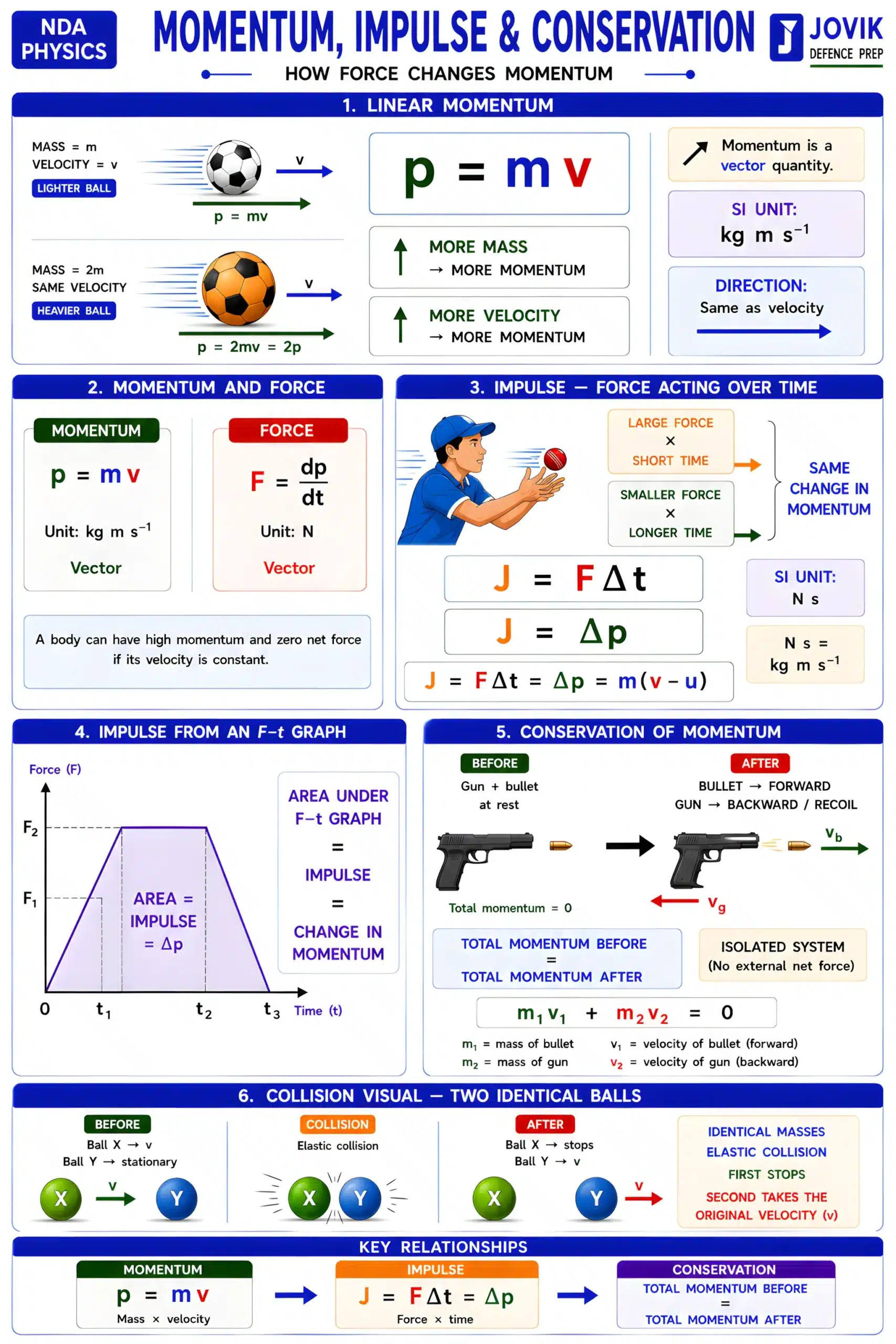
Every moving object has linear momentum, which is the product of its mass and velocity.
p = mv
p = linear momentum (kg m s⁻¹). m = mass (kg). v = velocity (m s⁻¹). Momentum is a vector quantity. It has the same direction as velocity. SI unit: kg m s⁻¹. Momentum can be positive, negative, or zero. Speed has no direction; momentum does.
Properties of Momentum
Momentum is a vector quantity. [NDA 2011-II]
Momentum is conserved in an isolated system, meaning one with no external net force. [NDA 2011-II]
Momentum is NOT the same as force in linear motion. Force is the rate of change of momentum. A body at constant high speed has high momentum but zero net force. [NDA 2011-II | NDA 2013-I]
If two bodies move with equal velocities and one has double the mass, the heavier body has double the momentum. Momentum scales linearly with mass when velocity is constant. [NDA 2016-I]
An object undergoing non-accelerated (uniform) motion has zero rate of change of momentum. Constant velocity means constant momentum means zero net force. [NDA 2013-I]
Momentum in Circular Motion
A car moving in a circle at uniform speed has constant speed, but continuously changing direction. Velocity is changing. Therefore, momentum is changing. Changing momentum requires a net force, which is the centripetal force. Momentum is not constant in uniform circular motion, even though speed is. [NDA 2013-I | NDA 2021-II]
8. Impulse and the Impulse–Momentum Theorem
A small force acting for a long time can change an object’s momentum just as much as a large force acting for a short time. The quantity that captures this combined effect is called impulse.
What Is Impulse?
Impulse is the product of force and the time over which it acts.
J = F × Δt
J = impulse (N s or kg m s⁻¹). F = force (N). Δt = time of application (s). Impulse is a vector. It has the same direction as the force. Its SI unit is N s, which is the same as kg m s⁻¹.
The Impulse–Momentum Theorem
From Newton’s Second Law: F = Δp/Δt, so F × Δt = Δp. Impulse equals the change in momentum of the body.
J = F × Δt = Δp = m(v − u)
Impulse equals change in momentum, not change in force, not work done, not energy. [NDA 2016-I]
Area Under the F–t Graph
Just as area under a v–t graph gives displacement, the area under a force–time (F–t) graph gives impulse, and therefore the change in momentum.
Numerical Examples
A force F acts on a body for 3 s, changing its momentum from 10 g cm/s to 40 g cm/s. Change in momentum = 30 dyne·s. Force = Δp/Δt = 30/3 = 10 dynes. [NDA 2013-I]
A trapezoidal F–t graph peaks at 20 N with effective impulse area = 400 N·s. Object mass = 10 kg, starting from rest. Final speed = 400/10 = 40 m/s. [NDA 2026-I]
A 1000 kg car at 72 km/h (= 20 m/s) is stopped in 0.2 s. Retarding force = Δp/Δt = (1000 × 20)/0.2 = 100,000 N = 100 kN. [NDA 2024-II]
Bouncing Ball: Vector Nature of Momentum
A ball bounces elastically off the ground. Speed before and after = same (no energy loss). But direction reverses. Downward becomes upward. Momentum changes from −mv to +mv. Change in momentum = 2mv. Speed and kinetic energy are unchanged; momentum changes because it is a vector. [NDA 2019-II]
| Quantity | Definition | Formula | SI Unit | Scalar/Vector | NDA Confusion |
| Force | Push or pull that changes motion | F = ma or F = dp/dt | Newton (N) | Vector | F ∝ acceleration, NOT momentum |
| Momentum | Mass in motion | p = mv | kg m s⁻¹ | Vector | Rate of change of p = F (not same as F) |
| Impulse | Force applied over time | J = FΔt = Δp | N s = kg m s⁻¹ | Vector | Impulse = Δp, not ΔF or work done |
| Acceleration | Rate of change of velocity | a = Δv/Δt = F/m | m s⁻² | Vector | At uniform speed, a = 0 only if no direction change |
9. Newton’s Third Law
The Law
Newton’s Third Law: For every action force, there is an equal and opposite reaction force acting on a different body.
Three things are always true about action–reaction pairs: they are equal in magnitude, opposite in direction, and they act on different bodies: never on the same body.
Why Action and Reaction Never Cancel
Students often ask: if action and reaction are equal and opposite, why do things move? Because they act on different bodies. Cancellation requires two forces on the same object. Action–reaction pairs act on two different objects. They can never cancel each other.
Applications of Newton’s Third Law
A man on frictionless ice can move by throwing an object in the opposite direction. The reaction force propels him forward. This is Newton’s Third Law. [NDA 2011-I]
A jet engine expels exhaust gases backwards; the reaction force propels the aircraft forward. A rocket expels gases downward; the reaction lifts the rocket upward. Both operate on conservation of linear momentum, a consequence of the Third Law. [NDA 2011-I]
The gravitational force Earth exerts on the Moon is equal in magnitude but opposite in direction to the force the Moon exerts on Earth. Neither force is greater. [NDA 2023-I]
Series Spring Balances
Two identical spring balances S₁ (above) and S₂ (below) are connected in series, with a 10 kg mass hanging from S₂. Both balances read 10 kg. [NDA 2023-I]
S₂ supports the hanging mass. S₁ supports S₂ and the mass. Each must bear the full 10 kg weight. The readings do not add, halve, or share. They are both identical at 10 kg.
10. Conservation of Linear Momentum
The Principle
In an isolated system, meaning one where no external net force acts, the total linear momentum remains constant. This follows from combining Newton’s Second and Third Laws.
Total momentum before = Total momentum after
Conservation of momentum in a collision follows from both Newton’s Second and Third Laws together. Newton’s First Law alone is insufficient. [NDA 2015-II]
Bullet Recoil: Worked Example
A 10 g (= 0.01 kg) bullet is fired at 300 m/s from a 1 kg pistol. Initial total momentum = 0 (both at rest).
0 = (0.01)(300) + (1)(v_pistol)
3 + v_pistol = 0, so v_pistol = −3 m/s. [NDA 2022-II] The negative sign confirms the pistol recoils in the direction opposite to the bullet. The magnitude of recoil is 3 m/s.
Boy Jumping onto Cart: Worked Example
A 52 kg boy jumps at 2 m/s horizontally onto a stationary 3 kg cart (frictionless wheels).
(52)(2) = (52 + 3)(v_final)
104 = 55 × v_final, so v_final = 104/55 ≈ 1.89 m/s. [NDA 2022-I] The final speed is less than 2 m/s because the total mass increased. Momentum is conserved but kinetic energy is not. Some is lost to the inelastic collision.
Elastic Collision of Identical Masses
A metallic bob X of mass m moves and collides elastically with an identical stationary bob Y. In a perfectly elastic collision between identical masses, the first mass comes to a complete stop and the second moves off with the original velocity of the first. Bob X stops at the point of collision; bob Y moves away at X’s original speed. [NDA 2024-I]
Internal Forces Cannot Change Centre of Mass Velocity
When a chemical reaction or explosion occurs within a system, the internal forces are equal and opposite. They produce equal and opposite impulses within the system. The net external impulse is zero, so the velocity of the centre of mass remains unchanged. [NDA 2019-II]
Internal forces can, however, change the kinetic energy of individual parts relative to the centre of mass. This is how explosions generate motion in individual fragments.
11. Resultant of Forces
Multiple forces acting on an object combine to produce a single equivalent effect. Finding that single equivalent force is called finding the resultant.
Perpendicular Forces
When two forces act at right angles to each other, their resultant is found by the Pythagorean theorem.
R = √(F₁² + F₂²)
Forces of 3 N and 4 N act perpendicularly on a 1 kg body. Resultant = √(9 + 16) = √25 = 5 N. Acceleration = 5/1 = 5 m s⁻². [NDA 2015-II]
Forces at an Angle: Parallelogram Law
When two forces act at an angle θ to each other, their resultant is found by the parallelogram law.
R = √(F₁² + F₂² + 2F₁F₂ cos θ)
Two forces of 5 N each at an angle of 60° between them: R = √(25 + 25 + 2 × 5 × 5 × cos 60°) = √(25 + 25 + 25) = √75 ≈ 8.6 N. [NDA 2023-I]
Special Case: Resultant Equals Each Individual Force
If two equal forces of magnitude F produce a resultant also equal to F, then the angle between the two forces is 120° (= 2π/3 radians). The angle between each force and the resultant is 60° (= π/3 radians). [NDA 2026-I]
Verification: R = √(F² + F² + 2F²cos 120°) = √(F² + F² − F²) = F
Static Equilibrium: Net Force = Zero
For a block to remain at rest, the resultant of all forces acting on it must be zero. If forces of 10 N left, 15 N left, 2 N right, and 15 N right act on block P, the net without F = (10 + 15) − (2 + 15) = 8 N leftward. For equilibrium, the required force F = 8 N to the right. [NDA 2024-I]
12. Equilibrium
What Is Equilibrium?
A body is in equilibrium when the resultant of all forces acting on it is zero. The body experiences no net acceleration. It is either at rest or moving at constant velocity. The resultant of balanced forces is zero, not non-zero, not varying. [NDA 2011-II]
Types of Equilibrium
Equilibrium is not just about being stationary. It has three distinct types based on what happens when the object is slightly displaced.
| Type | What Happens on Displacement | Centre of Gravity | Restoring Force | Example |
| Stable | Object returns to original position | Rises : then lowers back | Acts toward equilibrium | Ball in a bowl |
| Unstable | Object moves further away | Lowers : cannot return | Acts away from equilibrium | Ball on top of a rod |
| Neutral | Object stays in new position | Neither rises nor lowers | No restoring force | Ball on a flat surface |
A ball balanced on top of a vertical rod is in unstable equilibrium. Any slight displacement lowers its centre of gravity, and no restoring force returns it to the top. [NDA 2018-I]
Circus Performer on Wire
A circus performer of mass M walks along a nearly horizontal wire. At each support, the wire makes a small angle θ with the horizontal. The tension T must supply an upward component T sin θ equal to Mg/2. For small θ, T sin θ ≈ Tθ, requiring T >> Mg. The tension in a nearly horizontal wire supporting a vertical load is always greater than the load: often much greater. [NDA 2010-II]
Metre Scale on Wedge Supports: Principle of Moments
A uniform metre scale of mass 0.24 kg rests horizontally on two wedges: W₁ at 0.2 m from one end, W₂ at 0.6 m from the same end. The scale centre is at 0.5 m. Weight = 2.4 N at centre.
Taking moments about W₁ (at 0.2 m): N₂ × (0.6 − 0.2) = 2.4 × (0.5 − 0.2). N₂ × 0.4 = 0.72. N₂ = 1.8 N. N₁ = 2.4 − 1.8 = 0.6 N. [NDA 2024-I]
13. Friction
Why Friction Exists
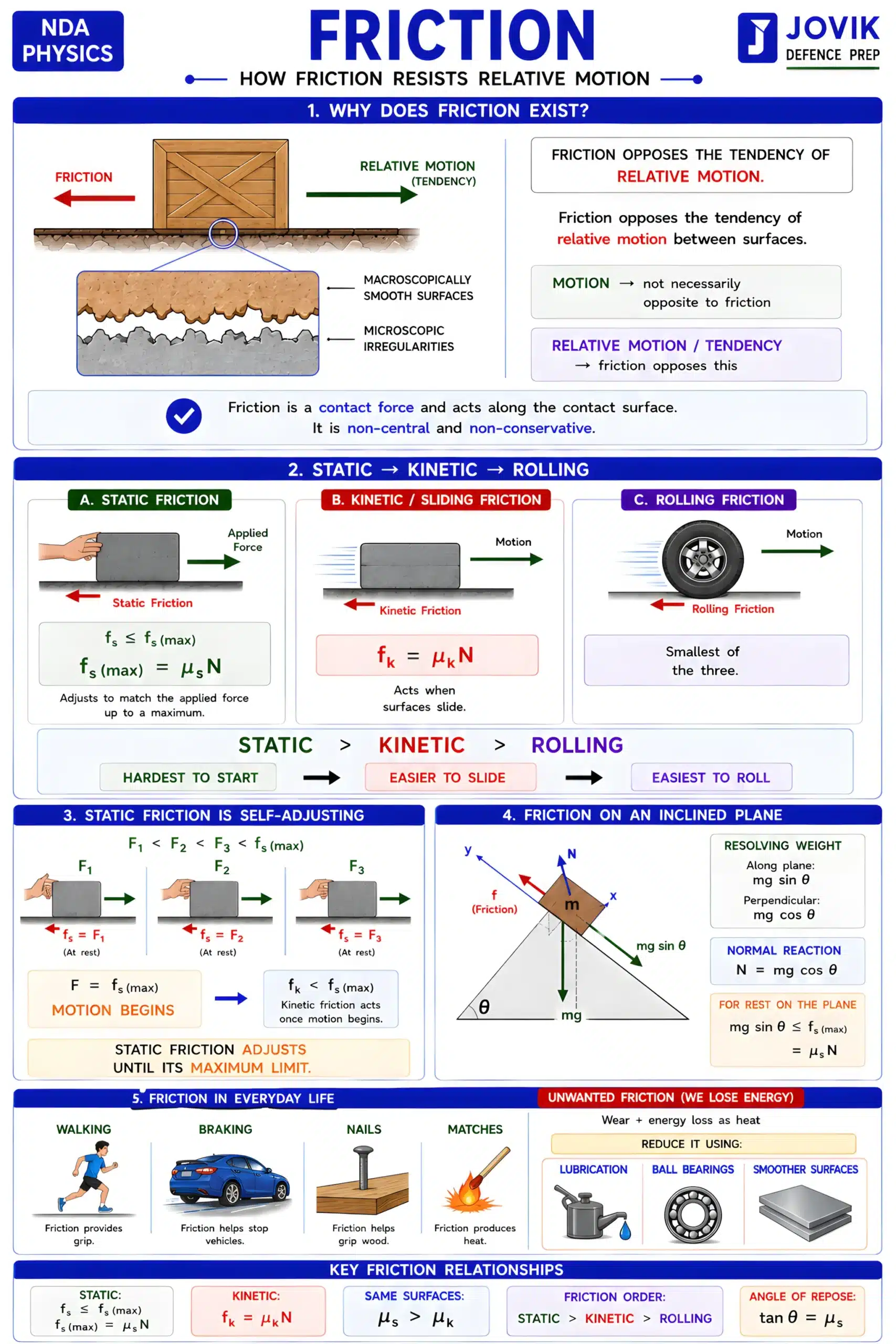
When two surfaces are in contact, even surfaces that appear smooth have microscopic bumps and valleys. These surface irregularities interlock and resist relative motion between the surfaces. Friction always opposes the tendency of relative motion between surfaces, not necessarily the motion itself.
Static Friction
Static friction acts when two surfaces are at rest relative to each other. It is a reactive force. It adjusts to match the applied force up to a maximum limit called limiting friction. Once this maximum is reached, the block begins to move.
f_s(max) = μₛ × N
f_s(max) = maximum static friction (N). μₛ = coefficient of static friction (dimensionless). N = normal force (N). For a 2 kg block on a 3 kg block (μₛ = 0.2, g = 10 m s⁻²): N = 20 N. Maximum static friction = 0.2 × 20 = 4 N. [NDA 2023-I]
Kinetic (Sliding) Friction
Kinetic friction acts when two surfaces slide against each other. Once motion begins, friction drops from its limiting value to the lower kinetic value.
f_k = μₖ × N
μₖ = coefficient of kinetic friction. μₖ is always less than μₛ for the same pair of surfaces.
Kinetic friction from kinematics: a 2 kg block at 3 m/s comes to rest in 3 m. Deceleration: v² = u² + 2as → 0 = 9 + 2a(3) → a = −1.5 m s⁻². Friction force = ma = 2 × 1.5 = 3 N. [NDA 2024-I]
A 2 kg block at 10 m/s comes to rest in 20 m. Deceleration: 0 = 100 + 2a(20) → a = −2.5 m s⁻². Friction force = 2 × 2.5 = 5 N. [NDA 2024-II]
Rolling Friction
Rolling friction acts when an object rolls on a surface. It is the smallest of the three types, because the contact area and surface deformation at any instant are minimal.
| ★ IMPORTANT Order of Friction Magnitudes: Static friction > Kinetic friction > Rolling friction [NDA 2024-I] Starting motion requires overcoming static friction, which is the hardest. Sliding motion involves kinetic friction, which is smaller. Rolling involves the least friction. |
Properties of Friction
Friction is a non-central force. It does not act along the line joining the centres of the two bodies. It acts along the contact surface, opposing relative motion. Friction is a non-conservative force. Work done against friction converts to heat, which is not recoverable as mechanical energy. Gravitational and electric forces are conservative; friction is not. [NDA 2019-I]
Advantages and Disadvantages of Friction
Advantages: We walk because friction between shoe soles and ground provides grip. Cars brake because friction between tyres and road decelerates them. Nails hold wood because friction grips the fibres. Matches ignite because friction produces heat.
Disadvantages: Friction causes wear and tear in engines, bearings, and tyres. It wastes energy as heat. Ball bearings, lubricants, and smooth surfaces are all methods to reduce unwanted friction.
Conveyor Belt: Variable Mass Application
Sand falls vertically onto a conveyor belt at 0.1 kg/s. The belt moves at 2 m/s. Force required = (dm/dt) × v = 0.1 × 2 = 0.2 N. [NDA 2023-I] This is Newton’s Second Law in variable-mass form: F = v × (dm/dt). The force is needed to keep imparting momentum to the newly arriving sand.
14. Apparent Weight: Lifts and Weightlessness
When you stand on a weighing scale in a lift, the scale does not measure your true weight. It measures the normal reaction the floor exerts on you. This is your apparent weight. When the lift accelerates, your apparent weight changes, even though your true mass and the gravitational force on you remain unchanged.
| Lift Situation | Formula for Apparent Weight W’ | Effect on Scale Reading |
| At rest or uniform velocity | W’ = mg | Normal weight: unchanged |
| Accelerating upward at a | W’ = m(g + a) | Heavier than normal |
| Accelerating downward at a | W’ = m(g − a) | Lighter than normal |
| Free fall (cable breaks, a = g) | W’ = m(g − g) = 0 | Weightlessness: scale reads zero |
When a lift cable breaks, the lift and its occupants fall freely together. Apparent weight = m(g − g) = 0. A 70 kg man becomes effectively weightless. [NDA 2016-I]
If the ratio of actual weight to apparent weight in a downward-accelerating lift is 3:2, then: mg / m(g − a) = 3/2. Solving: 2g = 3(g − a) → 3a = g → a = g/3. [NDA 2011-II]
Weightlessness in Orbit
An astronaut with Earth weight 600 N experiences weightlessness in the International Space Station. This does not mean gravity is absent. [NDA 2024-II]
Gravity is still acting on the astronaut. It provides the centripetal force for orbital motion. Weightlessness occurs because the astronaut and the station are in the same free-fall trajectory around Earth. The normal reaction from the floor on the astronaut is zero. This is why they float.
| ★ IMPORTANT Weightlessness means: normal reaction = zero. It does NOT mean: zero gravity, zero acceleration, or zero gravitational pull. Gravity still acts in orbit. It provides the centripetal force. [NDA 2024-II] |
15. Circular Motion: The Force Perspective
In Chapter 2, we studied circular motion from a kinematics perspective. Now we ask: what force is responsible for it?
Why Circular Motion Requires Force
A car travelling in a circle has constant speed. But its velocity changes direction continuously. Changing velocity means non-zero acceleration. By Newton’s Second Law, non-zero acceleration requires a non-zero net force. This net force is always directed toward the centre of the circle. It is called the centripetal force.
F_centripetal = mv²/r
m = mass (kg). v = speed (m s⁻¹). r = radius of circular path (m). F = force directed toward centre (N).
The Key Distinctions
A vehicle in uniform circular motion: speed is constant, velocity is not constant (direction changes), momentum is not constant (momentum is a vector, as direction changes). Net acceleration = centripetal, toward centre, not zero. [NDA 2013-I | NDA 2021-II]
A car moving on a circle with uniform speed experiences a change in velocity due to change in direction, not a change in speed. Momentum changes because velocity vector changes direction. [NDA 2021-II]
16. Special Applications
Banking of Roads
When a car navigates a curve, the centripetal force needed to turn it comes from friction on a flat road. On a banked road, the road surface is tilted inward. This tilt provides a component of the normal reaction toward the centre, reducing the required friction and allowing safer cornering at higher speeds.
tan θ = v² / (rg)
θ = angle of banking. v = safe speed. r = radius of curve. g = acceleration due to gravity. At this angle, no friction is needed for the designed speed.
Angle of Repose
The angle of repose is the maximum angle of an inclined plane at which an object just begins to slide. Below this angle, static friction holds it. At this angle, static friction is at its maximum.
tan θ = μₛ
θ = angle of repose. μₛ = coefficient of static friction. This relationship means measuring the angle of repose directly gives the coefficient of static friction, which is a useful experimental technique.
Skydiver : Terminal Velocity
A skydiver falls from rest. Initially, gravity (P) exceeds air drag (Q), so the skydiver accelerates downward. As speed increases, drag increases. Eventually drag equals gravity. Net force = zero, and the skydiver reaches terminal velocity: constant speed, zero acceleration.
After the parachute opens, drag force Q increases dramatically. Gravity P remains unchanged. Net upward force decelerates the skydiver until a new, lower terminal velocity is reached. [NDA 2024-II | NDA 2026-I]
A 60 kg skydiver falling at uniform speed: upward drag force = mg = 60 × 9.8 = 588 N. [NDA 2026-I]
Lami’s Theorem
When three concurrent coplanar forces are in equilibrium, Lami’s Theorem states that each force is proportional to the sine of the angle between the other two forces.
F₁/sin α = F₂/sin β = F₃/sin γ
F₁, F₂, F₃ = three forces in equilibrium. α = angle between F₂ and F₃. β = angle between F₁ and F₃. γ = angle between F₁ and F₂. Useful for solving equilibrium problems with three non-parallel forces.
Rocket Propulsion
A rocket expels exhaust gases at high speed backward. By Newton’s Third Law, the equal and opposite reaction force pushes the rocket forward. By conservation of momentum, as the rocket loses mass (exhaust), it gains speed in the forward direction. Rocket propulsion is the clearest example of Newton’s Third Law operating without any external surface to push against.
Important Distinctions
Newton’s First Law vs Second Law
The First Law is logically independent of the Second. It defines the concept of an inertial reference frame and establishes what “no net force” means physically. The Second Law quantifies what happens when force acts. Setting a = 0 in the Second Law gives F = 0, which is consistent with the First Law, but the First Law is not derived from the Second.
Mass vs Weight
Mass is scalar, constant, independent of location, and is the constant of proportionality in F = ma. Weight is a force (vector), varies with g, and is given by W = mg. A spring balance measures weight; a beam balance measures mass.
Static vs Kinetic Friction
Static friction is reactive. It adjusts to match applied force up to a maximum. Kinetic friction is constant at μₖN once motion starts. The maximum static friction is always greater than kinetic friction for the same surfaces.
Momentum vs Impulse vs Force
Momentum (p = mv) is what an object has by virtue of its mass and velocity. Impulse (J = FΔt) is what changes momentum. It is the cause. Force (F = dp/dt) is the rate at which momentum changes. All three are vector quantities. Force is not proportional to momentum. It is proportional to the rate of change of momentum.
Weightlessness in Orbit vs Zero Gravity
In orbit, gravity still acts on the astronaut. Weightlessness means the normal reaction force from the floor is zero because both astronaut and station are in free fall together. Zero gravity would mean no gravitational force, which is impossible close to Earth.
Quick Revision
Newton’s Three Laws
- First Law: No net force → no change in state of motion. Defines inertia and inertial frames.
- Second Law: F = ma = dp/dt. Force is proportional to ACCELERATION, not momentum.
- Third Law: Action and reaction: equal, opposite, on DIFFERENT bodies. Never cancel.
Force, Mass, Weight
- 1 N = 1 kg m s⁻² | F = ma | W = mg [NDA 2016-II | NDA 2022-I]
- Mass: constant everywhere, scalar, constant of proportionality in F = ma [NDA 2016-I | NDA 2021-II]
- Weight: varies with g, vector, = mg downward
Momentum and Impulse
- p = mv | Vector | SI unit: kg m s⁻¹ [NDA 2011-II]
- J = FΔt = Δp | Impulse = change in momentum [NDA 2016-I]
- Area under F–t graph = Impulse = Δp [NDA 2026-I]
- Retarding force = Δp/Δt | 1000 kg car at 20 m/s stopped in 0.2 s → F = 100 kN [NDA 2024-II]
- Ball bounces: speed unchanged, KE unchanged, momentum changes (vector reversal) [NDA 2019-II]
Conservation of Momentum
- Total momentum before = Total momentum after (isolated system)
- Follows from BOTH Second and Third Laws: not First Law alone [NDA 2015-II]
- Bullet recoil: 0.01 kg × 300 m/s → pistol recoil = −3 m/s [NDA 2022-II]
- Boy + cart: 52 × 2 = 55 × v → v ≈ 1.89 m/s [NDA 2022-I]
- Elastic collision identical masses: first stops, second takes all velocity [NDA 2024-I]
- Internal forces cannot change centre of mass velocity [NDA 2019-II]
Resultant of Forces
- Perpendicular: R = √(F₁² + F₂²) | 3N + 4N → 5N, a = 5 m s⁻² [NDA 2015-II]
- Parallelogram: R = √(F₁² + F₂² + 2F₁F₂ cosθ) [NDA 2023-I]
- Two equal forces of 5N at 60° → R ≈ 8.6 N [NDA 2023-I]
- Resultant = each individual force → angle between forces = 120° [NDA 2026-I]
Friction
- Order: Static > Kinetic > Rolling [NDA 2024-I]
- f_s(max) = μₛN | f_k = μₖN | μₛ > μₖ always
- Friction is non-central and non-conservative [NDA 2019-I]
- From kinematics: 2 kg at 3 m/s stops in 3 m → friction = 3 N [NDA 2024-I]
- Angle of repose: tan θ = μₛ
- Conveyor belt: F = (dm/dt) × v = 0.1 × 2 = 0.2 N [NDA 2023-I]
Apparent Weight in Lift
- At rest / uniform: W’ = mg
- Accelerating upward: W’ = m(g + a): feels heavier
- Accelerating downward: W’ = m(g − a): feels lighter [NDA 2011-II]
- Free fall (cable breaks): W’ = 0 : weightlessness [NDA 2016-I]
- Orbit: normal reaction = 0, gravity still acts, free-fall trajectory [NDA 2024-II]
Circular Motion
- Uniform circular motion: speed constant, velocity changes, momentum changes, acceleration ≠ 0 [NDA 2013-I | NDA 2021-II]
- Net acceleration: toward centre (centripetal): never zero [NDA 2013-I]
- F_centripetal = mv²/r
Laws of Motion Previous Year Questions
Practice NDA previous-year questions from the Laws of Motion chapter with detailed solutions and important tips.