NDA Current Affairs | 13 Sep Exam
Practice Now

Kinematics – NDA Physics Notes
Exam Relevance: NDA High Frequency | Graphs · Equations of Motion · Free Fall · Projectile · Mach Number · Velocity-Time Graphs
Reading Time: 25–30 minutes | Last Updated: 2026
Everything moves. The Earth spins. Rivers flow. Planets orbit. A bullet leaves a barrel.
Before we can explain why things move, we must first learn how to describe motion precisely. Kinematics is that description.
Kinematics does not ask why an object moves. It asks how: how far, how fast, how long, and in what direction. It is the language of motion. It is the foundation that every other chapter of Physics is built on.
NDA has tested kinematics in every paper since 2010. Graphical interpretation of motion alone accounts for more than twelve questions across the PYQ bank. This chapter earns marks every single year. Learn it well.
1. What Is Kinematics?
The word kinematics comes from the Greek word for motion. It is the branch of Physics that describes the motion of objects without asking what causes that motion.
Kinematics gives us tools to answer four questions about any moving object: Where is it? How fast is it moving? In which direction? How quickly is its speed changing?
To answer these questions precisely, we first need to define two pairs of quantities that are often confused: distance and displacement, and speed and velocity.
2. Distance and Displacement
Distance
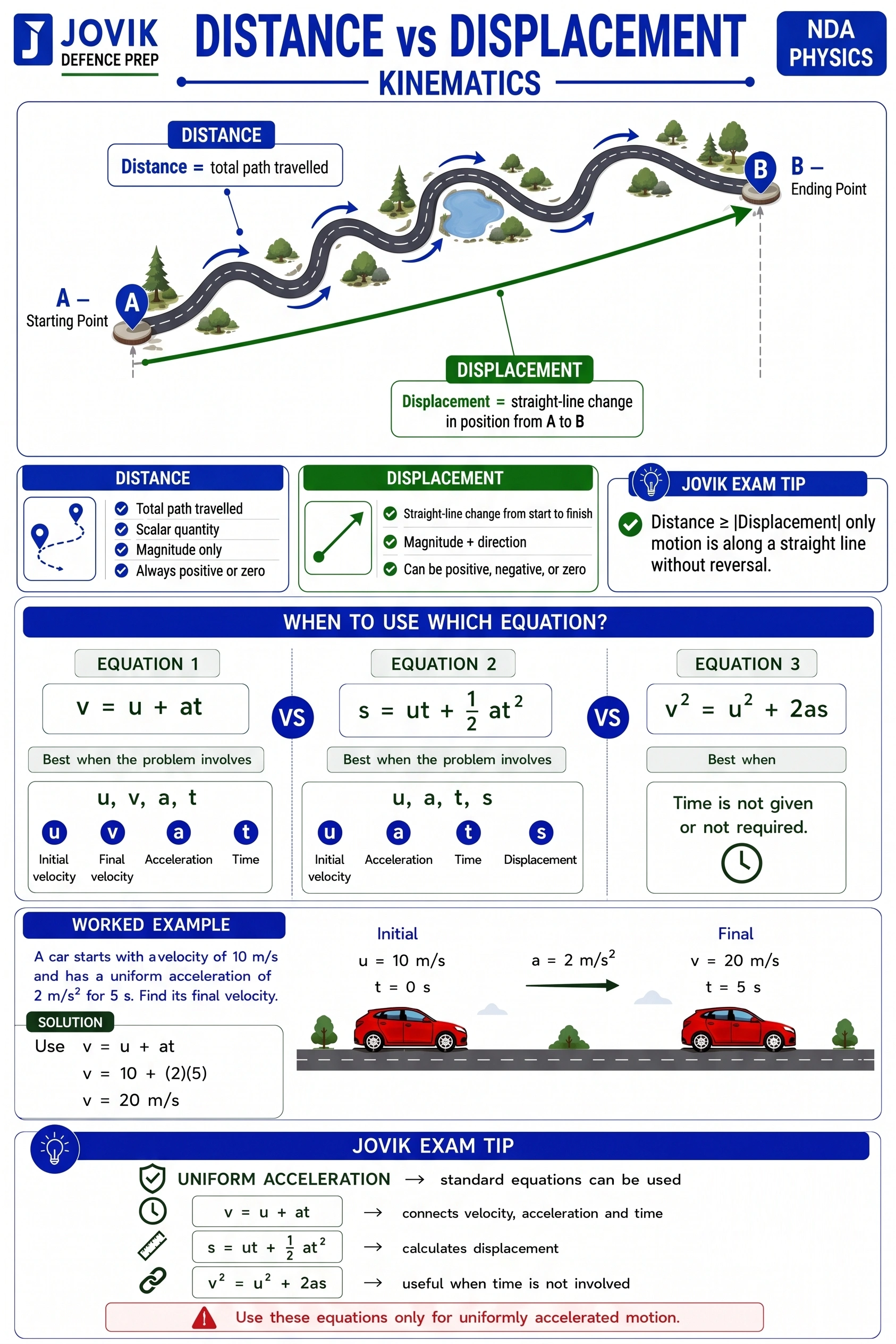
Distance is the total length of the path actually travelled by an object. It does not matter which direction you moved. Distance counts every metre of road, regardless of turns or reversals. Distance is a scalar quantity. It has magnitude only. It is always positive or zero. It can never be negative.
Displacement
Displacement is the straight-line distance from the starting point to the ending point, measured in the direction from start to end. Displacement does not care about the path taken. It only cares about where you started and where you ended. Displacement is a vector quantity. It has magnitude and direction. It can be positive, negative, or zero.
The Key Relationship: Distance vs Displacement
Distance is always greater than or equal to displacement magnitude. Written formally: d ≥ |S⃗|. [NDA 2013-I]
Distance equals displacement only when the entire path is a straight line without any reversal. Distance can never be less than displacement magnitude.
The Round Trip: A Critical NDA Concept
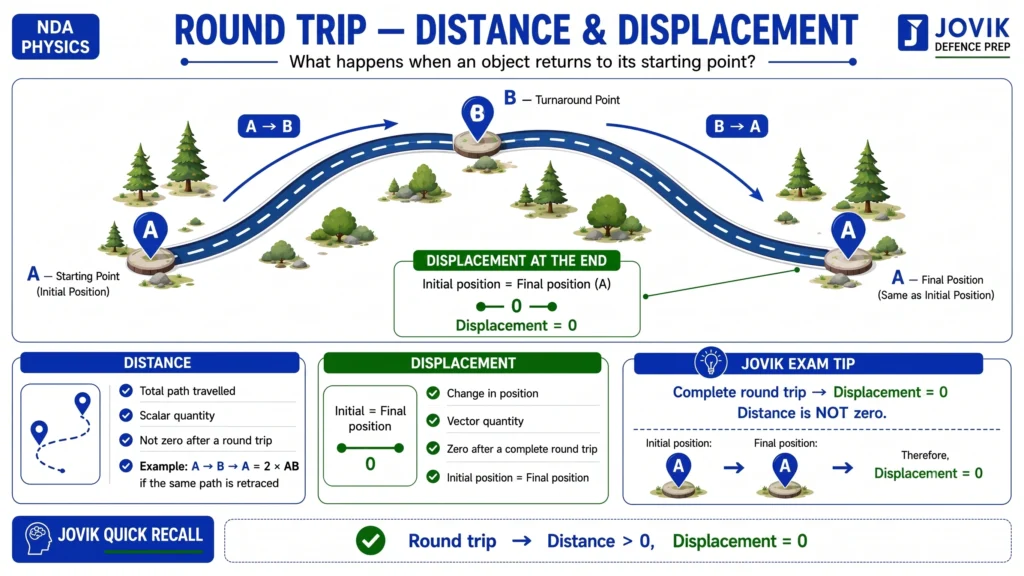
When an object returns to its starting point after any journey, two things are always true. First: the distance covered is the total road travelled, out and back. This is non-zero. Second: the displacement is zero. The object began and ended at the same point. The net shift is nothing.
A car travels 50 km south from Bengaluru and returns to Bengaluru. The time taken is 2 hours. Distance = 100 km. Displacement = 0. Average speed = 100/2 = 50 km/h. Average velocity = 0/2 = 0. [NDA 2019-II]
3. Scalars and Vectors
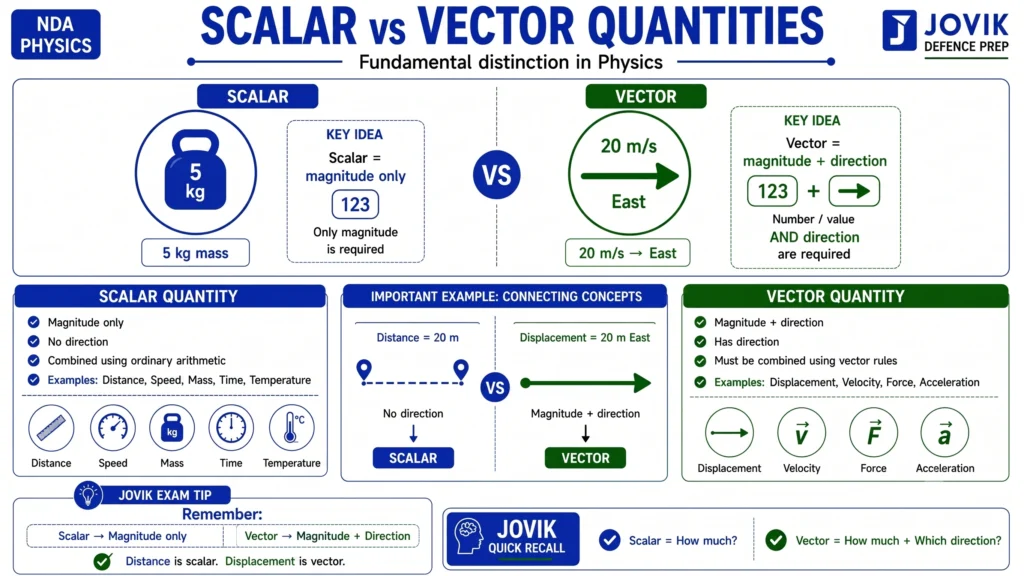
Physical quantities are divided into two types based on whether they have direction.
| Property | Scalar | Vector |
| Definition | Magnitude only | Magnitude + Direction |
| Can be negative? | No (magnitude is always ≥ 0) | Yes (direction gives sign) |
| Examples | Distance, Speed, Mass, Time | Displacement, Velocity, Acceleration, Force |
| How added | Simple arithmetic | By vector rules (head-to-tail or components) |
A body moving in a circle at constant speed has a changing velocity, because direction changes continuously. Constant speed does not mean constant velocity if direction keeps changing. This distinction between scalar speed and vector velocity is one of the most tested concepts in NDA Kinematics.
4. Speed and Velocity
Speed
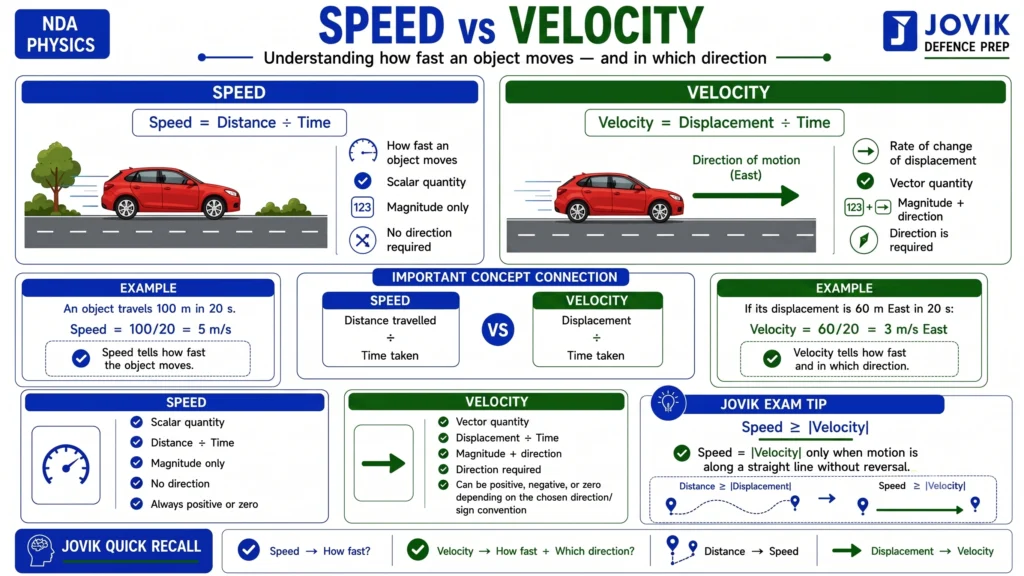
Speed is the rate at which distance is covered.
Speed = Distance / Time
Speed is a scalar quantity. SI unit: m s⁻¹. Speed is always positive or zero. It can never be negative.
Velocity
Velocity is the rate at which displacement changes.
Velocity = Displacement / Time
Velocity is a vector quantity. SI unit: m s⁻¹. Velocity can be positive, negative, or zero, depending on direction. Speed is a scalar. Velocity is a vector. [NDA 2022-II] An object can have constant speed while its velocity changes, if it is turning. An object with zero displacement over a time interval has zero average velocity, even if it was moving the entire time.
5. Average Speed and Average Velocity
For any journey that is not perfectly uniform, we use average values to describe the overall motion.
Average Speed = Total Distance / Total Time
Average Velocity = Total Displacement / Total Time
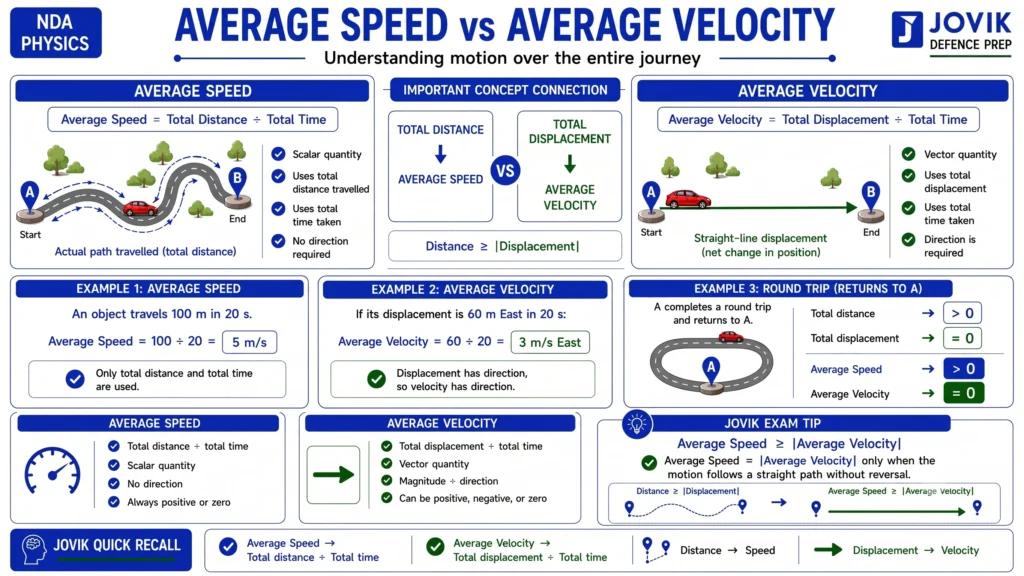
A car records odometer readings of 2000 km at the start and 2400 km at the end of an 8-hour journey. Total distance = 400 km. Total time = 8 h. Average speed = 400/8 = 50 km/h. [NDA 2023-II]
For a round trip: displacement = 0, so average velocity = 0. [NDA 2019-II] Average speed is still non-zero because total distance is non-zero. The two are not the same for any journey involving a change of direction.
| Property | Average Speed | Average Velocity |
| Formula | Total Distance / Total Time | Total Displacement / Total Time |
| Type | Scalar | Vector |
| Round trip value | Non-zero (distance ≠ 0) | Zero (displacement = 0) |
| Can be negative? | No | Yes |
| When equal? | When path is straight, no reversal | Same condition |
6. Relative Velocity
Motion is always observed from somewhere. The same object can appear to move at different speeds depending on who is watching. This is relative velocity.
Relative velocity of A with respect to B: v_rel = v_A − v_B
v_A = velocity of A in a common frame. v_B = velocity of B in the same frame. The result tells you how fast A appears to move when observed from B. SI unit: m s⁻¹.
A man sitting inside a moving train has a speed of 60 km/h relative to the ground. But relative to the train itself, his speed is zero. [NDA 2015-II] He and the train are moving together. No relative motion exists between them.
When two objects move in the same direction, their relative velocity is the difference of their speeds. When they move toward each other, the relative velocity is the sum of their speeds.
7. Uniform Motion
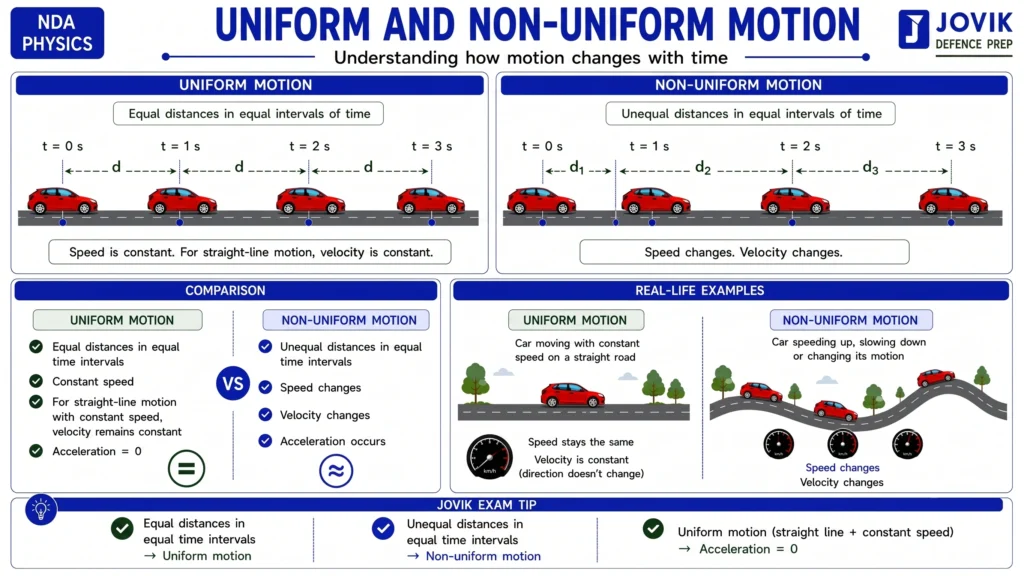
An object is in uniform motion when it covers equal distances in equal intervals of time. Three things are always true for uniform motion: velocity is constant, acceleration is zero, and displacement increases steadily with time.
S = v × t
S = displacement (m). v = constant velocity (m s⁻¹). t = time (s). When S = vt holds, all three conditions of uniform motion are simultaneously satisfied. [NDA 2014-I | NDA 2025-I]
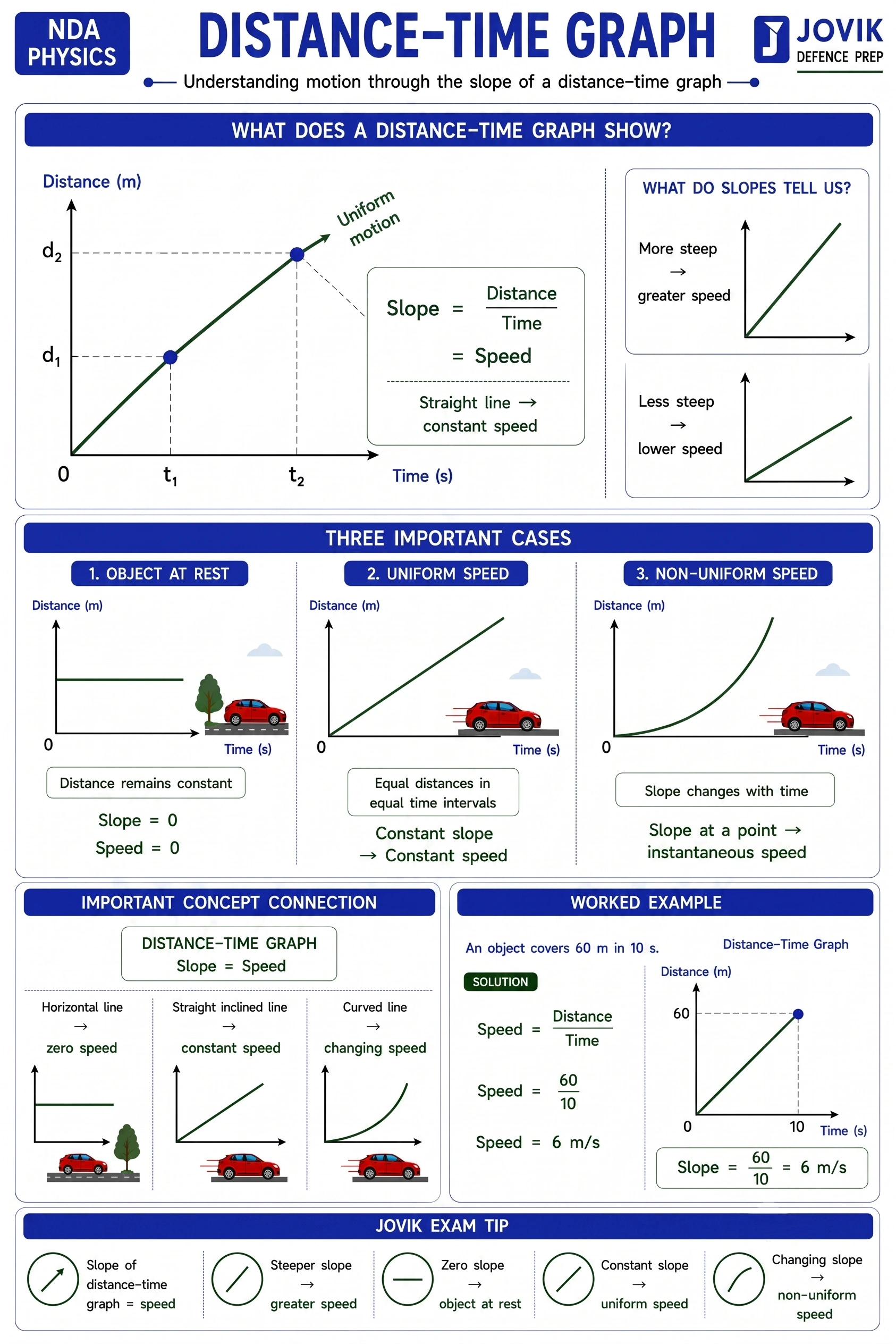
On a displacement–time graph, uniform motion appears as a straight line with non-zero slope. The slope gives the value of velocity. On a velocity–time graph, uniform motion appears as a horizontal straight line, with velocity constant and acceleration zero.
A straight line parallel to the time axis on a displacement–time graph means displacement is not changing. The object is stationary. Velocity = 0. [NDA 2014-II]
8. Non-Uniform Motion and Acceleration
When an object covers unequal distances in equal intervals of time, its velocity is changing. This is non-uniform motion. The rate at which velocity changes is called acceleration.
a = (v − u) / t
a = acceleration (m s⁻²). v = final velocity (m s⁻¹). u = initial velocity (m s⁻¹). t = time taken (s). Acceleration is a vector quantity. Positive acceleration means speeding up. Negative acceleration (deceleration or retardation) means slowing down.
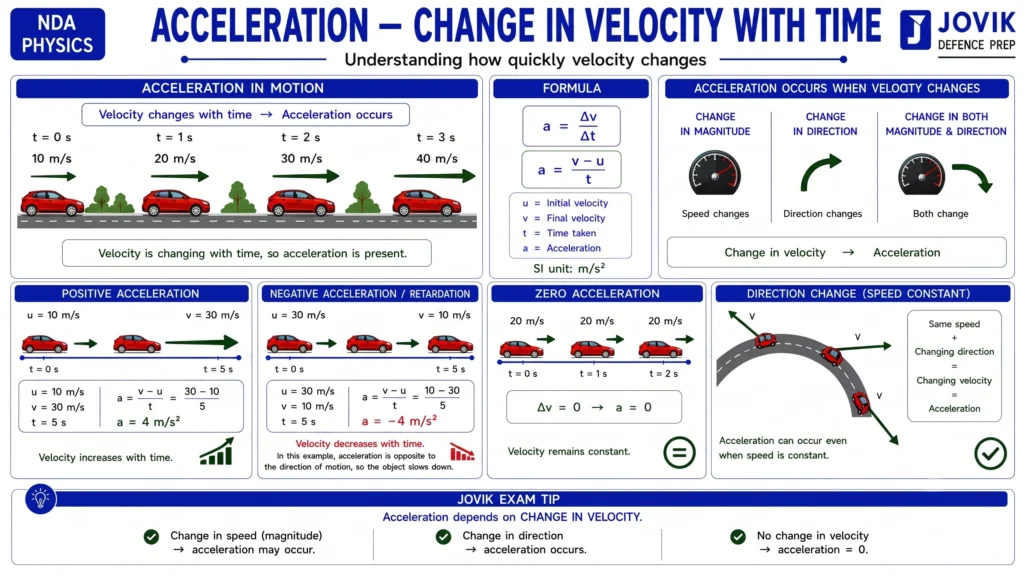
At uniform speed, velocity magnitude does not change, so acceleration = zero. [NDA 2025-I] This is true only if the direction is also unchanged (straight-line motion).
| Property | Uniform Motion | Non-Uniform Motion |
| Speed | Constant | Changing |
| Velocity | Constant (magnitude + direction) | Changing (magnitude or direction or both) |
| Acceleration | Zero | Non-zero |
| x–t graph shape | Straight line | Curve (parabola for constant acceleration) |
| v–t graph shape | Horizontal line | Sloped line (straight if acceleration is constant) |
A car with speed readings 0, 2, 4, 6, 8 m/s at 0, 1, 2, 3, 4 seconds shows uniform acceleration of 2 m/s². Distance in 4 s = ½ × 2 × 16 = 16 m. Average speed = (0 + 8)/2 = 4 m/s. [NDA 2017-I]
9. Equations of Motion
When acceleration is constant, three standard equations connect initial velocity, final velocity, acceleration, time, and displacement. A fourth equation handles the special case of distance in a specific second. These equations apply only when acceleration is constant and motion is along a straight line.
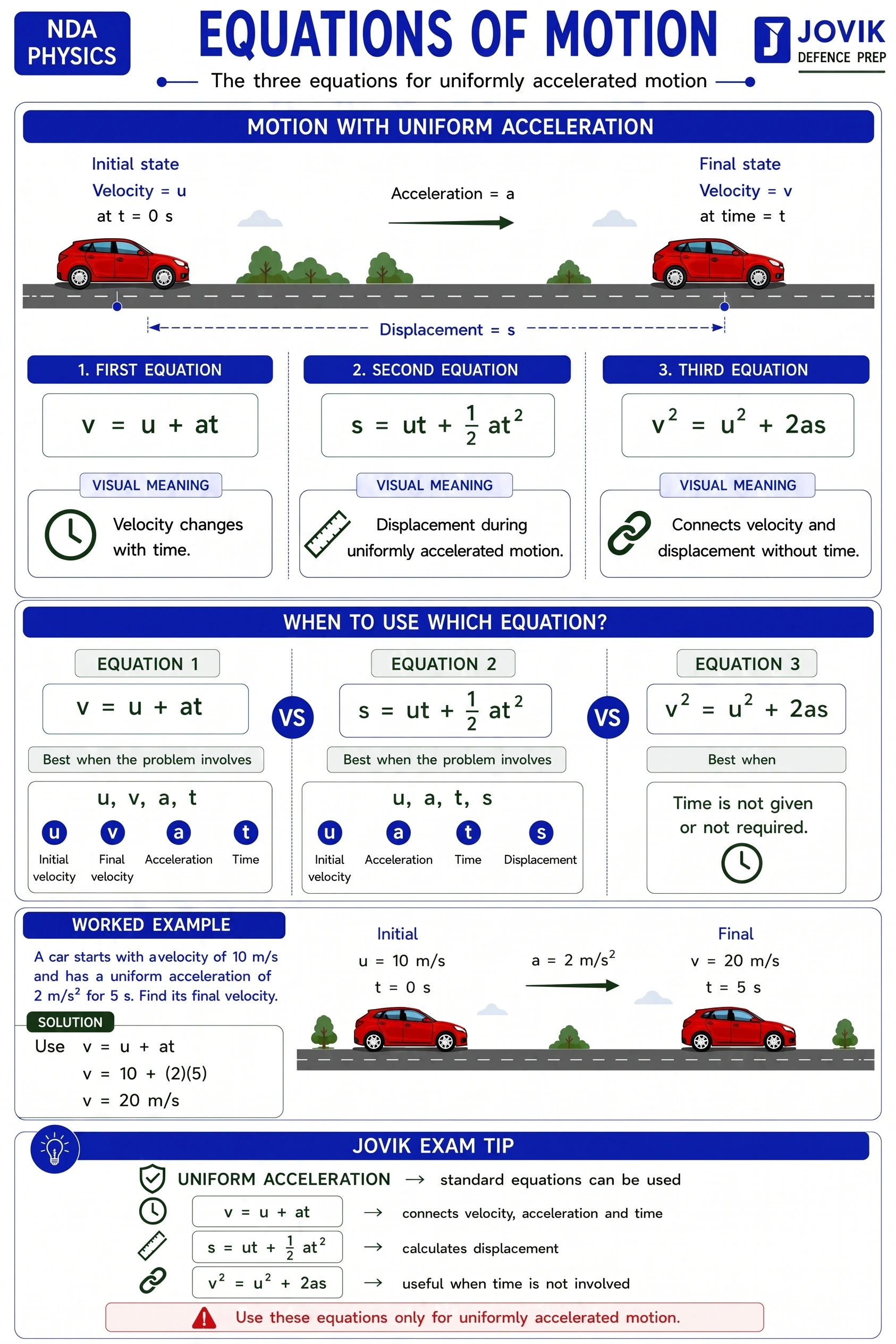
First Equation: v = u + at
Acceleration is the rate of change of velocity. Rearranging a = (v − u)/t directly gives the first equation.
v = u + at
v = final velocity (m s⁻¹). u = initial velocity (m s⁻¹). a = acceleration (m s⁻²). t = time elapsed (s).
On a velocity–time graph, this equation is a straight line. The y-intercept is u (initial velocity). The slope is a (acceleration). The line does not pass through the origin unless u = 0. [NDA 2018-I | NDA 2022-II | NDA 2023-II]
Second Equation: s = ut + ½at²
Displacement equals the area under a velocity–time graph. For a straight-line v–t graph, the area is a trapezium. Calculating that area gives the second equation.
s = ut + ½at²
s = displacement (m). u = initial velocity (m s⁻¹). a = acceleration (m s⁻²). t = time (s). Under a constant force, acceleration is constant. With initial velocity u, displacement grows as t², producing a parabola on the displacement–time graph. [NDA 2015-I]
Third Equation: v² = u² + 2as
This equation connects velocity and displacement directly, without needing time.
v² = u² + 2as
v = final velocity. u = initial velocity. a = acceleration. s = displacement. Note: v² − u² = 2as is the correct form. The form u² − v² = 2as is wrong. It reverses the sign. [NDA 2025-I]
A car with initial velocity 12 m/s is brought to rest (v = 0) over 45 m. From v² = u² + 2as: 0 = 144 + 2a(45). So a = −1.6 m/s². The negative sign confirms deceleration. [NDA 2025-I]
Fourth Equation: Distance in the nᵗʰ Second
This formula gives the distance covered in one specific second, not from the start, but during that single second.
sₙ = u + ½a(2n − 1)
sₙ = distance covered during the nᵗʰ second (m). u = initial velocity. a = acceleration. n = the second number. This formula gives the distance in that one second only, not the total distance from the start. [NDA 2025-I]
| Equation | What It Gives | Useful When |
| v = u + at | Final velocity after time t | Time is known, displacement not needed |
| s = ut + ½at² | Displacement after time t | Time is known, final velocity not needed |
| v² = u² + 2as | Velocity after displacement s | Time is unknown |
| sₙ = u + ½a(2n − 1) | Distance in the nᵗʰ second only | Specific second’s distance needed |
Average Velocity for Equal Distances
When a particle moves with uniform acceleration over two equal distances, the correct formula for overall average velocity uses the harmonic mean, not the arithmetic mean.
v̄ = 2v₁v₂ / (v₁ + v₂)
v₁ = average velocity over first segment. v₂ = average velocity over second segment. This applies only when the distances are equal, not the time intervals.
If average velocity A to B is 10 m/s and B to C is 15 m/s (with AB = BC): v̄ = 2(10)(15)/(10+15) = 300/25 = 12 m/s. [NDA 2014-II]
10. Graphical Interpretation of Motion
Graphical interpretation of motion is the highest-frequency topic in NDA Kinematics, with more than twelve PYQs. Understanding every graph type is essential.
The Displacement–Time (x–t) Graph
On a displacement–time graph, time is on the horizontal axis and displacement is on the vertical axis. The slope of the graph at any point gives the velocity at that instant.
Slope of x–t graph = velocity
Straight line, non-zero slope → uniform velocity (constant slope = constant speed). [NDA 2013-I]
Horizontal line → stationary. Displacement not changing. Velocity = 0. [NDA 2014-II]
Upward curve (parabola) → velocity increasing. Acceleration present. [NDA 2011-II | NDA 2015-I]
Under a constant force, acceleration is constant and the x–t graph is a parabola, not a straight line. [NDA 2015-I]
The Time–Position (t–x) Graph
Some NDA questions plot time on the vertical axis and position on the horizontal axis. The axes are swapped. On such a graph, the slope = Δt/Δx = 1/velocity. A steeper line means slower motion.
When three objects A, B, C are plotted on a t–x graph, the one with the smallest slope (most horizontal line) has the highest speed. [NDA 2019-I]
The Velocity–Time (v–t) Graph
On a velocity–time graph, time is on the horizontal axis and velocity is on the vertical axis.
Slope of v–t graph = acceleration
Area under v–t graph = displacement
Positive slope → acceleration (object speeding up). [NDA 2019-I]
Negative slope (downward) → retardation (object slowing down). [NDA 2015-II]
Horizontal line → zero acceleration (uniform velocity).
Shaded area under the v–t graph represents displacement, not distance, not speed, not momentum. [NDA 2010-II]
The equation v = u + at traces a straight line on the v–t graph. The y-intercept is u (where the line starts when t = 0). The slope is a (the gradient). [NDA 2018-I | NDA 2023-II] If u ≠ 0, the line does not pass through the origin.
Average acceleration over a time interval = Δv/Δt. This is the slope of the v–t graph over that interval. A negative result confirms deceleration. [NDA 2018-II]
Skydiver Speed–Time Profile
A skydiver accelerates under gravity from the moment of jumping. As speed increases, air resistance also increases. Eventually, air resistance equals gravity and net force becomes zero. At that point, the skydiver reaches terminal velocity, a constant maximum speed.
The speed–time graph of a skydiver shows a curve that rises steeply then flattens asymptotically to a horizontal line at terminal velocity. It is not a straight line. [NDA 2024-II]
Uniform Circular Motion : Displacement Along One Axis
An object moving in a circle at constant speed traces a circular path. If we measure only the x-component of its position over time, that component varies as a sine or cosine function, producing a smooth wave on the x–t graph.
The displacement along any single axis from a uniform circular motion graphs as a sinusoidal curve, not a straight line, not a parabola. [NDA 2012-I]
| ★ IMPORTANT GRAPHICAL SUMMARY: Slope and Area Rules: Slope of x–t graph = velocity | Slope of v–t graph = acceleration Area under v–t graph = displacement [NDA 2010-II] These three rules are tested repeatedly. They cannot be swapped. |
11. Free Fall and Motion Under Gravity
When no force except gravity acts on an object, it is in free fall. Gravity pulls every object downward with the same acceleration.
g = 9.8 m s⁻² ≈ 10 m s⁻² (directed downward)
The direction is always downward. The magnitude does not depend on the mass, size, shape, or material of the object.
Mass Independence in Free Fall
In vacuum, all objects fall with exactly the same acceleration g. A five-rupee coin, a feather, and a mango dropped simultaneously from the same height reach the ground at the same time. [NDA 2012-II | NDA 2017-II] In air, a feather falls more slowly because air resistance affects it more relative to its weight. But in vacuum, there is no air resistance, so all objects fall identically.
Equal Acceleration, Unequal Everything Else
Two objects of unequal masses dropped from the same height have equal acceleration (both have g) at every instant during free fall. [NDA 2025-I]
They do not have equal momentum, because momentum = mv and masses differ. They do not have equal kinetic energy, because KE = ½mv² and masses differ. They do not have equal potential energy, because PE = mgh and masses differ. Only acceleration is equal. Everything else differs.
| ★ IMPORTANT In free fall: ALL objects have EQUAL acceleration (g). [NDA 2025-I] Momentum, kinetic energy, and potential energy all DIFFER for objects of different masses. Only acceleration is mass-independent. |
Equations of Free Fall
For an object released from rest (u = 0) and falling a height h:
s = ½gt² (height fallen in time t)
v = gt (velocity after falling for time t)
v = √(2gh) (velocity after falling height h)
s = height fallen (m). g = 9.8 m s⁻². t = time (s). v = velocity at that point (m s⁻¹).
12. Vertical Projection
When an object is thrown straight upward, it decelerates at rate g, stops momentarily at maximum height, then accelerates back downward at g.
Time to Reach Maximum Height
At maximum height, the ball stops momentarily. Its velocity becomes zero. Using v = u − gt with v = 0:
0 = u − gt → t = u / g
t = time to reach maximum height (s). u = initial upward velocity (m s⁻¹). g = 9.8 m s⁻².
For u = 25.2 m/s: t = 25.2/9.8 ≈ 2.57 s. [NDA 2016-II] | For u = 40 m/s: t = 40/10 ≈ 4 s. [NDA 2022-I] | For u = 80 m/s: t = 80/10 = 8 s. [NDA 2014-II]
| ★ IMPORTANT At maximum height: velocity = 0. [NDA 2011-II] The expression u²/(2g) gives the MAXIMUM HEIGHT reached, not the velocity at that point. Final velocity at maximum height is ALWAYS zero. |
Maximum Height Reached
h = u² / (2g)
h = maximum height above launch point (m). u = initial upward velocity (m s⁻¹). g = 9.8 m s⁻². For a tennis ball reaching maximum height 20 m: 20 = u²/20, so u² = 400, giving u = 20 m/s. [NDA 2021-II]
Vertical Projection from a Height
A bullet fired upward from the top of a 400 m tower at 80 m/s (g = 10 m/s²): it rises to 320 m above the tower, then falls a total of 720 m to the ground. Setting up s = ut − ½gt² with s = −400 m (ground level relative to launch point): −400 = 80t − 5t². Solving gives t = 20 s. [NDA 2014-II]
Two Bodies in Vertical Collision
Ball A thrown upward from ground at 20 m/s; Ball B thrown downward from 40 m height at 20 m/s simultaneously. Relative velocity = 20 + 20 = 40 m/s (approaching). Both experience the same g, so g cancels in relative motion. Relative velocity stays constant at 40 m/s. Time to meet = 40 m ÷ 40 m/s = 1 s. Height of A at t = 1 s: h = 20(1) − ½(9.8)(1) ≈ 15.1 m. [NDA 2016-II]
13. Projectile Motion
When an object is given a velocity and then moves under gravity alone, it follows a curved path called a trajectory. The key principle: horizontal and vertical motions are completely independent. Gravity acts only downward. It does not affect horizontal motion at all.
Horizontal Projectile (Thrown from a Height)
An object thrown horizontally from height h has zero initial vertical velocity. Gravity pulls it downward while it moves horizontally at constant speed.
Time to reach ground: t = √(2h/g)
Horizontal Range: R = u × t
h = height of launch (m). g = acceleration due to gravity. u = horizontal speed (m s⁻¹). t = time of flight (s).
A stone thrown horizontally from a 20 m building at 12 m/s: t = √(2 × 20/10) = √4 = 2 s. Range = 12 × 2 = 24 m. [NDA 2023-I]
Projectile at an Angle
When an object is launched at angle θ above the horizontal with initial speed u, its velocity has two components: horizontal = u cos θ, vertical = u sin θ.
Time of flight: T = 2u sin θ / g
Maximum height: H = u² sin²θ / (2g)
Horizontal range: R = u² sin 2θ / g
Range is maximum when θ = 45°. Two complementary angles (e.g. 30° and 60°) give the same range for the same initial speed.
Minimum Velocity for the Staircase
A ball launched horizontally from the top of a staircase with 5 steps : each 10 cm high and 10 cm wide (g = 10 m s⁻²). The ball must reach the lowest step without hitting any intermediate step. Setting up: vertical fall 0.5 m, t = √ (2 × 0.5/10) = √0.1 s. Horizontal: R = u × √0.1. For R ≥ 0.5 m: u ≥ 0.5/√0.1 = 1 m/s. [NDA 2012-II]
14. Special Applications
Motion on an Inclined Plane
On a smooth inclined plane at angle θ to the horizontal, the component of gravity along the slope is g sin θ. An object released from rest accelerates down the slope at this rate.
a = g sin θ
a = acceleration along the slope (m s⁻²). g = 9.8 m s⁻². θ = angle between slope and horizontal.
A ball released from rest covers 100 cm in 4 s on an inclined plane. a = 2s/t² = 2(100)/16 = 12.5 cm s⁻². g sin θ = 12.5, giving sin θ = 12.5/1000 = 1/80. So θ = sin⁻¹ (1/80). [NDA 2018-II]
Mach Number and Supersonic Motion
Mach number is the ratio of an object’s speed to the speed of sound in the same medium. Mach number is dimensionless. It has no unit. The speed of sound in air at room conditions is approximately 332 m/s.
Mach number = Speed of object / Speed of sound
| Mach Number | Speed Category | Description |
| < 1 | Subsonic | Slower than sound |
| = 1 | Sonic | Exactly at speed of sound |
| > 1 | Supersonic | Faster than sound |
| > 5 | Hypersonic | Much faster than sound |
A jet flying at Mach 2 with speed of sound = 332 m/s has airspeed = 2 × 332 = 664 m/s. [NDA 2011-I]
An object with Mach number greater than 1 is moving at supersonic speed. [NDA 2017-I] Supersonic flight produces shock waves not present at subsonic speeds.
15. Motion in One and Two Dimensions
Coordinates Needed to Describe Motion
The number of coordinates needed to describe an object’s position equals the number of dimensions of its motion. An ant constrained to move on a thin circular wire can only move forward or backward along the wire. Its position is completely described by one coordinate, such as the arc length from a reference point, or the angle from a fixed direction. [NDA 2013-I] Despite the wire being circular, the motion is one-dimensional because the ant has only one degree of freedom.
Displacement Vector Components
A particle’s displacement is given as: x⃗ = aî + btĵ + (c/2)t²k̂
The x-component (aî) has no time dependence, so position along x is fixed. The y-component (btĵ) is linear in t, meaning constant velocity b along y. The z-component ((c/2)t²k̂) is quadratic in t, giving constant acceleration c along z. The particle is uniformly accelerated in the k̂-direction only. [NDA 2013-I]
Perpendicular Displacements
When an object moves in two perpendicular directions, the net displacement is found by the Pythagorean theorem, not simple addition.
Net displacement = √(d₁² + d₂²)
A vehicle moves 100 m east, then 400 m south. Net displacement = √(100² + 400²) = √170000 ≈ 412 m (at an angle south-east). [NDA 2024-II]
Important Distinctions
Distance vs Displacement
Distance is the total path length: always positive, scalar. Displacement is the net shift from start to finish: can be zero or negative, vector. For any motion: distance ≥ |displacement|.
Speed vs Velocity
Speed is scalar: magnitude of how fast an object moves. Velocity is vector: how fast and in which direction. Speed is always non-negative. Velocity can be negative. You can have constant speed with changing velocity (circular motion).
Average Speed vs Average Velocity
Average speed = total distance / total time. Always non-negative. Average velocity = total displacement / total time. For any round trip, average velocity = 0 regardless of the speed or path. They are numerically equal only for straight-line motion without reversal.
Slope of x–t vs Slope of v–t
Slope of a displacement–time graph = velocity. Slope of a velocity–time graph = acceleration. These are not interchangeable. The slope of x–t gives velocity. The slope of v–t gives acceleration.
Area under v–t vs Distance
Area under a velocity–time graph = displacement (not distance). If the object reverses direction, the area below the time axis represents displacement in the opposite direction. Total distance is the sum of absolute areas above and below the axis.
Quick Revision
Distance and Displacement
- Distance = total path length — scalar, always ≥ 0
- Displacement = straight-line shift from start to end: vector, can be 0 or negative
- d ≥ |S⃗| always [NDA 2013-I]
- Round trip: displacement = 0, average velocity = 0 [NDA 2019-II]
Speed and Velocity
- Speed = scalar, always ≥ 0 | Velocity = vector, can be negative [NDA 2022-II]
- Average speed = total distance / total time
- Average velocity = total displacement / total time
- Person at rest in moving train: speed relative to train = 0 [NDA 2015-II]
Equations of Motion (uniform acceleration, straight line only)
- v = u + at | y-intercept = u, slope = a on v–t graph [NDA 2018-I | NDA 2022-II]
- s = ut + ½at² | displacement–time graph is a parabola under constant acceleration [NDA 2015-I]
- v² = u² + 2as | note: v² − u² = 2as is correct; u² − v² form is wrong [NDA 2025-I]
- sₙ = u + ½a(2n − 1) | distance in the nᵗh second only, not from start [NDA 2025-I]
- Deceleration: car u = 12 m/s to rest in 45 m → a = −1.6 m/s² [NDA 2025-I]
- Average velocity for equal distances: v̄ = 2v₁v₂/(v₁ + v₂) [NDA 2014-II]
Graphical Interpretation
- Slope of x–t graph = velocity | Slope of v–t graph = acceleration
- Area under v–t graph = displacement [NDA 2010-II]
- Straight line on x–t = uniform velocity | Horizontal on x–t = stationary [NDA 2013-I | NDA 2014-II]
- Parabola on x–t = constant acceleration present [NDA 2011-II | NDA 2015-I]
- Negative slope on v–t = retardation [NDA 2015-II | NDA 2019-I]
- v = u + at: y-intercept = u, slope = a: line NOT through origin if u ≠ 0 [NDA 2018-I | NDA 2023-II]
- Skydiver: rising curve → flattens to terminal velocity [NDA 2024-II]
- Circular motion displacement along one axis → sinusoidal curve [NDA 2012-I]
Free Fall and Vertical Projection
- All objects fall at g in vacuum: mass does not matter [NDA 2012-II | NDA 2017-II]
- Two unequal masses dropped: equal acceleration: NOT equal momentum, KE, or PE [NDA 2025-I]
- Time to max height: t = u/g [NDA 2016-II | NDA 2022-I]
- Max height: h = u²/(2g) [NDA 2021-II]
- At max height: velocity = ZERO (not u²/2g: that is height, not velocity) [NDA 2011-II]
- Tower problem (u = 80 m/s, h = 400 m): time to ground = 20 s [NDA 2014-II]
Projectile Motion
- Horizontal and vertical motions are independent
- Horizontal projectile from height h: t = √(2h/g), R = ut [NDA 2023-I]
- Stone from 20 m building at 12 m/s: R = 24 m [NDA 2023-I]
- Max range at 45° | Complementary angles give equal range
- Minimum horizontal velocity over staircase = 1 m/s [NDA 2012-II]
Special Applications
- Inclined plane: a = g sin θ | sin θ = 1/80 from NDA problem [NDA 2018-II]
- Mach number = object speed/speed of sound [NDA 2011-I | NDA 2017-I]
- Mach 2 at 332 m/s sound speed → airspeed = 664 m/s [NDA 2011-I]
- Mach > 1 = supersonic [NDA 2017-I]
Kinematics Previous Year Questions
Practice NDA previous-year questions from the Kinematics chapter with detailed solutions and important tips.