Free NDA 2026 Preparation Guide
View Strategy

Making of the Constitution – NDA Polity Notes
Exam Relevance: High Frequency · GOI Act 1935 · August Offer · Cabinet Mission · Drafting Committee · B.N. Rau
Reading Time: 30–35 minutes | Last Updated: 2026
The Indian Constitution did not appear overnight. It was the product of a long constitutional journey, one that stretched over more than two centuries of colonial rule, through a series of British legislative experiments, and finally through nearly three years of intensive debate inside the Constituent Assembly. Understanding this journey is the purpose of this chapter.
This chapter is about how the Constitution came into existence. It is not about what it contains. You are studying the making of a document, not its provisions. Every event you learn here is part of one continuous chain: each colonial Act created the conditions for the next; each British proposal built on the one before; and finally, the Constituent Assembly and its Drafting Committee brought the entire process to completion.
For NDA, this chapter has a distinctive testing pattern. Questions focus on who was (and who was NOT) part of the Drafting Committee, what the Cabinet Mission Plan actually proposed, which document first conceded Indian constitutional responsibility, and what the Government of India Act 1935 introduced. Negation-type questions are especially common here. Pay attention throughout to what each proposal did NOT do, and who did NOT hold each role.
1. Pre-1935 Constitutional Milestones
To understand why the Government of India Act 1935 was so significant, you need to understand what came before it. British India did not suddenly acquire a comprehensive constitutional framework. It arrived there slowly, through a series of Acts, each one a cautious, incremental step toward self-governance.
The process began in 1773 with the Regulating Act, the first attempt by the British Parliament to bring some governmental order to the East India Company’s activities in India. From there, each major Act responded to the limitations of the one before it. By 1935, this accumulated legislative experience produced the most comprehensive colonial constitutional instrument India had ever seen.
| Act / Year | Key Provision |
| Regulating Act, 1773 | First Parliamentary control over East India Company; created the Governor-General of Bengal; established the Supreme Court at Calcutta |
| Pitt’s India Act, 1784 | Dual control: Board of Control (British government) + Court of Directors (Company); distinguished political from commercial functions |
| Charter Act, 1833 | Governor-General of Bengal became Governor-General of India; began centralisation; first step toward an all-India administration |
| Government of India Act, 1858 | Crown’s direct rule replaced Company rule after 1857 revolt; Secretary of State for India created; Viceroy replaced Governor-General |
| Indian Councils Act, 1861 | Legislative councils expanded; Indians nominally included; foundation of legislative devolution |
| Indian Councils Act, 1909 (Morley-Minto Reforms) | Separate communal electorates for Muslims introduced; enlarged legislative councils; element of association for Indians in governance |
| Government of India Act, 1919 (Montagu-Chelmsford Reforms) | Introduced dyarchy in provinces; divided provincial subjects into transferred (Indian ministers) and reserved (British control); bicameral central legislature created |
| Government of India Act, 1935 | Most comprehensive colonial constitutional instrument; provincial autonomy; proposed All-India Federation; Federal Court; became primary source of the Indian Constitution |
The most important of these milestones for NDA purposes is the 1919 Act. It introduced dyarchy, a system of dual governance in the provinces. Under dyarchy, certain provincial subjects were transferred to elected Indian ministers (education, health, agriculture), while others remained reserved under British-controlled officials (finance, law and order). Dyarchy was an important but limited experiment in Indian self-rule. It was important enough to be tested as a named concept, yet limited enough that it failed and was replaced by the far more significant 1935 Act.
| ★ IMPORTANT: The 1919 Act introduced dyarchy, meaning limited Indian self-governance at the provincial level. The 1935 Act superseded it with full provincial autonomy and became the primary source of the Indian Constitution. |
2. Government of India Act 1935
The Government of India Act 1935 was the culmination of more than 150 years of British constitutional experimentation in India. It was the most comprehensive, most detailed, and most consequential piece of legislation Britain ever applied to India. And it was directly and heavily borrowed by the framers of the Indian Constitution of 1950, making it the single most important source of the Indian Constitution.
The 1935 Act introduced three transformative provisions. All three were confirmed by NDA: [NDA 2011-II]
| Provision | What It Meant | What Happened To It |
| Provincial Autonomy | Provinces could govern themselves in defined areas without central interference; elected provincial governments formed | Fully operationalised from 1937; provinces ran their own governments |
| All-India Federation | Proposed a union of British Indian provinces and Princely States under a federal structure | Never came into force : the Princely States did not accede to the proposed federation |
| Federal Court | An apex judicial authority for the proposed federation, to hear constitutional disputes | Established and operational; became the precursor to the Supreme Court of India in 1950 |
A critical point that NDA has tested: all three provisions were contained in the 1935 Act. However, they were not all implemented. Provincial autonomy was operationalised from 1937, and the Federal Court was established. But the proposed All-India Federation never came into force, because the Princely States refused to accede to it. The federation remained a proposal on paper. [NDA 2011-II]
The Indian Constitution of 1950 drew heavily from the 1935 Act, particularly its federal structure, emergency provisions, distribution of legislative powers, system of all-India services, and the office of Governor. Ambedkar himself acknowledged this debt. The 1935 Act was not just a piece of colonial legislation; it was a constitutional blueprint that India adapted and expanded for its own democratic purposes.
| ★ IMPORTANT: GOI Act 1935: Provincial autonomy (implemented) | All-India Federation (proposed, never came into force) | Federal Court (established). All three were in the Act, but not all three were realised. [NDA 2011-II] |
3. British Proposals: The Progressive Sequence
The Government of India Act 1935 gave India a constitutional framework, but it still kept ultimate constitutional authority with the British government. The question of who would actually frame a new Constitution for independent India remained unanswered. Between 1940 and 1946, the British made three formal proposals on this question, each one more specific and more consequential than the last.
These three proposals are not separate historical facts to memorise in isolation. They form a progressive sequence. Each one became necessary because the one before it fell short. Understanding why each proposal was made (and why it succeeded or failed) is exactly what NDA tests when it asks chronological-priority questions.
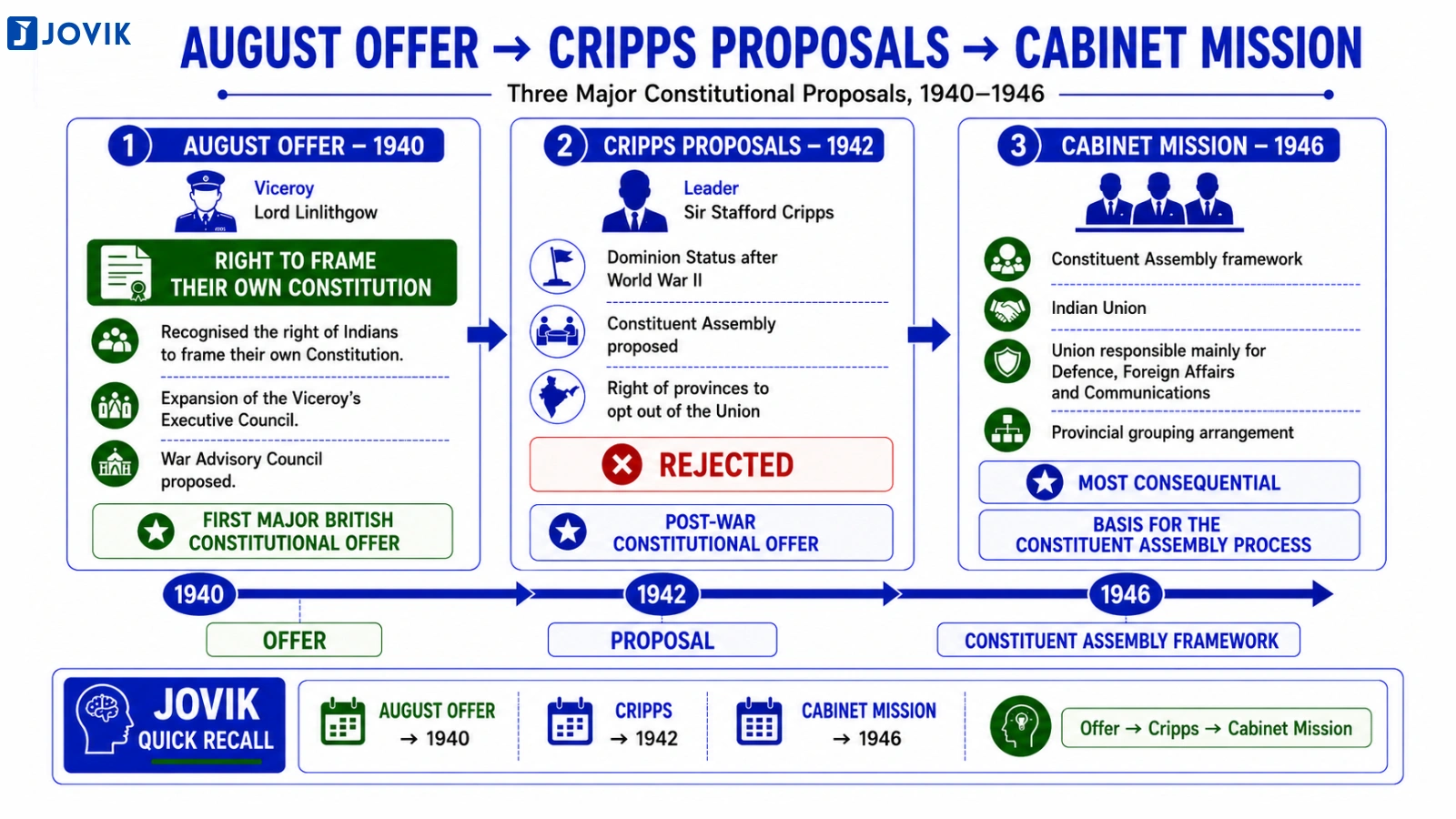
The August Offer, 1940
By 1940, India was drawn into the Second World War without its own consent. Indian political leaders demanded a clear British commitment on India’s constitutional future in exchange for wartime cooperation. Viceroy Lord Linlithgow responded with the August Offer of 1940.
The August Offer made a landmark concession: the principle that Indians themselves should be primarily (though not solely) responsible for framing the Constitution of independent India. [NDA 2020-I & II]
This was the first time the British government formally acknowledged that Indians, not the British Parliament, should be the primary authors of their own Constitution. The Cripps Proposals (1942) and the Cabinet Mission Plan (1946) would later elaborate on this principle with greater specificity and institutional detail. But the historical credit for the first concession belongs to the August Offer of 1940. Students who know the Cabinet Mission’s institutional importance often mistakenly credit it as the origin of this principle. That is incorrect. [NDA 2020-I & II]
The Cripps Proposals, 1942
The August Offer was a vague concession of principle without specifying constitutional machinery. By 1942, the war situation had worsened. Japan had entered the conflict and was advancing toward India’s borders. Britain needed active Indian cooperation and sent Sir Stafford Cripps to negotiate.
The Cripps Proposals went further than the August Offer. They offered India Dominion Status after the war, proposed a constituent assembly to frame the new Constitution, and included the right of provinces and Princely States to opt out of the new union, the right of non-accession.
But the Cripps Proposals failed. The Indian National Congress rejected them primarily because they did not offer immediate self-governance and because the right of non-accession threatened national unity. The Muslim League rejected them for different reasons. With both major political parties opposed, Cripps left India without agreement.
The Cabinet Mission Plan, 1946
By 1946, Britain had emerged from the war exhausted and had elected a Labour government committed to granting India independence. Three Cabinet ministers, namely Lord Pethick-Lawrence, Sir Stafford Cripps, and A.V. Alexander were sent to India. This mission became the most consequential constitutional initiative in the final phase of British India.
The Cabinet Mission Plan directly established the framework under which the Constituent Assembly would be formed. Unlike the August Offer’s vague principle or the Cripps Proposals’ conditional offer, the Cabinet Mission produced a concrete mechanism for constitution-making , one that was actually implemented.
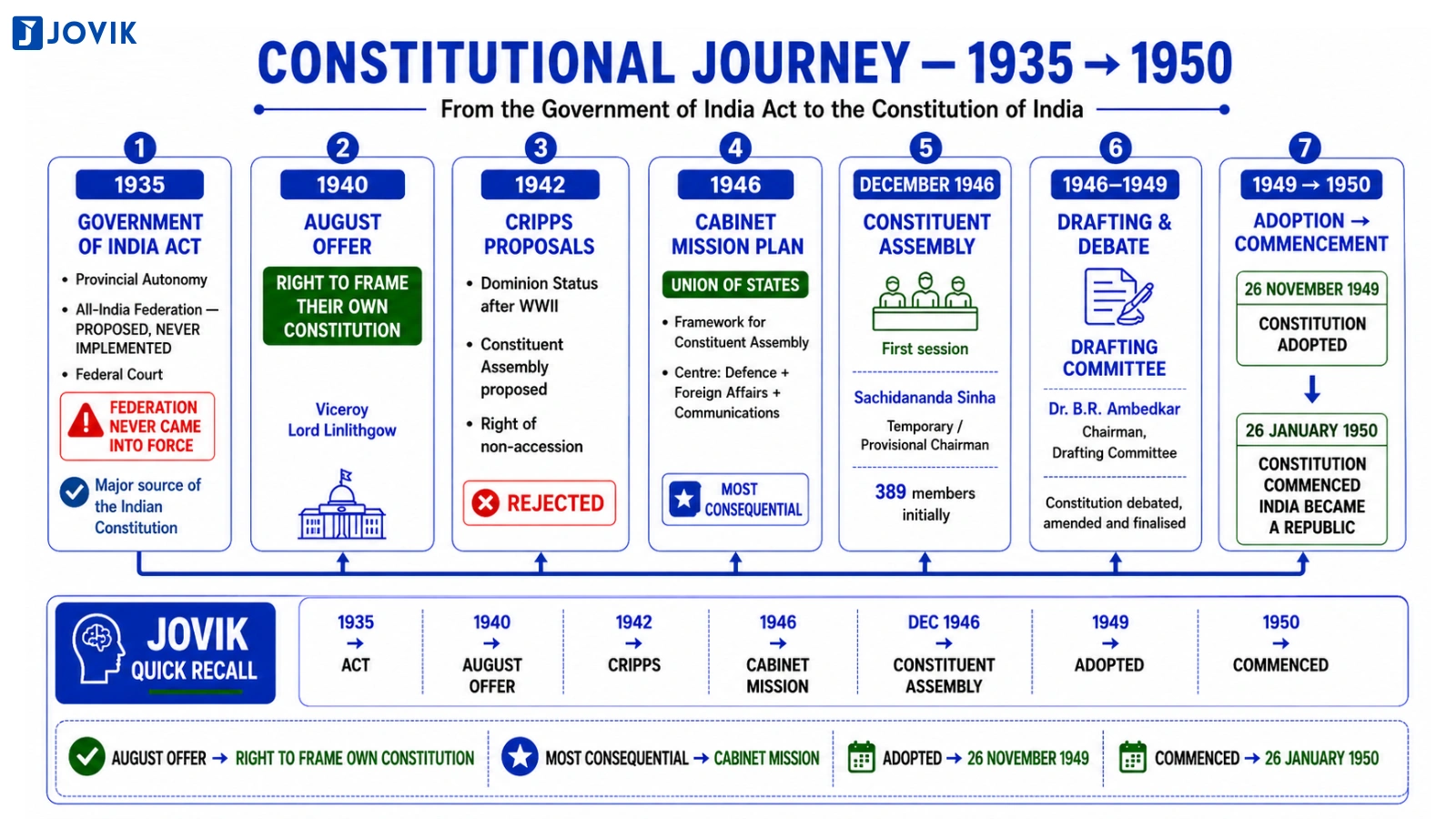
| Proposal / Act | What It Offered | Constitutional Significance |
| GOI Act, 1935 | Provincial autonomy; proposed federation; Federal Court | Most comprehensive colonial legislation; primary source of the Indian Constitution; federation never realised |
| August Offer, 1940 (Linlithgow) | Expanded Executive Council; promise of constitutional body after war; Indians primarily responsible for own Constitution | FIRST concession that Indians should primarily frame their own Constitution: the key NDA-tested fact [NDA 2020-I & II] |
| Cripps Proposals, 1942 | Dominion Status after WWII; constituent assembly; right of non-accession | Specified constitutional machinery more clearly; rejected by both Congress and League; no lasting institutional result |
| Cabinet Mission Plan, 1946 | Union of States; three-tier structure; Constituent Assembly framework | Most consequential proposal; directly established the Constituent Assembly; led to constitution-making |
| ★ IMPORTANT: The four proposals form a progression: each one built on the one before. The August Offer was first. The Cabinet Mission was most consequential. |
4. Cabinet Mission Plan 1946: Structural Detail
The Cabinet Mission Plan deserves closer attention than the other proposals. Not just because it was the most consequential, but because NDA has directly tested its structural concept. The question “what did the Cabinet Mission plan envisage?” has one very specific answer, and it is not the answer most students give.
The Cabinet Mission Plan envisaged a Union of States for India, not a federation, not a confederation, and not a unitary form of government. [NDA 2017-II]
Understanding what “Union of States” means (and why it was distinct from a federation) requires a brief definition of all three structural concepts. The Cabinet Mission designed this concept specifically to accommodate both British Indian provinces and the Princely States under one structure, while keeping the central government deliberately limited.
| Structural Form | Defining Characteristic | Relevance to India |
| Federation | Strong central government; States surrender sovereignty; Constitution divides powers between Centre and States; States cannot secede | What the Indian Constitution of 1950 ultimately created: but NOT what the Cabinet Mission proposed |
| Confederation | Loose association; States retain full sovereignty; Centre derives power from States; States can secede freely | What the Cabinet Mission explicitly wanted to avoid |
| Union of States (Cabinet Mission) | Intermediate concept; Centre handles only defence, foreign affairs, and communications; Princely States and British Indian provinces both accommodated; deliberately less centralised than a federation | What the Cabinet Mission actually proposed: [NDA 2017-II] |
| Union of India (Constitution, Article 1) | India described as a Union of States; indestructible union; States cannot secede; Centre has strong powers | The eventual constitutional arrangement: distinct from the Cabinet Mission’s Union concept |
The distinction matters for NDA because the question in NDA 2017-II offered “Federation,” “Confederation,” “Unitary form of Government,” and “Union of States” as options. Students who have not studied this distinction specifically will likely choose “Federation,” the most familiar term. The correct answer is “Union of States.” A Federation implies a strong central government. The Cabinet Mission’s concept was deliberately weaker at the Centre, limited to defence, foreign affairs, and communications only.
| ★ IMPORTANT: Cabinet Mission 1946 = Union of States. Not a federation. Not a confederation. Not a unitary government. The Centre was limited to defence, foreign affairs, and communications under this proposal. [NDA 2017-II] |
5. The Constituent Assembly
The Cabinet Mission Plan did more than define a constitutional structure. It also provided the framework for forming the body that would actually write the Constitution. That body was the Constituent Assembly. Understanding its composition, its key figures, and what it produced is essential for NDA.
Composition
The Constituent Assembly was not directly elected by the people of India. Members were chosen by the Provincial Legislative Assemblies through indirect election. This was a practical necessity, as direct elections across the country were not yet feasible. The Assembly initially had 389 members: 296 from British Indian provinces and 93 from the Princely States. After the partition of India and Pakistan in August 1947, the membership was reduced to 299.
Key Institutional Roles: Temporary vs Permanent
The Constituent Assembly had its first sitting in December 1946. At that first session, the Assembly needed someone to preside while a permanent President was elected. By convention, the oldest member present was asked to chair the first session. That honour fell to Sachidananda Sinha, who served as the temporary or provisional chairman of that first session only.
Shortly thereafter, Dr. Rajendra Prasad was elected as the permanent President of the Constituent Assembly. He presided over the Assembly throughout its work until the Constitution was adopted on 26 November 1949. Sinha’s role was temporary, ceremonial, and limited to a single session. Rajendra Prasad’s role was ongoing, elected, and substantive. These two roles must never be confused.
| Role | Person | Nature of Role |
| Temporary / Provisional Chairman (first session only) | Sachidananda Sinha | Oldest member; presided only until permanent election; ceremonial and time-limited |
| Permanent President | Dr. Rajendra Prasad | Elected; presided over all subsequent sessions; most senior leadership role |
| Vice Presidents | Dr. H.C. Mookherjee; V.T. Krishnamachari | Assisted the President; presided when Rajendra Prasad was absent |
| Chairman, Drafting Committee | Dr. B.R. Ambedkar | Led the committee that prepared the actual text of the Constitution; principal architect |
The Objectives Resolution
The Constituent Assembly did not begin drafting the Constitution immediately. It first needed to agree on what kind of India the Constitution would create. On 13 December 1946, Jawaharlal Nehru moved the Objectives Resolution, a statement of the constitutional vision that would guide the drafting process.
The Objectives Resolution declared India to be a sovereign independent republic, guaranteed fundamental rights to all citizens, secured adequate safeguards for minorities, and committed the new nation to principles of social, economic, and political justice. The Assembly adopted the Objectives Resolution on 22 January 1947. It became the philosophical precursor to the Preamble of the Constitution. The Preamble is covered in full detail in Chapter 3.
Committees of the Constituent Assembly
The Constituent Assembly did not work as a single body. It formed specialised committees, each responsible for different aspects of the Constitution. The most important of these was the Drafting Committee (covered in the next section). Other key committees:
| Committee | Chairperson | Function |
| Union Powers Committee | Jawaharlal Nehru | Determined the powers of the Union government |
| Union Constitution Committee | Jawaharlal Nehru | Framed the structure of the Union government |
| Provincial Constitution Committee | Sardar Vallabhbhai Patel | Framed the structure of provincial/state governments |
| Advisory Committee on Fundamental Rights | Sardar Vallabhbhai Patel | Prepared the list of Fundamental Rights and provisions for minorities |
| Steering Committee | Dr. Rajendra Prasad | Coordinated the overall work of the Constituent Assembly |
| Drafting Committee | Dr. B.R. Ambedkar | Prepared the draft text of the entire Constitution: the most consequential committee |
| ★ IMPORTANT: Constituent Assembly: 389 members initially → 299 after partition. Sachidananda Sinha = temporary first-session chairman. Rajendra Prasad = permanent President. Nehru moved the Objectives Resolution on 13 December 1946. |
6. The Drafting Committee
The Constituent Assembly had nearly 300 members, all with views about what the Constitution should contain. But constitutions cannot be written by committees of 300. A smaller, specialised body was needed to take all the debates, all the proposals, and all the expert knowledge and shape them into a coherent constitutional text.
That body was the Drafting Committee, the most important committee of the Constituent Assembly, entrusted with preparing the actual draft of the Constitution. The Drafting Committee was a seven-member body, chaired by Dr. B.R. Ambedkar. His intellectual leadership in organising, synthesising, and drafting the constitutional text earned him the title Father of the Indian Constitution.
Membership: The Complete List
NDA has tested Drafting Committee membership twice: once to identify the adviser [NDA 2009-I] and once to identify who was not a member [NDA 2014-II]. Both require knowing the complete membership precisely. The table below includes all seven members, the Constitutional Adviser, and the two most important non-members.
| Person | Role | Key Notes |
| Dr. B.R. Ambedkar | Chairman, Drafting Committee | Principal architect of the Constitution; led the entire drafting process |
| K.M. Munshi | Member | Member, Drafting Committee [NDA 2014-II] |
| Alladi Krishnaswamy Ayyar | Member | Member, Drafting Committee. Note: “Krishnaswamy Iyer” (used in NDA 2014-II as a distractor) does not correspond to any actual member. The correct name is Alladi Krishnaswamy Ayyar. |
| N. Gopalaswami Ayyangar | Member | Member, Drafting Committee; former Prime Minister of Jammu & Kashmir |
| B.L. Mitter | Member | Member, Drafting Committee; later replaced by T.T. Krishnamachari due to ill health |
| Md. Saadulla | Member | Member, Drafting Committee |
| D.P. Khaitan | Member (replaced by T.T. Krishnamachari) | Original seventh member; replaced by T.T. Krishnamachari after his death |
| B.N. Rau (Sir Benegal Narsing Rau) | ★ Constitutional Adviser: NOT a member of the Drafting Committee | Produced the initial constitutional draft that the Committee used as its working document; indispensable technical role; but held an advisory position: not a seat on the Committee [NDA 2009-I] |
| Mahatma Gandhi | No institutional role: not elected to the Constituent Assembly | Gandhi was neither elected to the Constituent Assembly nor appointed to the Drafting Committee or any other committee. His influence was philosophical and moral, particularly on the Directive Principles. He held no formal position in the constitution-making process. [NDA 2014-II] |
| Jawaharlal Nehru | Not on the Drafting Committee | Moved the Objectives Resolution; chaired the Union Powers Committee and Union Constitution Committee; but was not a member of the Drafting Committee |
B.N. Rau: The Constitutional Adviser
B.N. Rau’s role deserves a dedicated explanation because it is the most frequently confused concept in this section. NDA 2009-I directly tested it. [NDA 2009-I]
Sir Benegal Narsing Rau was appointed as the Constitutional Adviser to the Constituent Assembly. His role was to provide technical and comparative constitutional expertise. He studied constitutions from around the world, particularly those of Ireland, the United States, Canada, and Australia, and produced an initial draft of the Constitution that the Drafting Committee then used as its working document.
B.N. Rau was not a member of the Drafting Committee. He did not sit on the Committee, did not vote in its deliberations, and did not share the Committee’s formal constitutional responsibilities. He was an adviser, external to the Committee, providing technical support to it. The distinction between Constitutional Adviser (B.N. Rau) and Chairman of the Drafting Committee (B.R. Ambedkar) must be kept absolutely clear.
The Distractor: “Krishnaswamy Iyer”
NDA 2014-II asked which of four people was NOT a member of the Drafting Committee. The four options were: B.R. Ambedkar, K.M. Munshi, Krishnaswamy Iyer, and M.K. Gandhi. The answer was both Krishnaswamy Iyer and M.K. Gandhi, but the question required selecting one answer, and both were non-members. [NDA 2014-II]
The name “Krishnaswamy Iyer” does not correspond to any verified member of the Drafting Committee. It is a plausible variant of “Alladi Krishnaswamy Ayyar”, who was an actual member. A student who knows the names shallowly might assume “Krishnaswamy Iyer” refers to the real member, and might therefore choose Gandhi as the only non-member. The NDA question exploits exactly this confusion. Know the correct name: Alladi Krishnaswamy Ayyar, not “Iyer.”
| ★ IMPORTANT: Drafting Committee Chairman = B.R. Ambedkar. Constitutional Adviser (NOT a member) = B.N. Rau. Gandhi had no institutional role. “Krishnaswamy Iyer” is a distractor: the actual member is Alladi Krishnaswamy Ayyar. |
7. Duration and Quantitative Facts
After the Drafting Committee produced its draft, the Constituent Assembly debated it clause by clause. This was a painstaking process of amendment, argument, and revision. The numbers reflect the scale of the effort:
| Metric | Value |
| Total time taken to draft the Constitution | 2 years, 11 months, and 17 days |
| Number of sessions held | 11 sessions |
| Total sitting days of the Constituent Assembly | 165 days |
| Initial membership of the Constituent Assembly | 389 members (296 from British India + 93 from Princely States) |
| Membership after partition | 299 members |
| Date of adoption | 26 November 1949 |
| Date of full commencement | 26 January 1950 |
| Original number of Articles | 395 |
| Original number of Schedules | 8 |
| Status at adoption | Longest written constitution in the world |
| ★ IMPORTANT : 2 years, 11 months, 17 days | 11 sessions | 165 sitting days | 395 Articles | 8 Schedules | Adopted 26 November 1949 | Commenced 26 January 1950. |
8. Adoption and Commencement
The constitutional journey that began in 1935 (or arguably in 1773) reached its conclusion in two stages.
On 26 November 1949, the Constituent Assembly formally adopted the Constitution. On that date, three clusters of provisions came into immediate force: those relating to citizenship, elections, and the appointment of judges of the Supreme Court and High Courts. The remaining provisions came into force on 26 January 1950; the date India became a sovereign democratic republic. 26 January is celebrated as Republic Day; 26 November is observed as Constitution Day (Samvidhan Divas) since 2015.
The full two-date framework, including what came into force on each date and the most commonly asked question (Emergency provisions came on 26 January, not 26 November), is covered in complete detail in Chapter P1. Cross-reference P1 for revision of this topic.
JOVIK QUICK RECALL
PRE-1935 MILESTONES
- Regulating Act 1773 → first Parliamentary control over Company
- GOI Act 1858 → Crown’s direct rule; Secretary of State created
- 1909 Act (Morley-Minto) → separate communal electorates for Muslims
- 1919 Act (Montagu-Chelmsford): Introduced dyarchy: transferred subjects (Indian ministers) + reserved subjects (British)
- 1935 Act: Provincial autonomy + proposed federation (never implemented) + Federal Court: primary source of Indian Constitution
GOVERNMENT OF INDIA ACT 1935
- Three features: Provincial autonomy (implemented) | All-India Federation (proposed, NEVER came into force) | Federal Court (established) [NDA 2011-II]
- Federation never came into force: Princely States did not accede
- Federal Court → became the Supreme Court of India in 1950
- Primary source of the Indian Constitution (federal structure, emergency provisions, GOI services, Governor)
BRITISH PROPOSALS: SEQUENCE
- 1940: August Offer (Linlithgow): FIRST concession: Indians primarily responsible for framing own Constitution [NDA 2020-I/II]
- 1942: Cripps Proposals: Dominion Status after WWII; constituent assembly; right of non-accession; REJECTED by Congress and League
- 1946: Cabinet Mission: Union of States (NOT federation); three-tier structure; established Constituent Assembly framework: most consequential [NDA 2017-II]
CABINET MISSION: UNION OF STATES
- Proposed: Union of States (NOT Federation, NOT Confederation, NOT Unitary government)
- Centre limited to: Defence + Foreign Affairs + Communications ONLY
- Designed to accommodate Princely States alongside British Indian provinces
CONSTITUENT ASSEMBLY
- Initial members: 389 (296 British India + 93 Princely States) → reduced to 299 after partition
- Indirect election through Provincial Legislative Assemblies
- Temporary Chairman (first session): Sachidananda Sinha: oldest member; ceremonial role only
- Permanent President: Dr Rajendra Prasad: elected; led Assembly until adoption
- Objectives Resolution: Moved by Jawaharlal Nehru: 13 December 1946 | Adopted: 22 January 1947 | Precursor to the Preamble
IMPORTANT COMMITTEES
- Union Powers + Union Constitution Committee → Nehru
- Provincial Constitution Committee + Advisory on Fundamental Rights → Patel
- Steering Committee → Rajendra Prasad
- Drafting Committee → Ambedkar (most important)
DRAFTING COMMITTEE: COMPLETE MEMBERSHIP
- Chairman: Dr B.R. Ambedkar
- Members (7): K.M. Munshi | Alladi Krishnaswamy Ayyar | N. Gopalaswami Ayyangar | B.L. Mitter | Md. Saadulla | D.P. Khaitan (→ replaced by T.T. Krishnamachari) [NDA 2014-II]
- Constitutional Adviser (NOT a member): B.N. Rau: produced initial draft for Committee to work upon [NDA 2009-I]
- NOT a member / NO institutional role: M.K. Gandhi | Jawaharlal Nehru [NDA 2014-II]
- “Krishnaswamy Iyer”: NDA distractor name: does NOT correspond to any real member. Actual member = Alladi Krishnaswamy Ayyar
DURATION AND DATES
- Duration: 2 years, 11 months, 17 days | 11 sessions | 165 sitting days
- Adopted: 26 November 1949 | Fully commenced: 26 January 1950
- Original Constitution: 395 Articles | 8 Schedules
WHO WAS FIRST?
- First to concede Indian constitutional responsibility → August Offer, 1940
- First session of Constituent Assembly chaired by → Sachidananda Sinha (temporary)
- Permanent President of Constituent Assembly → Dr Rajendra Prasad
- Chairman of Drafting Committee → Dr B.R. Ambedkar
- Constitutional Adviser (NOT a Drafting Committee member) → B.N. Rau
- Most consequential British proposal → Cabinet Mission Plan, 1946
- Primary source of the Indian Constitution → Government of India Act 1935