NDA Current Affairs | 13 Sep Exam
Practice Now

Electricity & Current – NDA Physics PYQs
Practice NDA Physics previous-year questions with detailed solutions and explanations.
Chapter-wise PYQs • Concept-based explanations • Exam insights
NDA 2026-I
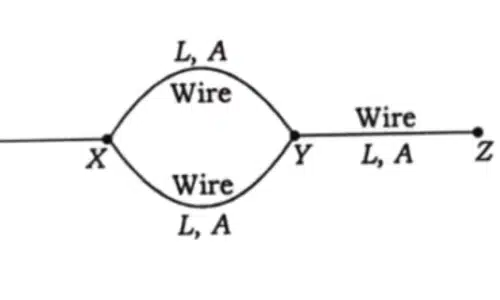
Q. 1. Three wires each of length L, cross-sectional area A and resistivity ρ are connected as shown in the figure. These are to be replaced by another wire of same resistivity such that the resistance between points X and Z does not change. If L₁ is the length and A₁ is the cross-sectional area of the new wire, then which one among the following is correct?
(a) L₁ = 3L and A₁ = 2A
(b) L₁ = L and A₁ = A
(c) L₁ = 2L and A₁ = 3A
(d) L₁ = 2L and A₁ = 2A
Answer: (a) L₁ = 3L and A₁ = 2A
| Explanation: Each wire has R = ρL/A. With two in parallel and that combination in series with the third: R_parallel = R/2, R_total = R/2 + R = 3R/2. For the replacement wire: ρL₁/A₁ = 3ρL/2A, so L₁/A₁ = 3L/2A. Option (a) gives 3L/2A. Concept Tested: Equivalent single wire: matching ρL₁/A₁ to the combined resistance 3ρL/2A |
| Note: The accompanying diagram shows two of the wires connected in parallel between points X and Y, with the third wire in series from Y to Z. Each wire has length L and area A. |
NDA 2025-I
Q. 2. The work done in moving a charge of 2 coulomb (C) from point A to point B is 24 J. What is the potential difference between A and B?
(a) 48 V
(b) 6 V
(c) 12 V
(d) 0·08 V
Answer: (c) 12 V
| Explanation: V = W/Q = 24/2 = 12 V. Concept Tested: Potential difference: V = W/Q |
Q. 3. Two conducting wires of the same material and of equal lengths and equal diameters are first connected in parallel and then in series in a circuit across the same potential difference. The ratio of heat produced in parallel and series combinations is
(a) 2 : 1
(b) 4 : 1
(c) 1 : 2
(d) 1 : 4
Answer: (b) 4 : 1
| Explanation: At constant voltage, P = V²/R. For two equal resistors R: R_parallel = R/2 and R_series = 2R. Ratio of heat = P_parallel/P_series = R_series/R_parallel = 2R ÷ (R/2) = 4. So 4 : 1. Concept Tested: Heat at constant voltage: P ∝ 1/R; parallel gives 4× the heat of series |
Q. 4. Which one of the following is NOT a basic property of electric charge?
(a) Charges can be added
(b) Charge is conserved
(c) Charge on a body is always an integral multiple of an electron or a proton charge
(d) Charges can be created and destroyed in an isolated system
Answer: (d) Charges can be created and destroyed in an isolated system
| Explanation: The three basic properties of charge are additivity, conservation, and quantisation. Option (d) contradicts conservation of charge: in an isolated system charge can be neither created nor destroyed. Concept Tested: Properties of electric charge: additivity, conservation, quantisation |
Q. 5. If the length of a copper wire is increased by twice, then its resistivity will be
(a) Doubled
(b) Halved
(c) Same
(d) One-fourth
Answer: (c) Same
| Explanation: Resistivity is an intrinsic property of the material and temperature. Changing the length changes the resistance (R = ρL/A) but leaves resistivity unchanged. Concept Tested: Resistivity: material property, independent of wire dimensions |
| ★ JOVIK Exam Insight The single most frequently tested misconception in this chapter: resistivity does NOT depend on length or area. Resistance does. R = ρL/A. Tested in NDA 2010-I, 2016-II, 2022-I, 2025-I in different forms. |
Q. 6. Which one of the following statements is NOT correct?
(a) An ammeter is always connected in series in the circuit to measure the current
(b) A Voltmeter is always connected to parallel in a circuit to measure the voltage
(c) A voltmeter has a high resistance and an ammeter has a low resistance
(d) A voltmeter has a low resistance and an ammeter has a high resistance
Answer: (d) A voltmeter has a low resistance and an ammeter has a high resistance
| Explanation: Options (a), (b) and (c) are correct. Option (d) reverses the properties: a voltmeter must have HIGH resistance (connected in parallel, drawing negligible current) and an ammeter must have LOW resistance (connected in series, without impeding the circuit current). Concept Tested: Meter properties: voltmeter high R in parallel; ammeter low R in series |
Q. 7. If three resistors of 1 Ohm each connect in parallel to each other the resultant resistance is
(a) 1 Ohm
(b) 1/3 Ohm
(c) 3 Ohm
(d) 9 Ohm
Answer: (b) 1/3 Ohm
| Explanation: For n identical resistors r in parallel: R_eq = r/n = 1/3 Ω. Concept Tested: Parallel identical resistors: R_eq = r/n |
NDA 2024-II
Q. 8. Two resistances of 5·0 Ω and 7·0 Ω are connected in series and the combination is connected in parallel with a resistance of 36·0 Ω. The equivalent resistance of the combination of three resistors is
(a) 24·0 Ω
(b) 12·0 Ω
(c) 9·0 Ω
(d) 6·0 Ω
Answer: (c) 9·0 Ω
| Explanation: Series: 5 + 7 = 12 Ω. Parallel with 36 Ω: 1/R = 1/12 + 1/36 = 3/36 + 1/36 = 4/36, so R = 9 Ω. Concept Tested: Mixed series-parallel: (5+7) Ω in parallel with 36 Ω gives 9 Ω |
Q. 9. Lightning is due to
(a) The flow of charges between different parts of the cloud
(b) The short-circuiting of charges between the upper and lower surfaces of the cloud
(c) The collection of positively charged particles on the base and collection of negatively charged particles at the top of the cloud
(d) The induction of positive charge on the ground below the negative charge at the base of the cloud
Answer: (d) The induction of positive charge on the ground below the negative charge at the base of the cloud
| Explanation: Negative charge accumulates at the base of a thundercloud. This induces positive charge on the ground beneath it. When the potential difference becomes large enough, the air breaks down and a massive discharge: lightning: occurs between cloud base and ground. Concept Tested: Lightning: electrostatic induction between cloud base and ground |
Q. 10. In which one among the following situations, the bulb would glow the most? (Consider all batteries are the same)

(a) One cell with two bulbs in series
(b) Two cells in series with two bulbs in series
(c) One cell with a single bulb
(d) Two cells in series with two bulbs in parallel
Answer: (d)
| Explanation: Let one cell have EMF V and one bulb resistance R. Brightness is the power in a single bulb, P = V_bulb²/R. Option (a): one cell with two bulbs in series gives each bulb V/2, so P = V²/4R. Option (b): two cells in series with two bulbs in series gives 2V across 2R, so each bulb gets V and P = V²/R. Option (c): one cell with one bulb gives the bulb V, so P = V²/R. Option (d): two cells in series with two bulbs in parallel puts the full 2V across each bulb, so P = 4V²/R. Option (d) is four times brighter than (b) or (c) and sixteen times brighter than (a). Concept Tested: Bulb brightness: series cells raise the supply voltage while parallel bulbs each receive it in full |
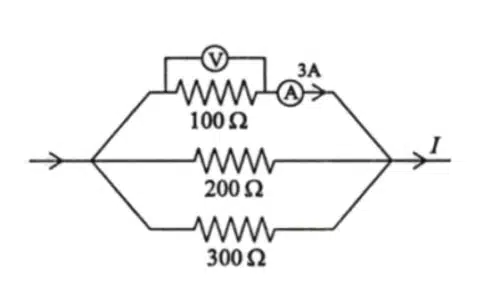
Q. 11. For an electric circuit given below, the correct combination of voltage (V) and current (I) is
(a) V = 900 V; I = 18 A
(b) V = 300 V; I = 5·5 A
(c) V = 600 V; I = 1 A
(d) V = 300 V; I = 2 A
Answer: (b) V = 300 V; I = 5·5 A
| Explanation: The network consists of 100 Ω, 200 Ω, and 300 Ω in parallel, with an ammeter reading 3 A in the 100 Ω branch and a voltmeter across that branch. The voltmeter therefore reads V = 3 × 100 = 300 V, and since the three resistors are in parallel, this same 300 V stands across all of them. The branch currents are 300/100 = 3 A, 300/200 = 1·5 A and 300/300 = 1 A, so the total line current is I = 3 + 1·5 + 1 = 5·5 A. This matches V = 300 V with I = 5·5 A. Concept Tested: Parallel network: common voltage obtained from one branch, then branch currents summed |
Q. 12. An incandescent electric bulb converts 20% of power into light. Filament resistance 200Ω, current 2A, ON for 10h, rate ₹5/unit. Money spent on producing light:
(a) ₹5
(b) ₹6
(c) ₹7
(d) ₹8
Answer: (d) ₹8
| Explanation: Total power = I²R = 4 × 200 = 800 W. Light power = 20% × 800 = 160 W = 0.16 kW. Energy for light in 10 h = 1.6 kWh. Cost = 1.6 × ₹5 = ₹8. Concept Tested: Power efficiency and cost: P = I²R; 20% converted to light; cost = kWh × rate |
Q. 13. The AC mains domestic supply current in India changes direction in every:
(a) 50 s
(b) 1/50 s
(c) 100 s
(d) 1/100 s
Answer: (d) 1/100 s
| Explanation: India’s supply is 50 Hz: 50 complete cycles per second. Each cycle contains two direction reversals, so there are 100 reversals per second. The time between successive reversals is 1/100 s. Concept Tested: AC direction reversal: 50 Hz gives 100 reversals per second |
NDA 2024-I
Q. 14. An infinite combination of resistors, each having resistance R = 4Ω, is given below. What is the net resistance between the points A and B? (Each resistance is of equal value, R = 4)
(a) 0Ω
(b) 2 + 2√5 Ω
(c) 2 + √5 Ω
(d) ∞Ω
Answer: (b) 2 + 2√5 Ω
| Explanation: For an infinite ladder network the structure is self-similar: adding one more section leaves the total resistance X unchanged. This gives X = R + R·X/(R+X). Solving: X² − RX − R² = 0. For R = 4: X = (4 + √(16+64))/2 = (4 + 4√5)/2 = 2 + 2√5 Ω. Concept Tested: Infinite ladder network: self-similarity gives X² = R² + RX |
| Note: The accompanying diagram shows an infinite ladder in which each section contributes one resistor in series along the line and one resistor shunted across it, every resistor being 4 Ω. |
Q. 15. An electric circuit is given below. V₁ = 1V and Resistance R = 1000Ω.
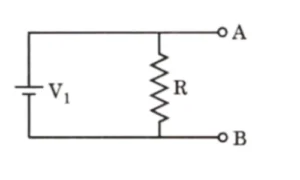
The current through the resistance R is very close to 1 mA and the voltage across point A and B, Vₐᴮ = 1V. Now the circuit is changed to:

where value of V₂ = 5V. The internal resistances of both the batteries are 0·1Ω. The current through the resistance R is about:
(a) 1·0 mA
(b) 1·2 mA
(c) 3·0 mA
(d) 5·0 mA
Answer: (c) 3·0 mA
| Explanation: The two cells sit in parallel across R, so replace them by a single equivalent source. For sources in parallel, the equivalent EMF is the conductance-weighted average: E_eq = (V₁/r₁ + V₂/r₂) ÷ (1/r₁ + 1/r₂) = (1/0·1 + 5/0·1) ÷ (1/0·1 + 1/0·1) = (10 + 50) ÷ 20 = 3 V. The equivalent internal resistance is r₁r₂/(r₁+r₂) = 0·05 Ω, which is negligible beside 1000 Ω. Current through R = 3 ÷ 1000·05 ≈ 3·0 mA. The check on the first circuit is consistent: V₁ alone gives 1/1000 = 1 mA, as stated in the question. Concept Tested: Cells in parallel: equivalent EMF is the conductance-weighted mean; then I = E_eq/R |
| Note: The accompanying diagrams show V₁ alone across R in the first circuit, and V₁ and V₂ side by side in parallel across R with the same polarity in the second. |
Q. 16. If the current through an electrical machine running on direct current is 15 A and the machine runs for 10 minutes, the charge that passes through the machine during this time is:
(a) 1·50 C
(b) 150 C
(c) 900 C
(d) 9000 C
Answer: (d) 9000 C
| Explanation: Q = I × t. The stated data are I = 15 A and t = 10 minutes = 600 s, so Q = 15 × 600 = 9000 C, which is option (d). Concept Tested: Electric charge: Q = It, with the time converted to seconds |
| Note: Editorial note: using the values stated in the question gives 9000 C, corresponding to option (d). The supplied source key indicates option (c) 900 C, which would require t = 60 s rather than the stated 10 minutes. The mathematically correct option for the data as printed is (d). |
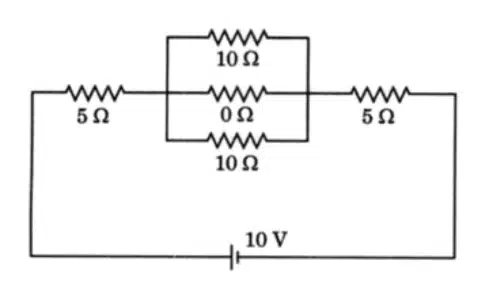
Q. 17. Consider the electric circuit: 5Ω in series with parallel combination of (10Ω and 0Ω and 10Ω) and 5Ω, powered by 10V. The current in the circuit is:
(a) 1 A
(b) (10/15) A
(c) 2 A
(d) 1·5 A
Answer: (a) 1 A
| Explanation: The middle group consists of 10 Ω, 0 Ω, and 10 Ω in parallel. The 0 Ω branch is a short, so the whole group reduces to 0 Ω, and the two 10 Ω resistors carry no current. The circuit shows a 5 Ω on each side of that group, so the total resistance is 5 + 0 + 5 = 10 Ω. With the 10 V supply, I = 10/10 = 1 A. Concept Tested: Short circuit in a parallel group: a 0 Ω branch collapses the group, leaving 5 Ω + 5 Ω |
Q. 18. Which one of the following is primarily responsible for conduction of current in a metal?
(a) Bound electrons
(b) Free electrons
(c) Both bound and free electrons
(d) Ions
Answer: (b) Free electrons
| Explanation: In a metal the outer electrons are not bound to individual atoms; they drift through the lattice under an applied field. These free (conduction) electrons carry the current. Bound electrons stay with their atoms and the positive ions form a fixed lattice. Concept Tested: Conduction in metals: carried by free electrons |
NDA 2023-II
Q. 19. The potential difference between the two end terminals of an electric heater is 220 V and the current through it is 0·5 A. What would be the current through the heater if the potential difference across the terminals of the heater is reduced to 120 V?
(a) 1·0 A
(b) 0·5 A
(c) 0·27 A
(d) 0·7 A
Answer: (c) 0·27 A
| Explanation: R = V/I = 220/0.5 = 440 Ω. At 120 V: I = 120/440 ≈ 0.273 A ≈ 0.27 A. Concept Tested: Ohm’s Law: find R from the first pair, then apply to the new voltage |
Q. 20. The heating element in an electric iron is usually made of:
(a) Constantan
(b) Tungsten
(c) Nichrome
(d) Copper
Answer: (c) Nichrome
| Explanation: Nichrome, a nickel-chromium alloy, combines high resistivity (so it generates substantial heat at modest current) with a high melting point (so it survives the operating temperature). Tungsten is used for bulb filaments; copper has far too low a resistivity to heat efficiently. Concept Tested: Heating element: nichrome for high resistivity and high melting point |
Q. 21. Which one of the following graphs correctly represents the current (I) – voltage (V) variation for a rectangular piece of a semiconductor wafer?

(a) A straight line through the origin, rising uniformly with V
(b) A straight line of negative slope
(c) A curve rising steeply and non-linearly with V
(d) A curve falling steeply as V increases
Answer: (c)
| Explanation: A semiconductor is a non-ohmic conductor: its resistance is not a constant, so current is not simply proportional to voltage. As the applied voltage rises the sample carries more current, the Joule heating within it increases, and heating liberates additional charge carriers because a semiconductor’s conductivity rises with temperature. Each increment of voltage therefore produces a larger increment of current than the one before it, and the characteristic bends upward instead of staying straight. That is the steeply rising non-linear curve of option (c). Option (a) is a straight line through the origin, which represents constant resistance and so describes an ohmic metallic conductor rather than a semiconductor. Options (b) and (d) both show the current falling as the voltage is raised, which no passive sample does. Concept Tested: Semiconductor I–V characteristic: non-ohmic, so the curve rises faster than linearly |
NDA 2023-I
Q. 22. In an electric circuit, a wire of resistance 10 Ω is used. If this wire is stretched to a length double of its original value, the current in the circuit would become:
(a) half of its original value.
(b) double of its original value.
(c) one-fourth of its original value.
(d) four times of its original value.
Answer: (c) one-fourth of its original value.
| Explanation: Stretching to double the length conserves volume, so the area halves. R_new = ρ(2L)/(A/2) = 4R = 40 Ω. At constant voltage I ∝ 1/R, so the current falls to one-fourth. Concept Tested: Wire stretching: R becomes 4×, so current becomes ¼ |
Q. 23. Three resistors of resistance R each: two in parallel and that parallel combination in series with the third: are connected in a circuit. What is the total resistance of the following circuit element?
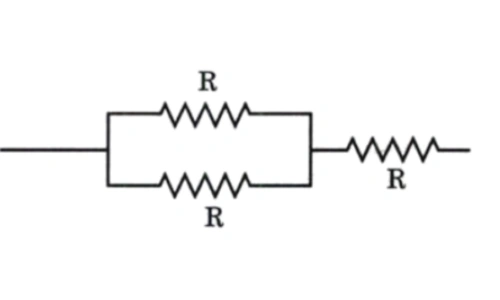
(a) R/2
(b) 3R
(c) 3R/2
(d) 2R/3
Answer: (c) 3R/2
| Explanation: Two R in parallel give R/2. In series with the third R: R/2 + R = 3R/2. Concept Tested: Mixed combination: parallel pair (R/2) in series with R |
Q. 24. An electric bulb is rated as 220 V and 80 W. When it is operated on 110 V, the power rating would be:
(a) 80 W
(b) 60 W
(c) 40 W
(d) 20 W
Answer: (d) 20 W
| Explanation: Bulb resistance R = V²/P = 220²/80 = 605 Ω. At 110 V: P = V²/R = 110²/605 = 20 W. Halving the voltage quarters the power because P ∝ V². Concept Tested: Bulb at reduced voltage: P ∝ V², so half voltage gives one-quarter power |
NDA 2022-II
Q. 25. An electric bulb is connected to 220 V generator. The current drawn is 600 mA. What is the power of the bulb?
(a) 132 W
(b) 13.2 W
(c) 1320 W
(d) 13200 W
Answer: (a) 132 W
| Explanation: P = VI = 220 × 0.6 = 132 W (600 mA = 0.6 A). Concept Tested: Electrical power: P = VI |
Q. 26. A current of 0.6 A is drawn by an electric bulb for 10 minutes. Which one of the following is the amount of electric charge that flows through the circuit?
(a) 6 C
(b) 0.6 C
(c) 360 C
(d) 36 C
Answer: (c) 360 C
| Explanation: Q = It = 0.6 × 600 = 360 C (10 minutes = 600 s). Concept Tested: Electric charge: Q = It with time in seconds |
Q. 27. Which one of the following terms cannot represent electrical power in a circuit?
(a) VI
(b) I²/R
(c) I²R
(d) V²/R
Answer: (b) I²/R
| Explanation: The valid expressions for power are VI, I²R and V²/R. I²/R has units of A²/Ω, which does not reduce to watts, so it cannot represent power. Concept Tested: Valid power formulas: VI, I²R, V²/R; I²/R is not one of them |
NDA 2022-I
Q. 28. Which of the following statements correctly explains/explain the existence of a positive force between two electric charges?
1. Both the charges are positive.
2. Both the charges are negative.
3. Both the charges are oppositely charged.
Select the correct answer using the code given below.
(a) 1 only
(b) 2 only
(c) 1 and 2 only
(d) 1, 2 and 3
Answer: (c) 1 and 2 only
| Explanation: A positive (repulsive) force arises between like charges: both positive or both negative. Opposite charges attract, which is a negative force, so statement 3 does not apply. Concept Tested: Coulomb’s Law: like charges repel, giving a positive force |
Q. 29. An electric wire of resistance 50 ohm is cut into five equal wires. These wires are then connected in parallel. What is the equivalent resistance of this combination?
(a) 2 ohm
(b) 10 ohm
(c) 0.5 ohm
(d) 5 ohm
Answer: (a) 2 ohm
| Explanation: Each piece is 50/5 = 10 Ω. Five 10 Ω in parallel give 10/5 = 2 Ω. General rule: R_new = R/n² = 50/25 = 2 Ω. Concept Tested: Wire cut into n parts and joined in parallel: R_new = R/n² |
Q. 30. The electric field lines from an isolated positively charged conducting sphere are
(a) tangential to the conducting surface
(b) at right angles to the conducting surface and towards the centre of the sphere
(c) at any angle to the conducting surface
(d) at right angles to the conducting surface and outwards from the centre of the sphere
Answer: (d) at right angles to the conducting surface and outwards from the centre of the sphere
| Explanation: At a conductor’s surface in electrostatic equilibrium the field must be normal to the surface: any tangential component would drive charge along the surface. For a positive charge the lines point radially outward. Concept Tested: Field at a conductor surface: perpendicular to the surface, outward for positive charge |
Q. 31. The frequency of an alternating current is 3 Hz. It implies that
(a) there are 6 cycles/s
(b) there are 3 cycles/s
(c) there are 2 cycles/s
(d) there is only 1 cycle/s
Answer: (b) there are 3 cycles/s
| Explanation: Frequency in hertz is the number of complete cycles per second, so 3 Hz means 3 cycles per second. Concept Tested: Frequency: 1 Hz = 1 cycle per second |
Q. 32. Which one of the following correctly represents the SI unit of resistivity?
(a) Ω
(b) Ω/m
(c) Ω cm
(d) Ω m
Answer: (d) Ω m
| Explanation: From R = ρL/A, ρ = RA/L, giving units Ω × m²/m = Ω m. Concept Tested: SI unit of resistivity: ohm-metre |
Q. 33. What is the current required to light a 60 W incandescent bulb in a domestic supply of 240 V?
(a) 0.5 A
(b) 0.25 A
(c) 1.0 A
(d) 5.0 A
Answer: (b) 0.25 A
| Explanation: I = P/V = 60/240 = 0.25 A. Concept Tested: Current from power rating: I = P/V |
Q. 34. Two resistors R₁ and R₂ arranged in parallel combination in an electrical closed circuit are made of the same material and of same thickness. If the length of R₂ is twice the length of R₁, then the total resistance R satisfies
(a) 3R = 2R₁
(b) 3R = 2R₂
(c) 2R = 3R₁
(d) 2R = 3R₂
Answer: (a) 3R = 2R₁
| Explanation: Same material and thickness means R ∝ length, so R₂ = 2R₁. In parallel: R = R₁R₂/(R₁+R₂) = R₁(2R₁)/(3R₁) = 2R₁/3. Rearranging gives 3R = 2R₁. Concept Tested: Parallel combination with proportional lengths: R ∝ L gives R = 2R₁/3 |
Q. 35. Why are the tyres of aircrafts made of conducting rubber?
1. So that the charge accumulated on the aircraft in flight, by rubbing the air, can easily be transferred to ground on landing.
2. So that the charge accumulated due to the operation of various electronic equipments in the aircraft in flight can easily be transferred to ground on landing.
Select the correct answer using the code given below.
(a) 1 only
(b) 2 only
(c) Both 1 and 2
(d) Neither 1 nor 2
Answer: (c) Both 1 and 2
| Explanation: Static charge builds up on an aircraft from friction with air during flight and from the operation of onboard electronics. Conducting tyres provide a discharge path to earth on landing, so both statements are correct. Concept Tested: Conducting tyres: safe discharge of static charge from both sources |
NDA 2021-II
Q. 36. Three equal resistors are connected in parallel configuration in a closed electrical circuit. Then the total resistance in the circuit becomes
(a) one-third of the individual resistance
(b) two-third of the individual resistance
(c) equal to the individual resistance
(d) three times of the individual resistance
Answer: (a) one-third of the individual resistance
| Explanation: For n identical resistors r in parallel, R_eq = r/n, so with n = 3 the result is r/3. Concept Tested: Parallel identical resistors: R_eq = r/3 for three resistors |
Q. 37. The device used to produce electric current is known as
(a) motor
(b) generator
(c) ammeter
(d) galvanometer
Answer: (b) generator
| Explanation: A generator converts mechanical energy into electrical energy, producing current. A motor does the reverse. An ammeter measures current and a galvanometer detects it. Concept Tested: Generator: converts mechanical energy to electrical energy |
NDA 2021-I
Q. 38. LED (a semi-conductor device) is an abbreviation that stands for
(a) Licence for Energy Detector
(b) Light Energy Device
(c) Light Emitting Diode
(d) Lost Energy Detector
Answer: (c) Light Emitting Diode
| Explanation: LED stands for Light Emitting Diode: a p-n junction that emits light when forward biased. Concept Tested: LED: Light Emitting Diode |
Q. 39. A current of 1.0 A is drawn by a filament of an electric bulb for 10 minutes. The amount of electric charge that flows through the circuit is
(a) 0.1 C
(b) 10 C
(c) 600 C
(d) 800 C
Answer: (c) 600 C
| Explanation: Q = It = 1.0 × 600 = 600 C (10 minutes = 600 s). Concept Tested: Electric charge: Q = It; convert minutes to seconds |
Q. 40. Which one of the following formulas does not represent electrical power?
(a) I²R
(b) IR²
(c) VI
(d) V²/R
Answer: (b) IR²
| Explanation: Power can be written as VI, I²R or V²/R. The expression IR² has units A × Ω², which does not reduce to watts, so it does not represent power. Concept Tested: Valid power formulas: IR² is not among them |
NDA 2020-I & II
Q. 41. The cost of energy to operate an industrial refrigerator that consumes 5 kW power working 10 hours per day for 30 days will be (Given that the charge per kW.h of energy = ₹4)
(a) ₹600
(b) ₹6,000
(c) ₹1,200
(d) ₹1,500
Answer: (b) ₹6,000
| Explanation: Energy = 5 kW × 10 h/day × 30 days = 1500 kWh. Cost = 1500 × ₹4 = ₹6,000. Concept Tested: Electrical energy cost: power × hours × days × rate |
| ★ JOVIK Exam Insight Electrical energy cost is a three-factor calculation: power × daily hours × days. NDA has tested this type in 2020-I & II and 2024-II. Always express power in kW and time in hours before multiplying by the unit rate. |
Q. 42. In an incandescent electric bulb, the filament of the bulb is made up of which metal?
(a) Aluminium
(b) Copper
(c) Tungsten
(d) Silver
Answer: (c) Tungsten
| Explanation: Tungsten has an extremely high melting point of about 3422°C together with high resistivity, so it can be heated past 2000°C to emit white light without melting. Concept Tested: Bulb filament: tungsten for high melting point and high resistivity |
Q. 43. Two equal resistors R are connected in parallel, and a battery of 12 V is connected across this combination. A dc current of 100 mA flows through the circuit as shown below:
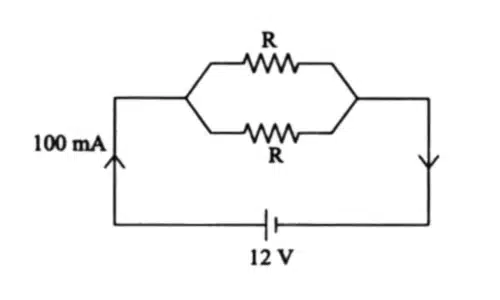
The value of R is
(a) 120 Ω
(b) 240 Ω
(c) 60 Ω
(d) 100 Ω
Answer: (b) 240 Ω
| Explanation: The parallel pair has R_eq = R/2. From the total current, R_eq = V/I = 12/0.1 = 120 Ω. Hence R = 2 × 120 = 240 Ω. Concept Tested: Parallel pair: R_eq = R/2, solved from total current |
Q. 44. A metallic wire having resistance of 20 Ω is cut into two equal parts in length. These parts are then connected in parallel. The resistance of this parallel combination is equal to
(a) 20 Ω
(b) 10 Ω
(c) 5 Ω
(d) 15 Ω
Answer: (c) 5 Ω
| Explanation: Each half is 10 Ω. Two 10 Ω in parallel give 5 Ω. General rule: R_new = R/n² = 20/4 = 5 Ω. Concept Tested: Wire cut in two and joined in parallel: R_new = R/4 |
Q. 45. When the short circuit condition occurs, the current in the circuit
(a) becomes zero
(b) remains constant
(c) increases substantially
(d) keeps on changing randomly
Answer: (c) increases substantially
| Explanation: A short circuit provides a near-zero-resistance path. By Ohm’s Law, the current I = V/R rises sharply, which is why a fuse melts to protect the circuit. Concept Tested: Short circuit: near-zero resistance causes a large current surge |
Q. 46. The instrument used for detecting the presence of electric current in a circuit is
(a) Refractometer
(b) Galvanometer
(c) Viscometer
(d) Diffractometer
Answer: (b) Galvanometer
| Explanation: A galvanometer detects small currents and indicates their direction. A refractometer measures refractive index, a viscometer measures viscosity and a diffractometer analyses diffraction patterns. Concept Tested: Galvanometer: detects presence and direction of current |
NDA 2019-II
Q. 47. Which one of the following statements regarding Ohm’s law is not correct?
(a) Ohm’s law is an assumption that current through a conductor is always directly proportional to the potential difference applied to it.
(b) A conducting device obeys Ohm’s law when the resistance of a device is independent of magnitude and polarity of applied potential difference.
(c) A conducting material obeys Ohm’s law when the resistance of material is independent of the magnitude and direction of applied electric field.
(d) All homogeneous materials obey Ohm’s law irrespective of whether the field is within range or strong.
Answer: (d) All homogeneous materials obey Ohm’s law irrespective of whether the field is within range or strong.
| Explanation: Ohm’s Law is an empirical approximation, not a universal law. Even homogeneous materials depart from it at very strong fields, and semiconductors and diodes are non-ohmic. Option (d) claims universal validity and is therefore false. Concept Tested: Ohm’s Law: an approximation that fails at strong fields and for non-ohmic devices |
Q. 48. “The sum of emf’s and potential differences around a closed loop equals zero” is a consequence of
(a) Ohm’s law.
(b) Conservation of charge.
(c) Conservation of momentum.
(d) Conservation of energy.
Answer: (d) Conservation of energy.
| Explanation: This is Kirchhoff’s Voltage Law. A charge carried once around a closed loop must return with the same energy, so the algebraic sum of EMFs and potential drops is zero. Kirchhoff’s Current Law is the one that follows from conservation of charge. Concept Tested: Kirchhoff’s Voltage Law: a consequence of conservation of energy |
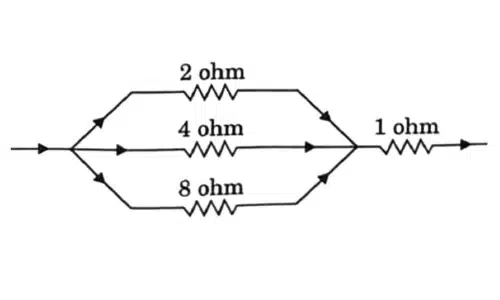
Q. 49. Consider the following part of an electric circuit: The total electrical resistance in the given part of the electric circuit is
(a) 15/8 ohm
(b) 15/7 ohm
(c) 15 ohm
(d) 17/3 ohm
Answer: (b) 15/7 ohm
| Explanation: The circuit has 2 Ω, 4 Ω and 8 Ω in parallel, and that group is in series with a 1 Ω resistor. For the parallel group: 1/R = 1/2 + 1/4 + 1/8 = 4/8 + 2/8 + 1/8 = 7/8, so R = 8/7 Ω. Adding the 1 Ω in series: 1 + 8/7 = 7/7 + 8/7 = 15/7 ohm. Concept Tested: Network reduction: three resistors in parallel (8/7 Ω) added in series to 1 Ω |
Q. 50. Water is heated with a coil of resistance R connected to domestic supply. The rise of temperature of water will depend on
1. Supply voltage.
2. Current passing through the coil.
3. Time for which voltage is supplied.
Select the correct answer from among the following:
(a) 1, 2 and 3
(b) 1 and 2 only
(c) 1 only
(d) 2 and 3 only
Answer: (a) 1, 2 and 3
| Explanation: Heat produced Q = VIt = I²Rt = V²t/R. Supply voltage, current and duration all enter this expression, and through Q = mcΔT they all affect the temperature rise. All three statements are correct. Concept Tested: Joule heating: temperature rise depends on voltage, current and time |
NDA 2019-I
Q. 51. Which one of the following can charge an insulator?
(a) Current electricity
(b) Static electricity
(c) Magnetic field
(d) Gravitational field
Answer: (b) Static electricity
| Explanation: An insulator cannot carry a flowing current, so it is charged by static means: friction or induction, which deposit charge that stays in place. Magnetic and gravitational fields do not transfer charge. Concept Tested: Charging an insulator: by static electricity, not current |
Q. 52. Let us consider a copper wire having radius r and length l. Let its resistance be R. If the radius of another copper wire is 2r and the length is l/2 then the resistance of this wire will be
(a) R
(b) 2R
(c) R/4
(d) R/8
Answer: (d) R/8
| Explanation: R = ρl/(πr²). For the second wire: ρ(l/2)/(π(2r)²) = ρl/(8πr²) = R/8. The halved length contributes a factor ½ and the doubled radius a factor ¼. Concept Tested: Resistance and geometry: R ∝ L and R ∝ 1/r² |
Q. 53. Two metallic wires A and B are made using copper. The radius of wire A is r while its length is l. A dc voltage V is applied across the wire A, causing power dissipation P. The radius of wire B is 2r and its length is 2l and the same dc voltage V is applied across it causing power dissipation P₁. Which one of the following is the correct relationship between P and P₁?
(a) P = 2P₁
(b) P = P₁/2
(c) P = 4P₁
(d) P = P₁
Answer: (b) P = P₁/2
| Explanation: R_B = ρ(2l)/(π(2r)²) = ρ(2l)/(4πr²) = R_A/2. At the same voltage P = V²/R, so P₁ = V²/(R_A/2) = 2P. Hence P = P₁/2. Concept Tested: Power at constant voltage: P ∝ 1/R; halved resistance doubles the power |
Q. 54. A fuse wire must be
(a) conducting and of low melting point
(b) conducting and of high melting point
(c) insulator and of high melting point
(d) insulator and of low melting point
Answer: (a) conducting and of low melting point
| Explanation: A fuse must conduct the normal working current, so it cannot be an insulator, and it must melt quickly when the current becomes excessive, so it needs a low melting point. Concept Tested: Fuse wire: conducting with a low melting point |
NDA 2018-II
Q. 55. The full form of LED is
(a) Light Emitting Diode
(b) Light Emitting Device
(c) Light Enhancing Device
(d) Light Enhancing Diode
Answer: (a) Light Emitting Diode
| Explanation: LED stands for Light Emitting Diode, a semiconductor p-n junction that emits light under forward bias. Concept Tested: LED: Light Emitting Diode |
Q. 56. If a free electron moves through a potential difference of 1 kV, then the energy gained by the electron is given by
(a) 1.6 × 10⁻¹⁹ J
(b) 1.6 × 10⁻¹⁶ J
(c) 1 × 10⁻¹⁹ J
(d) 1 × 10⁻¹⁶ J
Answer: (b) 1.6 × 10⁻¹⁶ J
| Explanation: Energy = eV = 1.6 × 10⁻¹⁹ C × 1000 V = 1.6 × 10⁻¹⁶ J. Concept Tested: Energy of an accelerated electron: E = eV |
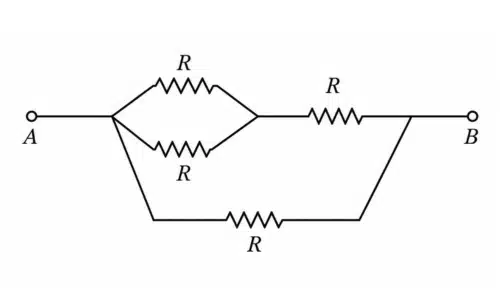
Q. 57. Consider the following circuit (a Wheatstone-bridge-like network of resistors, each of resistance R, between points A and B).
Which one of the following is the value of the resistance between points A and B in the circuit given above?
(a) 2/5 R
(b) 3/5 R
(c) 3/2 R
(d) 4R
Answer: (b) 3/5 R
| Explanation: Identify which resistors share both end nodes and combine them in parallel, then add the resistors that carry the same current in series. For the standard five-resistor bridge arrangement between A and B the reduction yields 3R/5. Concept Tested: Resistor network reduction: series and parallel combination between two terminals |
| Note: The accompanying diagram shows two resistors in parallel between A and an intermediate node, that pair in series with a third resistor to B, and a fourth resistor forming a separate branch straight from A to B. |
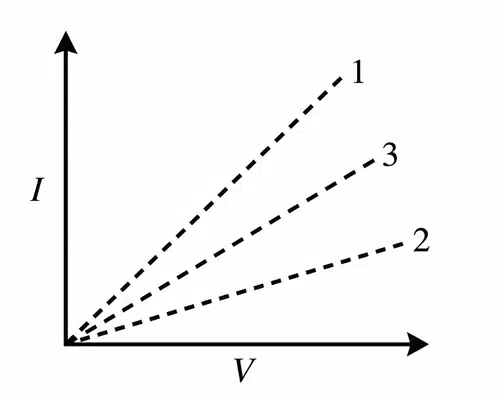
Q. 58. The graphs between current (I) and voltage (V) for three linear resistors 1, 2 and 3 are given below. If R₁, R₂ and R₃ are the resistances of these resistors, then which one of the following is correct?
(a) R₁ > R₂ > R₃
(b) R₁ < R₃ < R₂
(c) R₃ < R₁ < R₂
(d) R₃ > R₂ > R₁
Answer: (b) R₁ < R₃ < R₂
| Explanation: On an I–V graph the resistance is the reciprocal of the slope, R = V/I. A steeper line means more current for the same voltage and therefore a smaller resistance. Rank the three lines by steepness: the steepest has the smallest resistance and the shallowest the largest. Concept Tested: I–V graphs: steeper slope means lower resistance |
| Note: The accompanying graph shows three straight lines through the origin. Line 1 is the steepest, line 3 is intermediate and line 2 is the shallowest. |
NDA 2017-I
Q. 59. Which one of the following statements is correct with regard to the material of electrical insulators?
(a) They contain no electrons
(b) Electrons do not flow easily through them
(c) They are crystals
(d) They have more number of electrons than the protons on their surface
Answer: (b) Electrons do not flow easily through them
| Explanation: Insulators do contain electrons, but those electrons are tightly bound to their atoms and cannot drift freely under an applied field. That is what distinguishes an insulator from a conductor. Concept Tested: Insulators: electrons present but tightly bound, so they do not flow |
Q. 60. Which one of the following physical quantities does NOT affect the resistance of a cylindrical resistor?
(a) The current through it
(b) Its length
(c) The resistivity of the material used in the resistor
(d) The area of cross-section of the cylinder
Answer: (a) The current through it
| Explanation: R = ρL/A, so resistance depends on resistivity, length and cross-sectional area. For an ohmic resistor the resistance is constant and does not depend on the current flowing; the current is instead determined by the resistance. Concept Tested: Factors affecting resistance: ρ, L and A, but not the current |
Q. 61. Suppose a rod is given a negative charge by rubbing it with wool. Which one of the following statements is correct in this case?
(a) The positive charges are transferred from rod to wool
(b) The positive charges are transferred from wool to rod
(c) The negative charges are transferred from rod to wool
(d) The negative charges are transferred from wool to rod
Answer: (d) The negative charges are transferred from wool to rod
| Explanation: In frictional charging only electrons move; the positive nuclei are fixed in the solid. Since the rod ends up negative, electrons must have travelled from the wool to the rod, leaving the wool positively charged. Concept Tested: Triboelectric charging: only electrons transfer, never protons |
Q. 62. A positive charge +q is placed at the centre of a hollow metallic sphere of inner radius a and outer radius b. The electric field at a distance r from the centre is denoted by E. In this regard, which one of the following statements is correct?
(a) E = 0 for a < r < b
(b) E = 0 for r < a
(c) E = q/4πε₀r for a < r < b
(d) E = q/4πε₀a for r < a
Answer: (a) E = 0 for a < r < b
| Explanation: Inside the conducting material of the shell the field must be zero in electrostatic equilibrium. Within the cavity (r < a) the central charge produces a non-zero field, and outside the shell the field is that of the enclosed charge. Concept Tested: Electrostatic shielding: E = 0 within the conducting material of a shell |
NDA 2016-II
Q. 63. Which of the following items is used in the household wirings to prevent accidental fire in case of short circuit?
(a) Insulated wire
(b) Plastic switches
(c) Non-metallic coatings on conducting wires
(d) Electric fuse
Answer: (d) Electric fuse
| Explanation: When a short circuit drives an excessive current, the fuse wire melts and breaks the circuit before the wiring can overheat. Insulation and plastic fittings guard against shock but do not interrupt an overload. Concept Tested: Electric fuse: protects against short-circuit fires |
Q. 64. When three resistors, each having resistance r, are connected in parallel, their resultant resistance is x. If these three resistances are connected in series, the total resistance will be
(a) 3x
(b) 3rx
(c) 9x
(d) 3/x
Answer: (c) 9x
| Explanation: Parallel: x = r/3, so r = 3x. Series: 3r = 9x. The series value is always nine times the parallel value for three equal resistors. Concept Tested: Series versus parallel: for three equal resistors the ratio is 9 |
| ★ JOVIK Exam Insight Three identical resistors in parallel give r/3 and in series give 3r, so the ratio is always 9. NDA has tested this relationship in 2010-I, 2016-II, 2021-II and 2025-I. |
Q. 65. The property of electric current which is applicable in the fuse wire is
(a) chemical effect of current
(b) magnetic effect of current
(c) heating effect of current
(d) optical property of current
Answer: (c) heating effect of current
| Explanation: A fuse works by Joule heating: H = I²Rt. Excess current raises the wire above its melting point and it breaks the circuit. Concept Tested: Fuse operation: the heating effect of current |
Q. 66. Which one of the following statements is not correct?
(a) The SI unit of charge is ampere-second
(b) Debye is the unit of dipole moment
(c) Resistivity of a wire of length l and area of cross-section a depends upon both l and a
(d) The kinetic energy of an electron of mass m kg and charge e coulomb, when accelerated through a potential difference of V volt, is eV joule
Answer: (c) Resistivity of a wire of length l and area of cross-section a depends upon both l and a
| Explanation: Resistivity is fixed by the material and its temperature. It is the resistance, R = ρl/a, that varies with length and cross-section. Statement (c) confuses the two and is therefore false. Concept Tested: Resistivity versus resistance: only resistance depends on l and a |
NDA 2016-I
Q. 67. A simple circuit contains a 12 V battery and a bulb having 24 ohm resistance. When you turn on the switch, the ammeter connected in the circuit would read
(a) 0.5 A
(b) 2 A
(c) 4 A
(d) 5 A
Answer: (a) 0.5 A
| Explanation: I = V/R = 12/24 = 0.5 A. Concept Tested: Ohm’s Law: I = V/R |
Q. 68. Three resistors with magnitudes 2, 4 and 8 ohm are connected in parallel. The equivalent resistance of the system would be
(a) less than 2 ohm
(b) more than 2 ohm but less than 4 ohm
(c) 4 ohm
(d) 14 ohm
Answer: (a) less than 2 ohm
| Explanation: A parallel combination is always smaller than the smallest branch. Checking: 1/R = 1/2 + 1/4 + 1/8 = 7/8, so R = 8/7 ≈ 1.14 Ω, which is indeed below 2 Ω. Concept Tested: Parallel combination: always less than the smallest individual resistance |
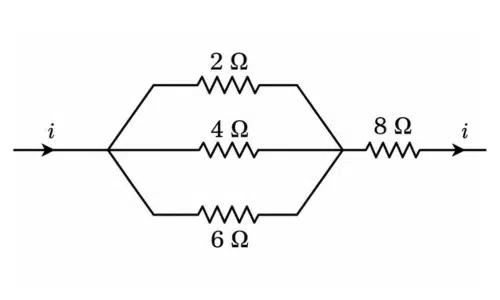
Q. 69. Consider the following circuit (resistors 2Ω, 4Ω, 6Ω arranged with 8Ω in series): The equivalent resistance of the circuit will be
(a) 12 Ω
(b) 8 11/12 Ω
(c) 9 1/11 Ω
(d) 24/25 Ω
Answer: (c) 9 1/11 Ω
| Explanation: Take the 2 Ω, 4 Ω and 6 Ω resistors in parallel: 1/R = 1/2 + 1/4 + 1/6 = 6/12 + 3/12 + 2/12 = 11/12, so R = 12/11 Ω = 1 1/11 Ω. This is below 2 Ω, as a parallel group must be. Adding the 8 Ω in series: 8 + 12/11 = 88/11 + 12/11 = 100/11 = 9 1/11 Ω. Concept Tested: Network reduction: three resistors in parallel (12/11 Ω) added in series to 8 Ω |
| Note: The accompanying diagram shows the 2 Ω, 4 Ω and 6 Ω resistors as three parallel branches, with the 8 Ω resistor in series after that group. |
Q. 70. A given conductor carrying a current of 1 A produces an amount of heat equal to 2000 J. If the current through the conductor is doubled, the amount of heat produced will be
(a) 2000 J
(b) 4000 J
(c) 8000 J
(d) 1000 J
Answer: (c) 8000 J
| Explanation: Joule’s Law: H = I²Rt, so H ∝ I² at constant R and t. Doubling the current quadruples the heat: 4 × 2000 = 8000 J. Concept Tested: Joule’s Law: heat varies as the square of the current |
NDA 2015-II
Q. 71. Lightning conductors are used to protect building from lightning strikes. Which of the following statements is / are true about lightning conductors?
1. Lightning conductors create an electric field at its top so that lightning strikes it preferentially
2. Lightning conductors reduce the effect of the strike by uniformly distributing the charge (current) over the surface of the building
3. Lightning conductors take all charge (current) to deep down in the earth
4. Lightning conductors must be installed at a place taller than the building
Select the correct answer using the code given below:
(a) 1 and 2
(b) 3 and 4 only
(c) 1, 3 and 4
(d) 4 only
Answer: (c) 1, 3 and 4
| Explanation: The sharp point concentrates the field so the strike is attracted there (1), the conductor carries the charge safely to earth (3), and it must stand above the building to intercept the strike (4). Statement 2 is wrong: the charge is led to earth rather than spread over the building. Concept Tested: Lightning conductor: attracts the strike and conducts it to earth |
Q. 72. Three equal resistances when combined in series are equivalent to 90 ohm. Their equivalent resistance when combined in parallel will be:
(a) 10 ohm
(b) 30 ohm
(c) 270 ohm
(d) 810 ohm
Answer: (a) 10 ohm
| Explanation: Series: 3r = 90, so r = 30 Ω. Parallel: r/3 = 10 Ω. Concept Tested: Series to parallel conversion: the parallel value is one-ninth of the series value |
Q. 73. The resistance of a wire of length l and area of cross-section a is x ohm. If the wire is stretched to double its length, its resistance would become:
(a) 2x ohm
(b) 0.5x ohm
(c) 4x ohm
(d) 6x ohm
Answer: (c) 4x ohm
| Explanation: Stretching conserves volume, so doubling the length halves the area. R_new = ρ(2l)/(a/2) = 4ρl/a = 4x. Concept Tested: Wire stretching: resistance grows as n² for a stretch factor n |
| ★ JOVIK Exam Insight Stretching a wire n times makes the resistance n²R, not nR, because the area shrinks by the same factor n. This is one of the most tested traps in the chapter: NDA has used it in 2012-I, 2015-II and 2023-I. |
NDA 2015-I
Q. 74. When you walk on a woolen carpet and bring your finger near the metallic handle of a door an electric shock is produced. This is because
(a) charge is transferred from your body to the handle
(b) a chemical reaction occurs when you touch the handle
(c) the temperature of the human body is higher than that of the handle
(d) the human body and the handle arrive at thermal equilibrium by the process
Answer: (a) charge is transferred from your body to the handle
| Explanation: Walking on wool charges the body by friction. Bringing a charged finger near a metal handle allows the accumulated charge to discharge rapidly through the small air gap, and that spark is felt as a shock. Concept Tested: Electrostatic discharge: frictional charging followed by rapid transfer to a conductor |
Q. 75. The product of conductivity and resistivity of a conductor
(a) depends on pressure applied
(b) depends on current flowing through conductor
(c) is the same for all conductors
(d) varies from conductor to conductor
Answer: (c) is the same for all conductors
| Explanation: Conductivity is defined as the reciprocal of resistivity, σ = 1/ρ. Their product is therefore exactly 1 for every conductor, regardless of material, dimensions, pressure or current. Concept Tested: Conductivity and resistivity: σρ = 1 always |
NDA 2014-I
Q. 76. Two conducting wires A and B are made of same material. If the length of B is twice that of A and the radius of circular cross-section of A is twice that of B, then their resistances Rₐ and Rᴮ are in the ratio
(a) 2 : 1
(b) 1 : 2
(c) 1 : 8
(d) 1 : 4
Answer: (c) 1 : 8
| Explanation: R = ρL/(πr²). Wire B has twice the length and half the radius, so its area is one-quarter. R_B = ρ(2L)/(πr²/4) = 8ρL/(πr²) = 8R_A, giving the ratio 1 : 8. Concept Tested: Resistance ratio: R ∝ L and R ∝ 1/r² |
Q. 77. During short-circuiting, the current flowing in the electrical circuit
(a) reduces substantially
(b) does not change
(c) increases instantaneously
(d) varies continuously
Answer: (c) increases instantaneously
| Explanation: A short circuit connects the supply through a path of almost no resistance, so I = V/R becomes very large almost immediately. Concept Tested: Short circuit: near-zero resistance gives an immediate current surge |
Q. 78. Van de Graaff generator is used for
(a) accelerating charged particles
(b) generating large currents
(c) generating electric field
(d) generating high-frequency voltage
Answer: (a) accelerating charged particles
| Explanation: A Van de Graaff generator accumulates charge on a large dome to build up potentials of millions of volts. That potential is used to accelerate charged particles to high energies for research and medical applications. Concept Tested: Van de Graaff generator: builds high potential to accelerate charged particles |
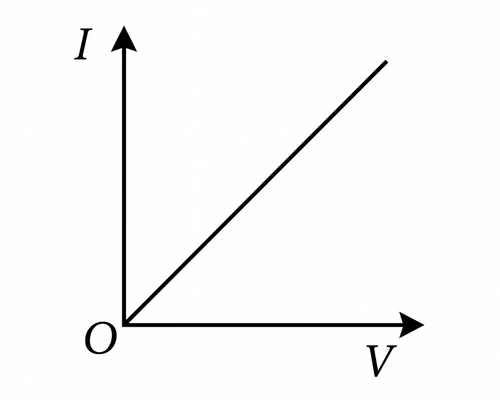
Q. 79. The current (I)-voltage (V) plot of a certain electronic device is given above. The device is
(a) a semiconductor
(b) a conductor which obeys Ohm’s law
(c) a superconductor
(d) an insulator
Answer: (b) a conductor which obeys Ohm’s law
| Explanation: The plot is a straight line passing through the origin, so I is directly proportional to V and the ratio V/I is the same at every point. A constant resistance is exactly the condition for ohmic behaviour, so the device is a conductor obeying Ohm’s law. A semiconductor would give a curved characteristic, a superconductor would show current at zero potential difference, and an insulator would show virtually no current at all. Concept Tested: Reading an I–V characteristic: a straight line through the origin means constant resistance |
Q. 80. A fuse is used in an electric circuit to
(a) break the circuit when excessive current flows through the circuit
(b) break the circuit when power gets off
(c) indicate if the current is flowing uninterrupted
(d) complete the circuit for flow of current
Answer: (a) break the circuit when excessive current flows through the circuit
| Explanation: A fuse is a protective device. When the current exceeds its rating the wire heats past its melting point and opens the circuit, protecting the wiring and appliances. Concept Tested: Fuse function: interrupts the circuit on excessive current |
Q. 81. A semiconducting device is connected in a series circuit with a battery and a resistance. Current is found to pass through the circuit. If the polarity of the battery is reversed, the current drops to zero. The device may be
(a) p-type semiconductor
(b) n-type semiconductor
(c) an intrinsic semiconductor
(d) p-n junction
Answer: (d) p-n junction
| Explanation: Conduction in one polarity and none in the other is the defining behaviour of a diode. A p-n junction conducts under forward bias and blocks under reverse bias. Plain p-type, n-type and intrinsic semiconductors conduct in either direction. Concept Tested: p-n junction diode: one-way conduction |
NDA 2013-I
Q. 82. Ohm’s law defines
(a) a resistance
(b) current only
(c) voltage only
(d) both current and voltage
Answer: (a) a resistance
| Explanation: Ohm’s Law states V = IR. Current and voltage are defined independently of it; what the law supplies is the constant of proportionality between them, which is the resistance R = V/I. Concept Tested: Ohm’s Law: defines resistance as the ratio V/I |
Q. 83. A current I flows through a potential difference V in an electrical circuit containing a resistance R. The product of V and I, i.e., VI may be understood as
(a) resistance R
(b) heat generated by the circuit
(c) thermal power radiated by the circuit
(d) rate of change of resistance
Answer: (c) thermal power radiated by the circuit
| Explanation: VI is the electrical power in watts: the rate at which energy is converted. The total heat generated is VIt, an energy rather than a rate, so option (b) would need the time factor. Concept Tested: Electrical power: P = VI is a rate, not a total energy |
Q. 84. Metal used to make wires for safety fuses must have
(a) very low resistivity and high melting point
(b) high resistivity and low melting point
(c) low resistivity and low melting point
(d) high resistivity and high melting point
Answer: (b) high resistivity and low melting point
| Explanation: High resistivity makes the fuse heat up strongly for a given current, and a low melting point lets it melt and break the circuit before the rest of the wiring is damaged. Concept Tested: Fuse material: high resistivity paired with a low melting point |
| ★ JOVIK Exam Insight Fuse wire needs high resistivity and a LOW melting point, while a heating element such as nichrome needs high resistivity and a HIGH melting point. Both must generate heat, but only the fuse is meant to melt. NDA has tested this contrast in 2011-I, 2013-I, 2019-I and 2023-II. |
NDA 2012-II
Q. 85. Which one among the following is the correct order of power consumption for light of equal intensity?
(a) CFL tube < Fluorescent tube < Incandescent bulb < Light emitting diode
(b) Light emitting diode < CFL tube < Fluorescent tube < Incandescent bulb
(c) CFL tube < Fluorescent tube < Light emitting diode < Incandescent bulb
(d) Incandescent bulb < Light emitting diode < Fluorescent tube < CFL tube
Answer: (b) Light emitting diode < CFL tube < Fluorescent tube < Incandescent bulb
| Explanation: For the same light output the LED draws the least power, followed by the CFL and then the fluorescent tube. The incandescent bulb is the least efficient because most of its energy leaves as heat. Concept Tested: Lighting efficiency: LED is most efficient, incandescent least |
Q. 86. Which one among the following is the true representation of (i) variable DC potential (ii) rheostat and (iii) AC ammeter respectively?
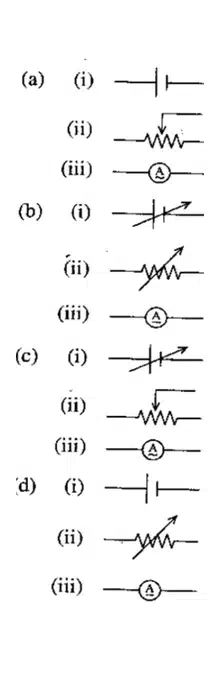
(a) (i) plain cell, (ii) resistor with slider, (iii) plain ammeter
(b) (i) cell with arrow, (ii) resistor with diagonal arrow, (iii) plain ammeter
(c) (i) cell with arrow, (ii) resistor with slider, (iii) ammeter marked with a tilde
(d) (i) plain cell, (ii) resistor with diagonal arrow, (iii) plain ammeter
Answer: (c)
| Explanation: Take the three symbols in turn. A variable DC potential is a cell symbol with an arrow drawn across it; a plain cell without the arrow is a fixed source. A rheostat is a resistor with a sliding tap drawn as an arrow meeting it at right angles, whereas a diagonal arrow straight through the resistor denotes a general variable resistor. An AC ammeter is the circled A carrying a tilde to mark alternating current; the circled A alone is a DC ammeter. Checking each set: (a) fails on (i) and (iii), (b) fails on (ii) and (iii), (d) fails on all three. Only set (c) has the arrowed cell, the slider-type rheostat and the circled A with the tilde beneath it. Concept Tested: Circuit symbols: variable DC source, rheostat and AC ammeter distinguished from their fixed or DC counterparts |
Q. 87. In India, distribution of electricity for domestic purpose is done in the form of
(a) 220 V; 50 Hz
(b) 110 V; 60 Hz
(c) 220 V; 60 Hz
(d) 110 V; 50 Hz
Answer: (a) 220 V; 50 Hz
| Explanation: Indian domestic supply is 220 V RMS at 50 Hz. The 110 V, 60 Hz standard is used in the United States. Concept Tested: Indian domestic supply: 220 V at 50 Hz |
Q. 88. Consider the following circuit:
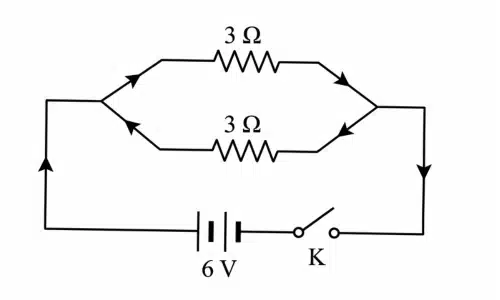
The current flowing through each of the resistors connected in the above circuit is
(a) 2 A
(b) 1 A
(c) 9 A
(d) 4 A
Answer: (a) 2 A
| Explanation: The circuit has two 3 Ω resistors in parallel connected across a 6 V battery through a switch. Because the branches are in parallel, the full 6 V appears across each 3 Ω resistor, so the current in each is I = V/R = 6/3 = 2 A. (The total current drawn from the battery is 4 A, but the question asks for the current through each resistor.) Concept Tested: Parallel branches: each carries the full supply voltage, so I = V/R per branch |
Q. 89. When an electrical safety fuse is rated (marked) as 16 A, it means it
(a) will not work if current is less than 16 A
(b) has a resistance of 16 Ω
(c) will work if the temperature is more than 16°C
(d) will be blown (break) if current exceeds 16 A
Answer: (d) will be blown (break) if current exceeds 16 A
| Explanation: The rating states the maximum current the fuse can carry safely. Beyond that value the wire melts and opens the circuit. It is not a resistance value or a temperature setting. Concept Tested: Fuse rating: the current above which the fuse melts |
NDA 2012-I
Q. 90. Two similarly charged bodies are kept 5 cm apart in air. If the second body is shifted away from the first by another 5 cm, their force of repulsion will be
(a) doubled
(b) halved
(c) quadrupled
(d) reduced to one-fourth
Answer: (d) reduced to one-fourth
| Explanation: Coulomb’s Law gives F ∝ 1/r². The separation goes from 5 cm to 10 cm, so r doubles and the force falls to one-quarter of its original value. Concept Tested: Coulomb’s Law: inverse square dependence on separation |
Q. 91. The resistance of a wire is 10 Ω. If it is stretched ten times, the resistance will be
(a) 1 Ω
(b) 10 Ω
(c) 100 Ω
(d) 1000 Ω
Answer: (d) 1000 Ω
| Explanation: Stretching to n times the length conserves volume, so the area becomes A/n and R_new = n²R. With n = 10: 100 × 10 = 1000 Ω. Concept Tested: Wire stretching: R_new = n²R, giving 100× for a tenfold stretch |
Q. 92. Two metallic wires A and B are of same material and have equal length. If the cross-sectional area of B is double that of A, then which one among the following is the electrical resistance of B?
(a) Twice that of A
(b) 4 times that of A
(c) ¼ that of A
(d) ½ that of A
Answer: (d) ½ that of A
| Explanation: R = ρL/A, so R ∝ 1/A at fixed material and length. Doubling the area halves the resistance. Concept Tested: Resistance and cross-section: R is inversely proportional to area |
NDA 2011-II
Q. 93. Two copper wires A and B of length l and 2l respectively, have the same area of cross-section. The ratio of the resistivity of wire A to the resistivity of wire B is
(a) 4
(b) 2
(c) 1
(d) 1/2
Answer: (c) 1
| Explanation: Both wires are copper, so their resistivity is identical and the ratio is 1. Their resistances differ: wire B has twice the length and so twice the resistance: but resistivity is a material property and does not change with dimensions. Concept Tested: Resistivity: a material property, so identical for two copper wires |
Q. 94. A neutral (uncharged) metal ball is suspended using a non-magnetic string. A positively charged insulating rod is placed near the ball which is observed to be attracted to the rod. This is because
(a) the ball becomes positively charged by induction
(b) the ball becomes negatively charged by induction
(c) there is a rearrangement of the electrons in the ball
(d) the number of electrons in the ball is more than the number of electrons on the rod
Answer: (c) there is a rearrangement of the electrons in the ball
| Explanation: The rod draws electrons in the ball toward the near face, leaving the far face positive. The ball stays neutral overall, but the negative face is closer to the rod and so the attraction outweighs the repulsion. Concept Tested: Electrostatic induction: charge redistributes while the total stays zero |
Q. 95. Potential at a point due to a point charge is V. The charge is doubled and also the distance of the point from the charge is doubled. The new potential is
(a) V/2
(b) 4V
(c) V
(d) 2V
Answer: (c) V
| Explanation: V = kq/r. Doubling both q and r gives k(2q)/(2r) = kq/r, so the potential is unchanged. Concept Tested: Electric potential: V = kq/r; doubling both leaves V unchanged |
Q. 96. Kilowatt-hour is the unit of
(a) potential difference
(b) electric power
(c) electric energy
(d) electric potential
Answer: (c) electric energy
| Explanation: The kilowatt-hour is the commercial unit of electrical energy: power in kilowatts multiplied by time in hours. One kWh equals 3.6 × 10⁶ J. The kilowatt alone is the unit of power. Concept Tested: Kilowatt-hour: a unit of energy, not power |
| ★ JOVIK Exam Insight The kWh confusion is a recurring NDA trap. NDA has tested the kWh concept in at least three papers (2011-II, 2018-I, 2022-II). Always remember: kWh measures energy, not power. |
Q. 97. Three resistance coils of 1 Ω, 2 Ω and 3 Ω are connected in series. If the combination is connected to a battery of 9 V, what is the potential drop across the resistance coil of 3 Ω?
(a) 2.0 volt
(b) 3.0 volt
(c) 4.5 volt
(d) 6.0 volt
Answer: (c) 4.5 volt
| Explanation: Total resistance = 1 + 2 + 3 = 6 Ω, so I = 9/6 = 1.5 A. The drop across the 3 Ω coil is IR = 1.5 × 3 = 4.5 V. Concept Tested: Series circuit: common current, voltage divides in proportion to resistance |
Q. 98. An electric lamp of 100 watt is used for 10 hours per day. The ‘units’ of energy consumed in one day by the lamp is
(a) 1 unit
(b) 0.1 unit
(c) 10 units
(d) 100 units
Answer: (a) 1 unit
| Explanation: Energy = 100 W × 10 h = 1000 Wh = 1 kWh, and one commercial unit is exactly 1 kWh. Concept Tested: Commercial unit: 1 unit = 1 kWh |
NDA 2011-I
Q. 99. The material used for electric fuse is an alloy of tin and lead. This alloy should have:
(a) high specific resistance and low melting point
(b) low specific resistance and high melting point
(c) low specific resistance and low melting point
(d) high specific resistance and high melting point
Answer: (a) high specific resistance and low melting point
| Explanation: High resistivity ensures the fuse wire heats strongly when the current rises, and the low melting point of the tin-lead alloy lets it melt promptly and break the circuit. Concept Tested: Fuse alloy: high resistivity with a low melting point |
Q. 100. If the electrical resistance of a typical substance suddenly drops to zero, then the substance is called:
(a) super conductor
(b) semiconductor
(c) conductor
(d) insulator
Answer: (a) super conductor
| Explanation: A superconductor loses all electrical resistance below a critical temperature, allowing current to persist without energy loss. Ordinary conductors and semiconductors always retain some resistance. Concept Tested: Superconductor: zero resistance below the critical temperature |
NDA 2010-II
Q. 101. Capacity of a parallel plate condenser can be doubled by:
1. doubling the areas of the plates
2. doubling the distance of separation between the plates
3. reducing the distance of separation between the plates to half the original separation
4. doubling both the areas of the plates and the distance of separation between the plates
Select the correct answer using the code given below?
(a) 1 and 4
(b) 1 and 3
(c) 3 only
(d) 2 and 3
Answer: (b) 1 and 3
| Explanation: C = ε₀A/d. Doubling the area doubles C (1) and halving the separation doubles C (3). Doubling the separation halves C, and doubling both A and d leaves C unchanged. Concept Tested: Parallel plate capacitor: C ∝ A and C ∝ 1/d |
Q. 102. If two conducting spheres are separately charged and then brought in contact?
(a) the total energy of the two spheres is conserved
(b) the total charge on the spheres is conserved
(c) both the total energy and charge are conserved
(d) the final potential is always the mean of the original potential of the two spheres
Answer: (b) the total charge on the spheres is conserved
| Explanation: Charge is conserved when the spheres touch and redistribute. Energy is not: some is lost as heat and radiation during the transfer. The final potential equals the mean of the originals only when the spheres are identical. Concept Tested: Contact between charged spheres: charge conserved, energy is not |
Q. 103. Two pieces of metallic wire having equal length and equal volume placed in air have different resistances. The two wires must?
(a) have different cross sections
(b) have different temperatures
(c) be of different materials
(d) be of same density
Answer: (a) have different cross sections
| Explanation: With R = ρL/A, equal lengths and equal volumes fix the cross-sectional area through A = V/L. Any remaining difference in resistance must therefore be traced to the geometry of the conducting path, which the source records as differing cross sections. Concept Tested: Resistance and geometry: R = ρL/A with length and volume fixed |
Q. 104. If a heater coil is cut into two equal parts and only one part is used in the heater, the heat generated will be?
(a) doubled
(b) four times
(c) one-fourth
(d) halved
Answer: (a) doubled
| Explanation: Half the coil has half the resistance. At the same supply voltage P = V²/R, so halving R doubles the power and therefore doubles the heat generated in a given time. Concept Tested: Heating at constant voltage: halving the resistance doubles the power |
| ★ JOVIK Exam Insight This one runs against intuition: using less wire produces MORE heat, because at a fixed supply voltage the lower resistance draws a larger current. Students often expect the heat to fall. |
Q. 105. A hollow metal ball carrying an electric charge produces no electric field at points?
(a) outside the sphere
(b) on its surface
(c) inside the sphere
(d) only at the centre
Answer: (c) inside the sphere
| Explanation: Charge on a conductor resides on the outer surface, and by Gauss’s Law the field is zero everywhere within the enclosed cavity: not merely at the centre. Outside the sphere the field is that of the total charge. Concept Tested: Electrostatic shielding: zero field throughout the interior, not just at the centre |
NDA 2010-I
Q. 106. The effective resistance of three equal resistances, each of resistance r, connected in parallel, is
(a) 3/r
(b) r/3
(c) 3r
(d) r³
Answer: (b) r/3
| Explanation: For n identical resistors in parallel R_eq = r/n. With three: 1/R = 3/r, so R = r/3. Concept Tested: Parallel identical resistors: R_eq = r/n |
Q. 107. The specific resistance of a conducting wire depends upon
(a) length of the wire, area of cross-section of the wire and material of the wire
(b) length of the wire and area of cross-section of the wire but not on the material of the wire
(c) material of the wire only but neither on the length of the wire nor on the area of cross-section of the wire
(d) length of the wire only but neither on the area of cross-section of the wire nor on the material of the wire
Answer: (c) material of the wire only but neither on the length of the wire nor on the area of cross-section of the wire
| Explanation: Specific resistance is another name for resistivity, which is fixed by the material and its temperature. Cutting or drawing the wire changes its resistance through R = ρL/A but leaves ρ untouched. Concept Tested: Specific resistance: depends on material alone, not on dimensions |
Q. 108. How many sixty watt (60 W) bulbs may be safely used in a 240-V supply with 4-ampere fuse?
(a) 4
(b) 8
(c) 12
(d) 16
Answer: (d) 16
| Explanation: Each bulb draws I = P/V = 60/240 = 0.25 A. The 4 A fuse allows 4/0.25 = 16 bulbs. Concept Tested: Fuse capacity: total current divided by the current per appliance |
Quick Revision
| Concept | Key Rule / Formula | Watch Out For |
| Resistivity | ρ = material property only; not L, not A | Resistance R = ρL/A depends on L and A; ρ does not |
| Resistance formula | R = ρL/A | ρ in Ω m; L in m; A in m²; R in Ω |
| SI unit of resistivity | Ω m (ohm-metre) | NOT Ω/m or Ω cm |
| Wire stretched n times | R_new = n²R (volume conserved) | NOT nR: area also changes (A → A/n) |
| Wire cut n parts, parallel | R_new = R/n² | Cut into 5: R_new = R/25 |
| Parallel identical n resistors | R_eq = r/n | Three r: R_eq = r/3; in series = 3r; ratio = 9 |
| Parallel resistors (general) | R_eq < smallest R | Always less than smallest in parallel |
| Series resistors | R_total = R₁ + R₂ + R₃ … | Current same; voltage divides proportionally |
| Ohm’s Law | V = IR | Valid only for ohmic devices at moderate fields |
| Electric power: valid forms | P = VI = I²R = V²/R | IR² and I²/R are NOT valid power formulas |
| Joule’s Law | H = I²Rt | H ∝ I² at constant R; doubling I → 4× heat |
| Heater coil cut in half | R halves → P doubles (at same V) | MORE heat from less wire at constant V |
| Heat: parallel vs series | Parallel gives 4× the heat of series (same V) | Ratio = R_series/R_parallel = 4 |
| Fuse wire | High ρ + low melting point | Different from heating element (high ρ + HIGH mp) |
| Heating element (Nichrome) | High ρ + high melting point | Nichrome for irons; tungsten for bulb filaments |
| Short circuit | Near-zero R → current increases substantially | Fuse melts to break circuit |
| Charge Q = It | Q (coulombs) = I (amperes) × t (seconds) | Always convert minutes to seconds |
| Potential difference | V = W/Q | W in joules; Q in coulombs; V in volts |
| kWh | 1 unit = 1 kWh = 3.6 × 10⁶ J | P(kW) × t(hours) = energy in kWh |
| Energy cost | Power(kW) × hours/day × days × rate | Three-factor calculation |
| Fuse rating | Melts when current > rated value | Not resistance, not temperature |
| India AC supply | 220 V, 50 Hz; direction changes 1/100 s | Not 110 V; not 60 Hz; not 1/50 s change |
| Ammeter | Series connection; LOW resistance | Reversed: short-circuits the component |
| Voltmeter | Parallel connection; HIGH resistance | Reversed: draws too much current |
| Galvanometer | Detects current presence and direction | Generator produces current; motor uses current |
| Superconductor | Resistance drops to zero below critical T | Not semiconductor; not ordinary conductor |
| LED full form | Light Emitting Diode | Most efficient light source |
| Power efficiency order | LED < CFL < Fluorescent < Incandescent | For equal light output |
| Bulb filament | Tungsten (high melting point ~3422°C) | Not copper or aluminium |
| Capacitor doubling C | Double A (area) or halve d (distance) | Doubling both: C unchanged |
| Electric field in hollow sphere | E = 0 throughout the interior | Not merely at the centre |
| Field lines at conductor surface | Perpendicular to surface; outward (positive) | Never tangential in electrostatics |
| Coulomb’s Law | F = kq₁q₂/r²; F ∝ 1/r² | Doubling distance → F reduces to 1/4 |
| p-n junction diode | Conducts one way only (forward bias) | Battery reversal → current drops to zero |
| Kirchhoff’s Voltage Law | Sum of V around closed loop = 0 | Consequence of energy conservation |
| Conductivity × Resistivity | σ × ρ = 1 (always) | Independent of material, length, or area |
| Charging an insulator | Only by static electricity | Current electricity cannot charge an insulator |
| Triboelectric charging | Only electrons transfer | Protons never move between bodies |
| Infinite ladder network | X² − RX − R² = 0 (self-similar) | For R = 4: X = 2 + 2√5 Ω |
| Short (0 Ω) in parallel branch | Whole parallel group becomes 0 Ω | Other branches carry no current |
Electricity & Current Notes
Units, Dimensions & Measurements NDA Notes with Important Tips and Quick Revision