Free NDA 2026 Preparation Guide
View Strategy

Sets – NDA Maths Notes
Exam Relevance: NDA (Foundational for Chapters 2, 3, 32) │ High Structural Importance | Topics: Set Notation · Special Sets · Subsets & Power Sets · Set Operations · Identities · Inclusion–Exclusion · Survey Problems · Cartesian Products
Reading Time: 30–35 minutes │ Last Updated: 2026
Mathematics is the language of logic. Before you can reason about functions, probabilities, or relationships, you need a precise way to talk about collections of objects. Sets give you exactly that.
A set is a well-defined collection of distinct objects. “Well-defined” means you can always decide (without ambiguity) whether any given object belongs to the collection or not. This condition is what separates a mathematical set from a vague list.
Consider two collections. The first: all natural numbers less than ten. The second: all good films released this year. The first is a set. The second is not, because “good” is a matter of opinion. Given any number, you can immediately say whether it belongs to the first collection. Given any film, reasonable people will disagree about the second.
Sets feed directly into three of the most important chapters in NDA Mathematics: Relations (Chapter 2), Functions (Chapter 3), and Probability (Chapter 32). The algebra of events in probability is set algebra. Learn this chapter well, and you are not merely preparing for it; you are building the foundation for a large part of the paper.
1. What Is a Set?
A set is usually denoted by a capital letter: A, B, C, U, and so on. Its members are called elements and are usually denoted by small letters: a, b, c, x, y.
If a belongs to set A, write a ∈ A. Read this as “a belongs to A” or “a is an element of A”.
If a does not belong to A, write a ∉ A.
1.1 How Sets Are Written
Roster (Tabular) Method. List every element inside curly braces, separated by commas.
Throughout this chapter, N denotes the set of positive integers {1, 2, 3, …}. Zero is not included unless explicitly stated.
N = {1, 2, 3, 4, …} – the natural numbers
A = {2, 3, 5, 7, 11, 13} – the first six prime numbers
W = {0, 1, 2, 3, 4, …} – the whole numbers
Set-Builder (Rule) Method. Describe a rule that every element must satisfy.
A = {x : x = 2n + 1, n ≥ 1, n ∈ N} – odd numbers from 3 upward
B = {x : 6 ≤ x ≤ 12, x ∈ N} – natural numbers from 6 to 12
The colon (:) or vertical bar (|) inside braces is read as “such that”. So {x : x > 0} reads “the set of all x such that x is greater than zero”.
| ★ IMPORTANT: A set is defined by its elements, not by how it is written. {1, 2, 3}, {3, 1, 2}, and {1, 1, 2, 2, 3} all define the same set. Order does not matter and repetition adds nothing. |
2. Special Sets
Before studying operations on sets, you need to recognise the types of sets that appear in NDA questions.
2.1 Null Set
A null set (empty set) contains no elements. It is written ∅ or {}. These two symbols mean exactly the same thing. Do not confuse ∅ with {0}, which is a set with one element (the number zero), or with {∅}, which is a set with one element (the empty set itself).
Example: The set of prime numbers between 24 and 28 is ∅, because 25 = 5×5, 26 = 2×13, and 27 = 3³ are not prime.
∅ = {} = the set with nothing in it [NDA 2011-II]
2.2 Singleton Set
A singleton set contains exactly one element. For example, {7} and {∅} are both singleton sets.
2.3 Finite and Infinite Sets
A finite set is one whose elements can be counted by natural numbers 1, 2, 3, …, n, and the process stops. A = {a, e, i, o, u} is finite with n(A) = 5.
An infinite set cannot be listed completely. The counting never stops. The natural numbers, integers, and real numbers are all infinite sets.
The set of all irrational numbers between √2 and √5 is infinite, as there are infinitely many irrationals in any interval. The set of all odd integers less than 100 is finite. It stops at 99. [NDA 2022-II]
The same pair of statements appeared in NDA 2022-II (with √2 and √5, and “less than 100”) and again in NDA 2024-II (with √12 and √15, and “less than 1000”). Only the numbers changed; the mathematical reasoning is identical. [NDA 2022-II, NDA 2024-II]
2.4 Universal Set
The universal set U is the set of all objects under consideration in a given problem. Every other set in the problem is a subset of U. For example, if you are studying natural numbers up to 20, then U = {1, 2, 3, …, 20} is the universal set.
3. Equal and Equivalent Sets
These two terms look similar but mean different things. NDA has tested this distinction directly.
Equal sets: Two sets A and B are equal if they contain exactly the same elements: every element of A is in B, and every element of B is in A. Write A = B.
A = {1, 3, 4} and B = {4, 1, 3} are equal. A = B.
Equivalent sets: Two sets are equivalent if they have the same number of elements (same cardinality), even if the elements themselves are different.
{1, 3, 5} and {2, 4, 7} are equivalent, both having three elements.
But {1, 3, 5} ≠ {2, 4, 7}. They are not equal.
Equal sets are always equivalent. Equivalent sets are not necessarily equal. [NDA 2021-I]
Disjoint sets: Two sets A and B are disjoint if they share no element, that is, A∩B = ∅.
{1, 2, 3} and {4, 5, 6} are disjoint.
| Property | Equal Sets | Equivalent Sets | Disjoint Sets |
| Definition | Exactly the same elements | Same number of elements | No elements in common |
| Cardinality | n(A) = n(B) and elements match | n(A) = n(B) | n(A∩B) = 0 |
| Notation | A = B | ∼ | A∩B = ∅ |
| Example | {1,3,5} = {5,3,1} | {1,3,5} and {2,4,7} | {1,2} and {3,4} |
| Key point | Equal ⟹ Equivalent | Equivalent ⇏ Equal | — |
| ★ IMPORTANT: Never count the elements inside a bracketed element. The bracket makes the whole inner set a single object. |
4. Subsets and Power Sets
4.1 Subsets
A is a subset of B (written A ⊆ B) if every element of A is also an element of B. If at least one element of A is not in B, then A is not a subset of B, written A ⊄ B.
If A = {1, 2} and B = {1, 2, 3, 4}, then A ⊆ B.
Two properties always hold: ∅ ⊆ A for every set A, and A ⊆ A for every set A.
∅ ⊆ A and A ⊆ A for every set A [NDA 2021-I]
4.2 Proper Subsets
A is a proper subset of B (written A ⊂ B) if A ⊆ B and A ≠ B. A set is a subset of itself, but not a proper subset of itself. The word “proper” means the set itself is excluded.
A = {1, 2} is a proper subset of B = {1, 2, 3}. But {1, 2, 3} is not a proper subset of itself.
4.3 Counting Subsets : The 2ⁿ Pattern
Before stating the formula, look at small cases to see where it comes from.
A = {a}: subsets are ∅ and {a}. Total: 2 = 2¹
A = {a, b}: subsets are ∅, {a}, {b}, {a,b}. Total: 4 = 2²
A = {a, b, c}: subsets are ∅, {a}, {b}, {c}, {a,b}, {a,c}, {b,c}, {a,b,c}. Total: 8 = 2³
The pattern is clear. Each element has two choices: it either belongs to a subset or it does not. For n elements, that gives 2 × 2 × … × 2 (n times) = 2ⁿ subsets in total.
| What to count | Formula | Example: n = 3 |
| All subsets (including ∅ and A) | 2ⁿ | 2³ = 8 |
| PROPER subsets (excluding A itself) | 2ⁿ − 1 | 2³ − 1 = 7 |
| Power set cardinality | |P(A)| = 2ⁿ | |P(A)| = 8 |
| Supersets of a fixed k-element subset (within an n-element set) | 2ⁿ⁻ᵏ | k=1, n=4: 2³ = 8 |
4.4 Set-Valued Elements : A Critical Confusion
A set can have another set as one of its elements. When this happens, count the inner set as a single object. Do not count its contents.
A = {{1, 2, 3}}: this set has one element, namely the set {1, 2, 3}. Its total subsets: 2¹ = 2. Its proper subsets: 2¹ − 1 = 1. [NDA 2022-I]
A = {λ, {λ, μ}}: this set has two elements : the object λ and the set {λ, μ}. Total subsets: 2² = 4.
| ★ IMPORTANT: A repeated element creates no new member of a set. A = {1, 5, 9} and B = {1, 5, 5, 9, 9} are equal sets, both having three distinct elements. |
4.5 Power Sets
The power set P(A) is the set of all subsets of A. It always contains 2ⁿ elements when A has n elements.
A = {1, 2}: P(A) = {∅, {1}, {2}, {1,2}}. So |P(A)| = 4 = 2²
Since ∅ ⊆ A and A ⊆ A, both ∅ and A are always members of P(A). This means P(A) is never empty. Even P(∅) = {∅} has one element.
|P(A)| = 2ⁿ where n = n(A) [NDA 2012-II, NDA 2021-I]
4.6 Supersets
B is a superset of A (written B ⊇ A) if every element of A belongs to B. The number of subsets of an n-element set that are supersets of a fixed k-element subset is 2ⁿ⁻ᵏ.
How many subsets of {1, 2, 3, 4} are supersets of {4}? Every such subset must contain 4, and may or may not contain each of 1, 2, 3. That gives 2³ = 8 choices. [NDA 2022-I]
How many proper subsets of {1, 2, 3, 4} are supersets of {3}? The full set of supersets of {3} in {1,2,3,4} is 8. Remove {1,2,3,4} itself (not a proper subset). That leaves 7. [NDA 2020-I & II]
| NDA Worked Example 1 Iterated Power Sets of the Empty Set |
| Question (NDA 2009-II) If A is the void set, what is the number of elements in P{P{P{P(A)}}}? |
| Solution Apply the formula |P(S)| = 2ⁿ(ˢⁿ) one step at a time. A = ∅ → n(A) = 0 → |P(A)| = 2⁰ = 1 Let A₁ = P(A). Then n(A₁) = 1 → |P(A₁)| = 2¹ = 2 Let A₂ = P(A₁). Then n(A₂) = 2 → |P(A₂)| = 2² = 4 Let A₃ = P(A₂). Then n(A₃) = 4 → |P(A₃)| = 2⁴ = 16 |
| Answer: 16 |
| ★ IMPORTANT: Apply the formula fresh at each level. The common mistake is computing 2⁰ = 1 and stopping there, or computing 4 × 4 = 16 without tracking which step gives n = 4. |
| [NDA 2009-II] |
| NDA Worked Example 2 Counting Elements When a Set Contains Set-Valued Members |
| Question (NDA 2022-I, NDA 2019-I) (a) If A = {{1, 2, 3}}, how many elements does the power set of A contain? (b) If A = {λ, {λ, μ}}, how many subsets does A have? |
| Solution Solution (a) Identify the elements of A. A has one member: the set {1, 2, 3}. Treat it as a single object. n(A) = 1 → |P(A)| = 2¹ = 2 The two subsets are ∅ and {{1, 2, 3}} itself. Answer (a): 2 Solution (b) A has two members: the object λ and the set {λ, μ}. The set {λ, μ} counts as one element. n(A) = 2 → total subsets = 2² = 4 |
| Answer: 4 subsets |
| ★ IMPORTANT Do not count the elements inside a bracketed inner set. {λ, μ} is one object in A, not two. |
| [NDA 2022-I, NDA 2019-I] |
5. Operations on Sets
Given two or more sets, we can construct new sets by combining or comparing them. These operations are used in every survey problem and every identity question.
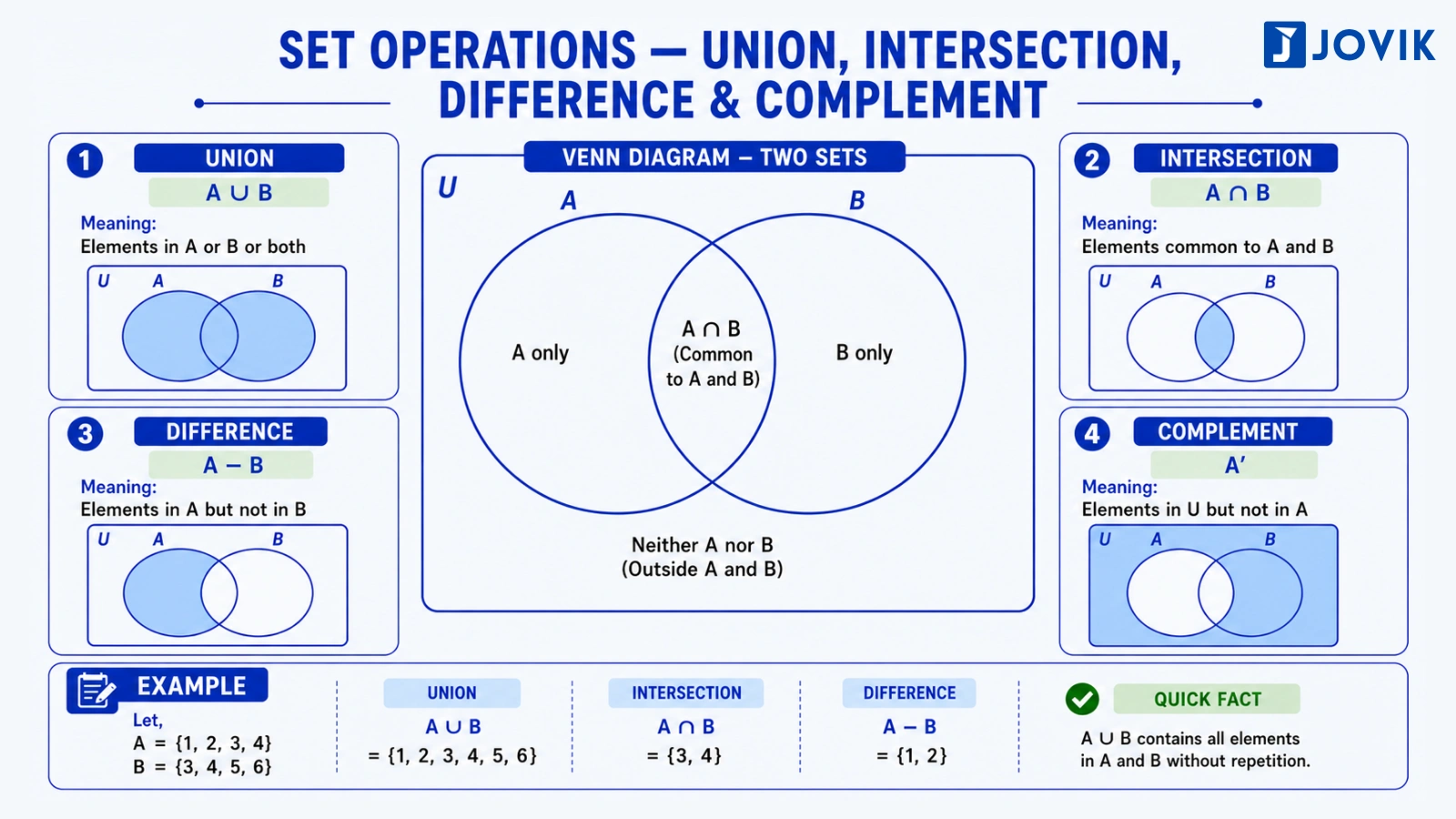
5.1 Union
A∪B is the set of all elements that belong to A, or to B, or to both.
A∪B = {x : x ∈ A or x ∈ B}
If A = {1,2,3,4} and B = {3,4,5,6}, then A∪B = {1,2,3,4,5,6}
A∩(A∪B) = A for any sets A and B [NDA 2012-I]
5.2 Intersection
A∩B is the set of all elements that belong to both A and B.
A∩B = {x : x ∈ A and x ∈ B}
If A = {1,2,3,4} and B = {3,4,5,6}, then A∩B = {3,4}
5.3 Difference
A − B (also written A \ B) is the set of elements that belong to A but not to B.
A − B = {x : x ∈ A, x ∉ B}
Using the same A and B above: A − B = {1, 2} and B − A = {5, 6}
A useful identity: A − B = A∩B′. This connects difference to intersection and complement.
(X − Y)′ = X′ ∪ Y [NDA 2009-I]
5.4 Complement
A′ (or Aᶜ or U − A) is the set of all elements in U that do not belong to A.
A′ = {x : x ∈ U, x ∉ A}
If U = {1,2,…,10} and A = {1,3,5,7,9}, then A′ = {2,4,6,8,10}
Two results always hold: A∪A′ = U and A∩A′ = ∅ [NDA 2021-I]
6. Symmetric Difference
A△B (the symmetric difference of A and B) is the set of elements that belong to A or to B, but not to both.
A△B = (A − B) ∪ (B − A) = (A∪B) − (A∩B)
If A = {1,2,3,4} and B = {3,4,5,6}, then A△B = {1,2,5,6}
If n(A) = 4 and n(B) = 3, the cardinality of A△B cannot be determined from this alone. It depends on how much A and B overlap. [NDA 2010-II]
A useful formula: n(A△B) = n(A) + n(B) − 2n(A∩B).
A△B = ∅ if and only if A = B. [NDA 2022-I]
7. Set Identities and Laws
Set identities are algebraic relationships between sets that hold for all possible sets A, B, C and a given universal set U. In the NDA examination, these identities are tested by presenting a block of claims and asking which are correct. The most powerful technique is not memorisation. It is the counterexample.
7.1 The Counterexample Technique
To prove that a claim is false, you need only one example where it fails. To prove a claim is true, you need a general argument. In NDA time conditions, constructing a small counterexample is almost always faster than proving.
Choose A = {1, 2}, B = {1}, C = {2}. This two-element example exposes most common false claims in this chapter.
7.2 The Identity Reference Table
| Identity / Law | Formula | NDA relevance |
| Idempotent | A∪A = A · A∩A = A | Foundational |
| Identity | A∪∅ = A · A∩U = A | Foundational |
| Annihilation | A∪U = U · A∩∅ = ∅ | Foundational |
| Complement | A∪A′ = U · A∩A′ = ∅ | Foundational |
| De Morgan (union) | (A∪B)′ = A′∩B′ | High : directly tested |
| De Morgan (intersection) | (A∩B)′ = A′∪B′ | High : directly tested |
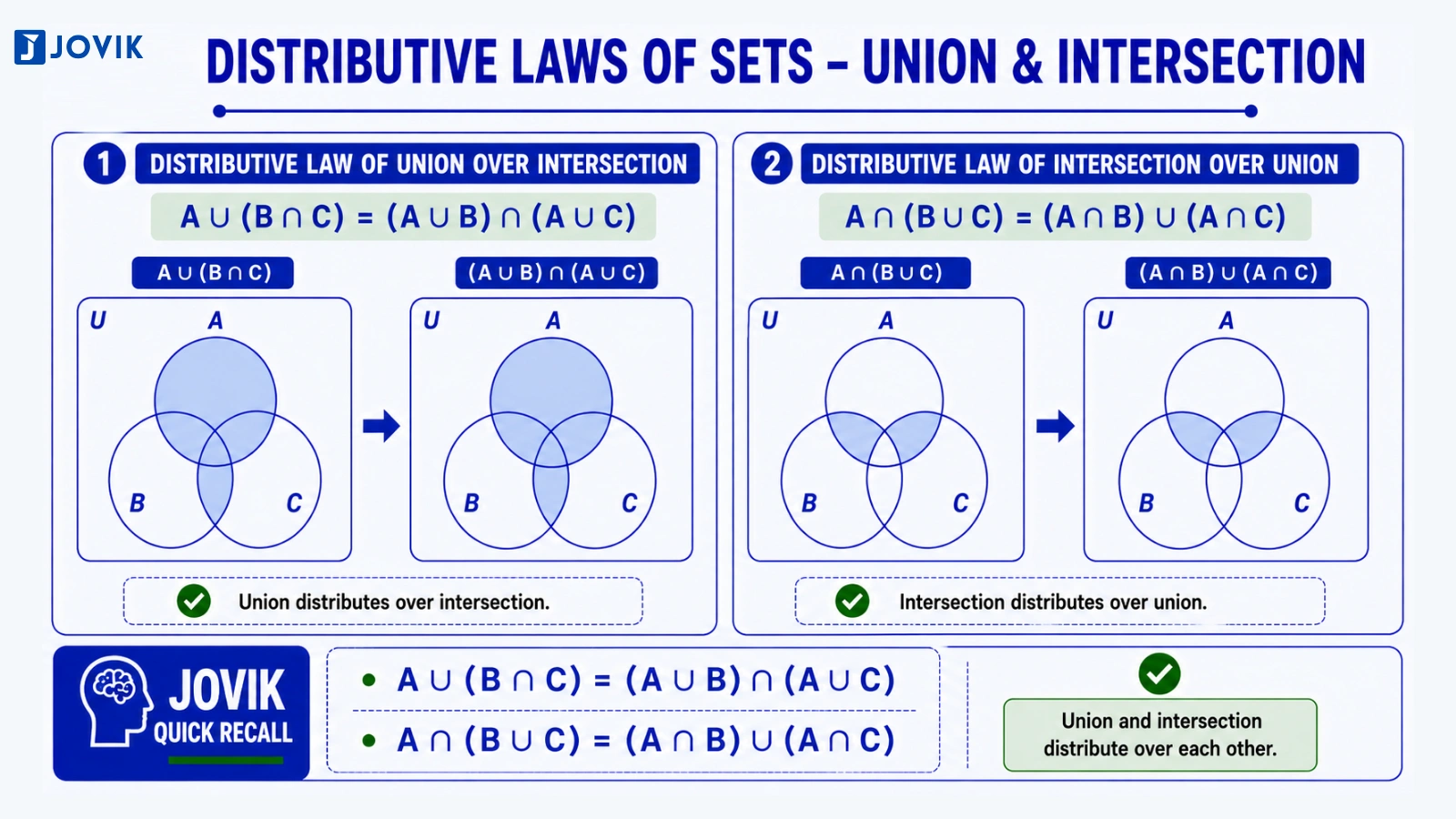
| Distributive (∪ over ∩) | A∪(B∩C) = (A∪B)∩(A∪C) | High |
| Distributive (∩ over ∪) | A∩(B∪C) = (A∩B)∪(A∩C) | High |
| Difference as intersection | A − B = A∩B′ | Frequently tested |
| Double complement | (A′)′ = A | Tested |
| Absorption | A∩(A∪B) = A · A∪(A∩B) = A | Foundational |
| Cancellation : FAILS | A∪B = A∪C does NOT force B = C | Critical Confusion [NDA 2022-II] |
| Cancellation : FAILS | A∩B = A∩C does NOT force B = C | Critical Confusion [NDA 2022-II] |
| A−B = ∅ iff A⊆B | A−B = ∅ means A⊆B, NOT necessarily A=B | Statement Confusion [NDA 2021-II] |
7.3 The Cancellation Confusion
Number algebra allows cancellation: if a + b = a + c, then b = c. Sets do not work this way.
Claim 1: A∪B = A∪C ⟹ B = C. FALSE.
Claim 2: A∩B = A∩C ⟹ B = C. FALSE.
Take A = {1, 2}, B = {1}, C = {2}.
A∪B = {1, 2} = A∪C. But B ≠ C. Claim 1 fails.
Take A = ∅. Then A∩B = ∅ = A∩C for any B and C. Claim 2 fails.
Both cancellation claims are false. [NDA 2022-II]
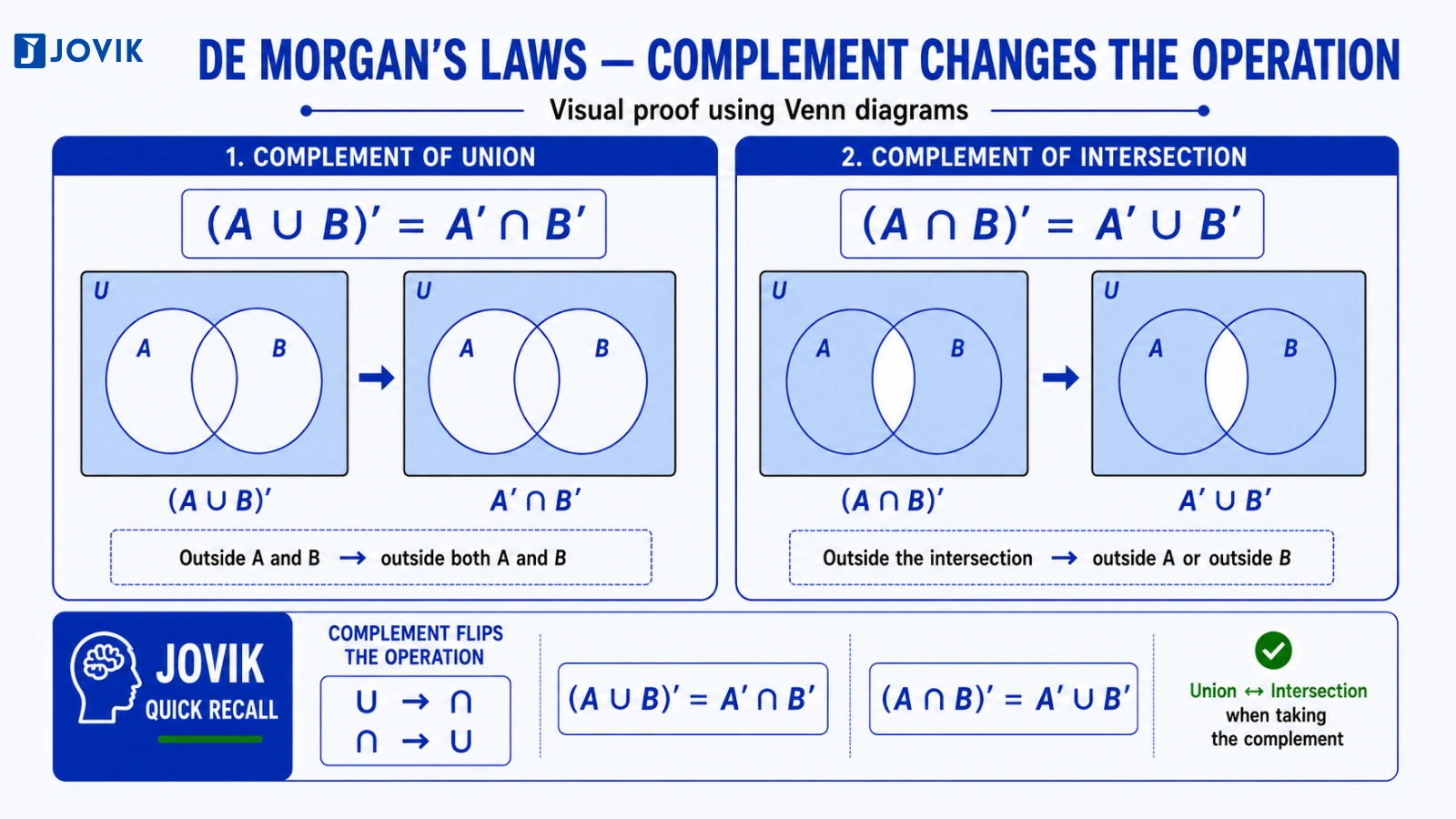
7.4 De Morgan’s Laws and Negation
When you complement a union or intersection, the connective flips:
(A∪B)′ = A′∩B′
(A∩B)′ = A′∪B′
x ∉ (A∪B) means x is outside A∪B. By De Morgan: x ∈ A′∩B′. So x ∉ A and x ∉ B. Both must fail.
x ∉ (A∩B) means x is outside A∩B. By De Morgan: x ∈ A′∪B′. So x ∉ A or x ∉ B. At least one must fail, but not necessarily both.
The connective changes: “not in the union” requires AND; “not in the intersection” requires OR.
NDA 2022-I-Q042 asked whether x ∉ (A∩B) implies x ∉ A AND x ∉ B. The answer is FALSE. The correct connective is OR. [NDA 2022-I]
7.5 Subset Implications
A = B ⟺ A ⊆ B and B ⊆ A. This is the standard way to prove two sets are equal. [NDA 2019-I]
A ⊆ B and B ⊆ C imply A ⊆ C (transitivity). But A ⊆ B and B ⊆ C do not imply B ⊆ A. [NDA 2019-I]
A − B = ∅ means every element of A is in B, i.e. A ⊆ B. It does not mean A = B. [NDA 2021-II]
7.6 Useful Derived Identities
A ∪ (B − A) = A ∪ B
A = (A ∩ B) ∪ (A − B)
All three statements in a 2023-II block were correct. [NDA 2023-II]
(A∪B) − {(A−B) ∪ (B−A) ∪ (A∩B)} = ∅
The set (A−B) ∪ (B−A) ∪ (A∩B) covers all of A∪B, so removing it leaves nothing. [NDA 2024-I]
A − B = Bᶜ − Aᶜ is correct. But A − Bᶜ ≠ Aᶜ − B. [NDA 2025-II]
| NDA Worked Example 3 Identity Verified and Disproved by Counterexample |
| Question (NDA 2022-II) Consider the following: 1. A∩B = A∩C ⟹ B = C 2. A∪B = A∪C ⟹ B = C Which of the above is/are correct? |
| Solution Test both claims using a small counterexample. Start with A = {1, 2}, B = {1}, C = {2}. Claim 1: A∩B = {1,2}∩{1} = {1}. A∩C = {1,2}∩{2} = {2}. Here A∩B ≠ A∩C, so this example does not refute Claim 1. Try a different one. Take A = ∅. Then A∩B = ∅ = A∩C for any B, C, in particular B = {1} and C = {2} which are unequal. So Claim 1 is FALSE. Claim 2: A∪B = {1,2}∪{1} = {1,2}. A∪C = {1,2}∪{2} = {1,2}. So A∪B = A∪C, yet B = {1} ≠ {2} = C. Claim 2 is FALSE. |
| Answer: Neither 1 nor 2 is correct. |
| ★ IMPORTANT: When the first counterexample does not refute a claim, adjust it. Do not conclude the claim is true. The technique is to ask: can I find any A, B, C that satisfy the hypothesis but violate the conclusion? |
| [NDA 2022-II] |
8. Operations on Described Sets
NDA questions often define sets through an algebraic rule rather than listing elements. The skill is to interpret the rule, compute a few elements to understand the structure, and then determine the required set operation.
The standard method:
- Compute elements for small values of n (or x, or the relevant parameter).
- Identify the pattern: what do the elements have in common?
- Form a conjecture about the set.
- Prove the conjecture algebraically. Pattern observation alone is not a proof.
- State the result.
N_a = {ax | x ∈ N}. Then N₁₂ ∩ N₈ = N₂₄, because the common multiples of 12 and 8 are the multiples of lcm(12, 8) = 24. [NDA 2009-II]
A = {x : x is a perfect square, x < 100} = {1, 4, 9, 16, 25, 36, 49, 64, 81}. B = even natural numbers. A∩B = {4, 16, 36, 64}: cardinality 4. [NDA 2012-I]
A = {4n+2 | n ∈ N} = {6, 10, 14, 18, …}. B = {3n | n ∈ N} = {3, 6, 9, 12, …}. A∩B consists of elements that are both of the form 4n+2 and a multiple of 3. Computing: 6 = 4(1)+2 ✓, 18 = 4(4)+2 ✓, 30 = 4(7)+2 ✓, so the pattern is {12n − 6 | n ∈ N} = {6, 18, 30, …}. [NDA 2011-I]
Algebraic proof: An element belongs to A∩B if it is simultaneously of the form 4m+2 (m ∈ N) and a multiple of 3. So 3 | (4m+2), which requires 4m ≡ 1 (mod 3), giving m ≡ 1 (mod 3). Write m = 3j−2 for j ∈ N: then 4(3j−2)+2 = 12j−6. Hence every element of A∩B has the form 12j−6, confirming A∩B = {12n−6 | n ∈ N}.
NDA 2009-II : X = {4ⁿ − 3n − 1 | n ∈ N}, Y = {9(n−1) | n ∈ N}: Computing the first few elements of X gives 0, 9, 54, 243, all non-negative multiples of 9. Y = {0, 9, 18, 27, …} = all non-negative multiples of 9. A general proof that every element of X is a multiple of 9 requires the Binomial Theorem, which is developed in Chapter 11. Accepting that result, X ⊆ Y, and therefore X∪Y = Y. [NDA 2009-II]
9. Cardinality and Inclusion–Exclusion
The cardinality n(S) of a set S is the number of distinct elements in S. When sets overlap, simply adding their cardinalities double-counts the overlapping elements. The inclusion–exclusion principle corrects for this.
9.1 Why Direct Addition Fails
Suppose n(A) = 10 and n(B) = 8, and the sets share 3 elements. Adding 10 + 8 = 18 counts those 3 elements twice. The correct count of A∪B is 18 − 3 = 15.
9.2 Inclusion–Exclusion Formula Table
| Form | Formula |
| Two sets | n(A∪B) = n(A) + n(B) − n(A∩B) |
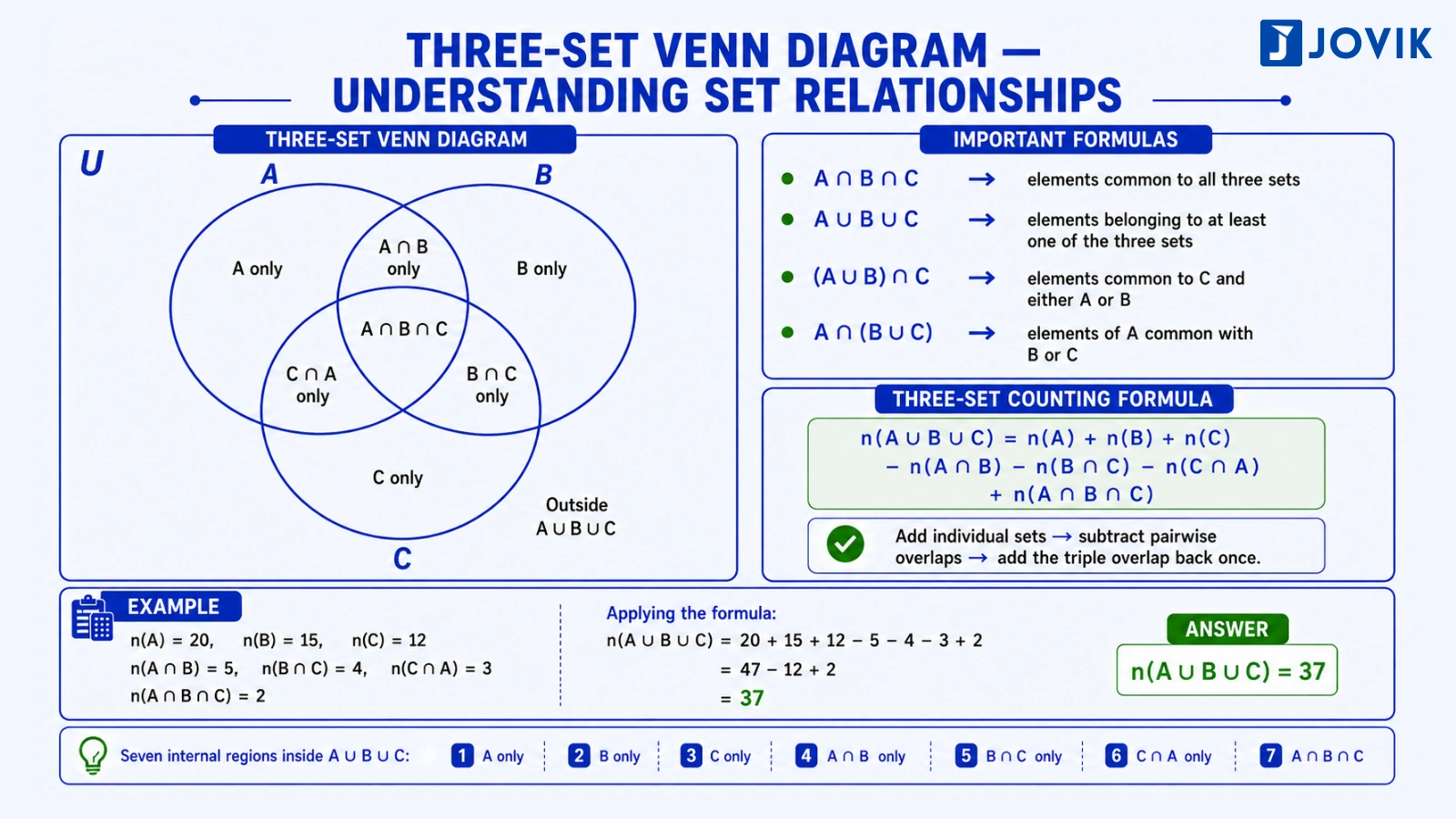
| Three sets | n(A∪B∪C) = n(A)+n(B)+n(C) − n(A∩B) − n(B∩C) − n(A∩C) + n(A∩B∩C) |
| Complement | n(A′) = n(U) − n(A) |
| Disjoint sets | n(A∪B) = n(A) + n(B) when A∩B = ∅ |
9.3 The Phrase-to-Region Table
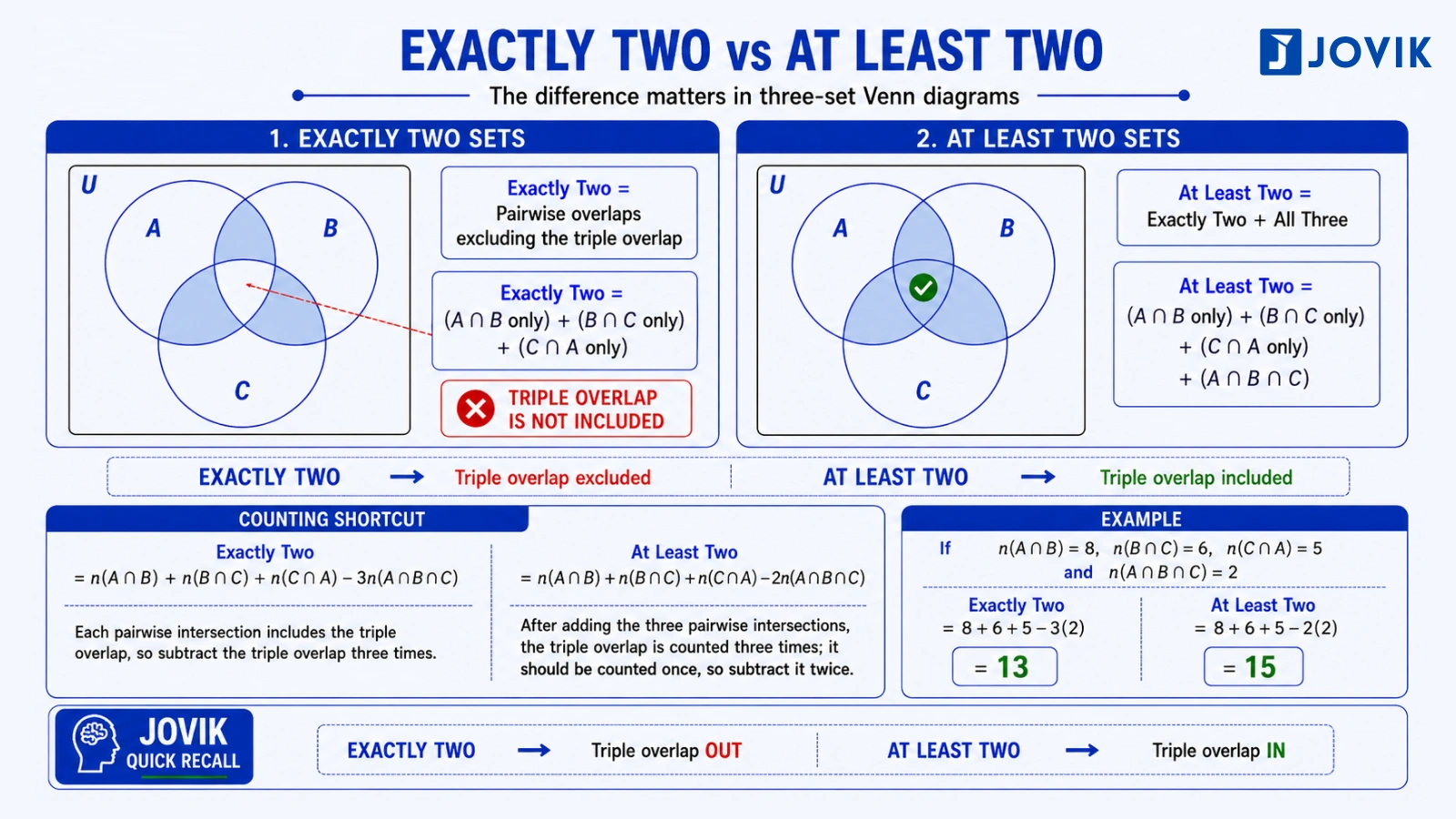
The inclusion–exclusion formula gives n(A∪B∪C): elements in at least one of the three sets. NDA questions ask for different regions. Each phrase maps to a specific combination of regions.
| Phrase | Regions Shaded | Formula | NDA Confusion |
| Only A | A outside B and C | n(A) − n(A∩B) − n(A∩C) + n(A∩B∩C) | — |
| Exactly one | Three outer-only regions | n(A)+n(B)+n(C) − 2n(A∩B) − 2n(B∩C) − 2n(A∩C) + 3n(A∩B∩C) | Often confused with “at least one” |
| Exactly two | Three pairwise-only overlaps (not centre) | n(A∩B)+n(B∩C)+n(A∩C) − 3n(A∩B∩C) | Most confused with “at least two” |
| At least two | Exactly-two regions + centre | n(A∩B)+n(B∩C)+n(A∩C) − 2n(A∩B∩C) | “At least” includes the centre |
| At least one | A∪B∪C | n(A∪B∪C) | — |
| None | Outside A∪B∪C | n(U) − n(A∪B∪C) | — |
| ★ IMPORTANT: In the NDA 2013-I cluster, a single arithmetic error in the centre region propagates through every subsequent answer. Fill the centre first and check it before proceeding. |
9.4 Percentage Surveys
When a survey is stated in percentages, the universal set U has cardinality 100. Every given figure is a percentage, and every answer must be returned in the units the question specifies.
10. Venn Diagrams and Survey Problems
A Venn diagram represents sets as overlapping circles inside a rectangle (the universal set). It makes the regions visible and prevents both double-counting and missing regions.
Critical observation: NDA papers almost never supply a Venn diagram. You must construct it from scratch. Across the entire paper history, the only known exception is NDA 2020. If you cannot draw a correct three-set Venn diagram from memory, you cannot answer cluster questions reliably.
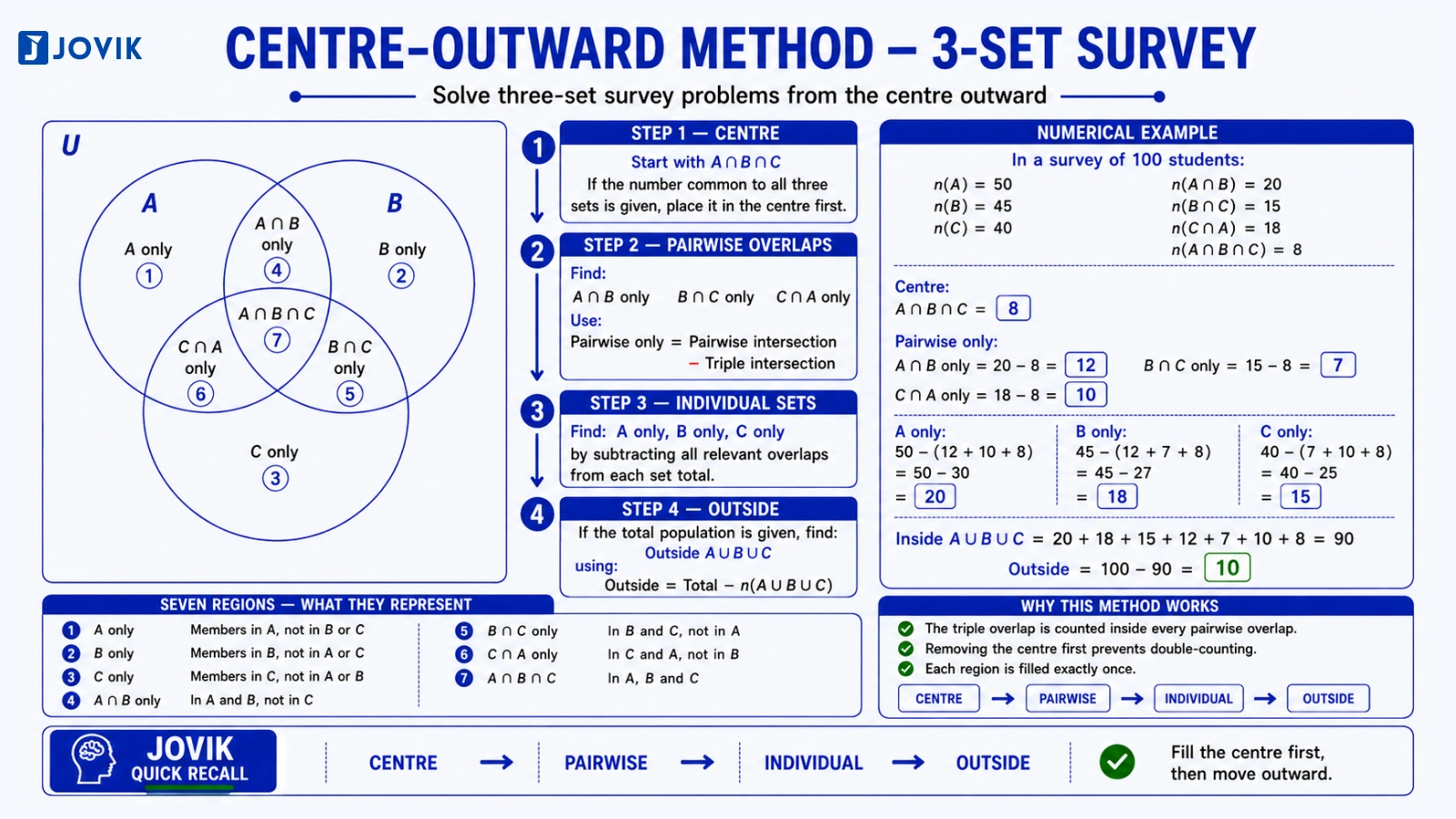
10.1 The Centre-Outward Method
In a three-set survey problem, always fill the Venn diagram in this order:
- Step 1: Fill the centre region A∩B∩C first.
- Step 2: Fill the three pairwise-only overlaps (A∩B only, B∩C only, A∩C only).
- Step 3: Fill the three outer-only regions (A only, B only, C only).
- Step 4: Calculate the “neither” region: n(neither) = n(U) − n(A∪B∪C).
- Step 5: Answer all sub-questions from the completed diagram.
The reason for working centre-outward: every pairwise overlap equals the pairwise-only region plus the triple region. You cannot fill the pairwise regions correctly unless you know the centre first.
| ★ IMPORTANT: In a general three-set problem, n(U) = 20 does not automatically mean everyone belongs to at least one set. The intended interpretation (that all 20 teachers are covered) is what closes the system. |
| NDA Worked Example 4 Three-Set Survey : Centre-Outward Method |
| Question (NDA 2009-I) Out of a group of 20 teachers in a school, 10 teach Mathematics (M), 9 teach Physics (P), and 7 teach Chemistry (C). Four teach both Mathematics and Physics, but none teach both Mathematics and Chemistry. What is the number of teachers who teach both Chemistry and Physics? |
| Solution Given: n(M) = 10, n(P) = 9, n(C) = 7, n(M∩P) = 4, n(M∩C) = 0 Since n(M∩C) = 0, no teacher belongs to both M and C. This immediately forces n(M∩P∩C) = 0 as well. Interpretation: The intended interpretation is that every teacher belongs to at least one subject group: n(M∪P∪C) = 20. Inclusion–Exclusion: 20 = n(M) + n(P) + n(C) − n(M∩P) − n(M∩C) − n(P∩C) + n(M∩P∩C) 20 = 10 + 9 + 7 − 4 − 0 − n(P∩C) + 0 20 = 22 − n(P∩C) n(P∩C) = 2 Verification: M only = 6, P only = 3, C only = 5, M∩P only = 4, P∩C only = 2, M∩C only = 0, centre = 0, neither = 0. Total = 6+3+5+4+2+0+0+0 = 20 ✓ n(M) = 6+4 = 10 ✓ n(P) = 3+4+2 = 9 ✓ n(C) = 5+2 = 7 ✓ |
| Answer: n(P∩C) = 2 |
| ★ IMPORTANT: In a general three-set problem, n(U) = 20 does not automatically mean everyone belongs to at least one set. The intended interpretation (that all 20 teachers are covered) is what closes the system. |
| [NDA 2009-I] |
| NDA Worked Example 5 Two-Set Survey : “Exactly One” vs “At Least One” |
| Question [NDA 2009-I] In an examination, 75 students passed in English (E) and 60 passed in Mathematics (M), with 45 passing in both. What is the number of students who passed in exactly one subject? |
| Solution Draw the two-set Venn. Fill the overlap first: n(E∩M) = 45. E only = n(E) − n(E∩M) = 75 − 45 = 30 M only = n(M) − n(E∩M) = 60 − 45 = 15 Exactly one = E only + M only = 30 + 15 = 45 |
| Answer: 45 |
| ★ IMPORTANT: “At least one” would give n(E∪M) = 75 + 60 − 45 = 90. That is a different question with a different answer. Always identify which phrase the question uses before applying any formula. |
| [NDA 2009-I] |
The same two-set “exactly one” structure appeared again in NDA 2025-II (Q011: cricket and football, 45 students). The method is identical; only the numbers and the phrasing of the overlap condition change.
| NDA Worked Example 6 Cluster Walkthrough : “Exactly Two” vs “At Least Two” |
| Question (NDA 2022-II, Q034–Q036) A university awarded medals in basketball (B), football (F), and volleyball (V). x students (x < 6) received medals in all three sports. The total number of medal winners was 15x. Medals awarded: basketball 5x, football 4x+15, volleyball x+25. Find: (a) exactly two sports (b) at least two sports (c) exactly one sport. |
| Solution Setting up: All medal winners together: n(B∪F∪V) = 15x. Let S = n(B∩F) + n(B∩V) + n(F∩V) denote the sum of all pairwise intersections. Apply three-set inclusion–exclusion: 15x = 5x + (4x+15) + (x+25) − [n(B∩F) + n(B∩V) + n(F∩V)] + x 15x = 10x + 40 + x − S S = 11x + 40 − 15x = 40 − 4x Reading from the Phrase-to-Region Table: Exactly two = S − 3·n(B∩F∩V) = (40−4x) − 3x = 40 − 7x At least two = S − 2·n(B∩F∩V) = (40−4x) − 2x = 40 − 6x Exactly one = Total − (at least two) = 15x − (40−6x) = 21x – 40 |
| Answer: (a) 40 − 7x (b) 40 − 6x (c) 21x – 40 |
| ★ IMPORTANT: “Exactly two” and “at least two” differ by the centre region (all-three), which equals x. They produce different answers from the same diagram. This pair was asked as adjacent questions in NDA 2011-I and again in NDA 2022-II. Read the phrase before choosing the formula. |
| [NDA 2011-I, NDA 2022-II] |
11. Minimum and Maximum Cardinality
Some NDA questions do not give enough information to compute n(A∩B) exactly. They ask for the least or greatest possible value of an overlap. These are extremal problems. You reason about which Venn configuration achieves the extreme, not which formula gives a unique answer.
11.1 Minimum Overlap
n(A∩B) is smallest when the overlap is as small as possible. The least it can be is max{0, n(A) + n(B) − n(U)}.
Example: n(A) = 70, n(B) = 60, n(U) = 100. Minimum n(A∩B) = max{0, 70 + 60 − 100} = 30.
11.2 Maximum Overlap
n(A∩B) is largest when as many elements as possible coincide. The most it can be is min{n(A), n(B)}.
Same example: maximum n(A∩B) = min{70, 60} = 60.
| ★ IMPORTANT: When the question asks for a “least” or “greatest” value, it is asking for a bound, not a single computed number. Identify the extremal configuration, then read off the value. |
Minimum and maximum overlap questions. [NDA 2013-II–2019-II]
12. Cartesian Products
The Cartesian product A×B is the set of all ordered pairs (a, b) where a ∈ A and b ∈ B. Order matters: (a, b) ≠ (b, a) unless a = b.
A×B = {(a, b) : a ∈ A, b ∈ B}
If A = {1, 2} and B = {3, 4}, then A×B = {(1,3), (1,4), (2,3), (2,4)}
Cardinality: n(A×B) = n(A) · n(B). So n(A×B) = n(B×A), even though A×B ≠ B×A in general. [NDA 2012-II]
Common elements of A×B and B×A: (a, b) belongs to both A×B and B×A if and only if a ∈ A∩B and b ∈ A∩B. So the number of common elements is n(A∩B)² = n². [NDA 2009-II, NDA 2012-I]
Distributivity: A×(B−C) = (A×B) − (A×C). This identity holds; the form (A−B)×(A−C) is incorrect. [NDA 2009-I]
If A∩C = ∅: then (A×B) ∩ (C×B) = ∅. [NDA 2011-I]
Cartesian products are covered here as the bridge to Chapter 2 : Relations, where ordered pairs form the foundation of the entire chapter.
13. Important Distinctions
∈ versus ⊆. “∈” is membership: a ∈ A means a is an element of A. “⊆” is inclusion: A ⊆ B means A is a subset of B. If A = {1, 2, 3}: 2 ∈ A is correct; {2} ∈ A is wrong; {2} ⊆ A is correct.
Equal versus equivalent. Equal sets have the same elements. Equivalent sets have the same cardinality. Equal implies equivalent; equivalent does not imply equal.
Subset versus proper subset. Every set is a subset of itself; no set is a proper subset of itself. Total subsets: 2ⁿ. Proper subsets: 2ⁿ − 1.
“Exactly two” versus “at least two”. Exactly two covers only the pairwise-only overlap regions (excludes the centre). At least two adds the centre region. A one-region difference that changes the numerical answer.
Null set notation. ∅ and {} mean the same thing. {0} is a set with one element. {∅} is a set containing the empty set. ∅ ≠ 0. [NDA 2011-II]
Set cancellation. For real numbers, a + b = a + c forces b = c. For sets, A∪B = A∪C does not force B = C. Set algebra is not numeric algebra.
Geometric Intersection
If P, Q, R are three non-collinear points, then line PQ and line PR share exactly one point, which is the point P itself. So PQ ∩ PR = {P}. [NDA 2011-I]
JOVIK Quick Recall
Set Types
- Null set: ∅ = {} : no elements. ∅ ≠ 0, ∅ ≠ {0}, ∅ ≠ {∅}. [NDA 2011-II]
- Finite vs infinite: counting stops (finite) vs never stops (infinite). [NDA 2022-II, NDA 2024-II]
- Equal: same elements. Equivalent: same cardinality. Equal ⟹ equivalent; not vice versa. [NDA 2021-I]
- Disjoint: A∩B = ∅.
Subsets and Power Sets
- All subsets: 2ⁿ [NDA 2009-I]
- Proper subsets: 2ⁿ − 1 (“proper” excludes the set itself) [NDA 2009-I, 2010-I, 2011-II, 2021-II]
- Power set: |P(A)| = 2ⁿ [NDA 2012-II, NDA 2021-I]
- Supersets of a k-element subset: 2ⁿ⁻ᵏ [NDA 2020-I & II, NDA 2022-I]
- Set-valued element: {{1,2,3}} has ONE element : the inner set is one object [NDA 2022-I, NDA 2019-I]
- Iterated power sets of ∅: 0 → 1 → 2 → 4 → 16 [NDA 2009-II]
Set Identities and Laws
- De Morgan: (A∪B)′ = A′∩B′ · (A∩B)′ = A′∪B′
- Distributive: A∩(B∪C) = (A∩B)∪(A∩C)
- Difference: A − B = A∩B′
- x ∉ (A∪B): x ∉ A AND x ∉ B (conjunction)
- x ∉ (A∩B): x ∉ A OR x ∉ B (disjunction) [NDA 2022-I]
- Cancellation FAILS: A∪B = A∪C does NOT force B = C [NDA 2022-II]
- A−B = ∅ means A ⊆ B, not A = B [NDA 2021-II]
- Counterexample technique beats memorisation for all statement-verification questions.
Inclusion–Exclusion and Phrase Map
- Two-set: n(A∪B) = n(A) + n(B) − n(A∩B)
- Three-set: n(A∪B∪C) = n(A)+n(B)+n(C) − n(A∩B) − n(B∩C) − n(A∩C) + n(A∩B∩C)
- Exactly one: n(A)+n(B)+n(C) − 2n(A∩B) − 2n(B∩C) − 2n(A∩C) + 3n(A∩B∩C) [NDA 2011-I, NDA 2022-II]
- Exactly two: n(A∩B)+n(B∩C)+n(A∩C) − 3n(A∩B∩C)
- At least two: n(A∩B)+n(B∩C)+n(A∩C) − 2n(A∩B∩C) [NDA 2011-I, NDA 2022-II]
- None: n(U) − n(A∪B∪C)
- Percentage survey: universal set = 100; all values and answers are percentages.
Survey Cluster Discipline
- Draw the three-set Venn FIRST. NDA papers almost never supply the diagram : NDA 2020 is the only known exception.
- Fill CENTRE first (A∩B∩C), then pairwise overlaps, then outer regions.
- One wrong centre value → all cluster marks at risk. [NDA 2013-I]
- “Exactly two” and “at least two” are different regions on the same diagram. [NDA 2011-I, NDA 2022-II]
Cartesian Products
- n(A×B) = n(A) · n(B)
- Common elements of A×B and B×A: n² where n = |A∩B| [NDA 2009-II, NDA 2012-I]
- A×(B−C) = (A×B) − (A×C) [NDA 2009-I]
Common Mistakes
| Common wrong answer | Correct understanding |
| “Exactly two” = “at least two” | “Exactly two” EXCLUDES the all-three region. “At least two” INCLUDES it. [NDA 2011-I, NDA 2022-II] |
| 2ⁿ = proper subsets | 2ⁿ = ALL subsets. Proper subsets = 2ⁿ − 1. [NDA 2009-I, NDA 2010-I, NDA 2021-II] |
| A∪B = A∪C forces B = C | Set cancellation FAILS. [NDA 2022-II] |
| x∉A∩B means x∉A AND x∉B | x∉A∩B means x∉A OR x∉B. [NDA 2022-I] |
| {{1,2,3}} has 3 elements | {{1,2,3}} has 1 element : the inner set is one object. [NDA 2022-I] |
| The Venn diagram will be supplied | NDA papers generally expect you to construct it yourself. Draw the diagram before solving the cluster. |
| Min overlap is a direct computation | Minimum overlap is a bound : find the extremal configuration. [NDA 2019-I] |
| Equivalent sets = equal sets | Equivalent means same cardinality only. Equal means same elements. [NDA 2021-I] |
| A−B = ∅ means A = B | A−B = ∅ means A ⊆ B, not necessarily A = B. [NDA 2021-II] |