Free NDA 2026 Preparation Guide
View Strategy

Sentence Structure – NDA English Notes
Exam Relevance: NDA English | Spotting Errors · Sentence Improvement| Tag Questions · Inversion · Correlative Structures · Conditional Sentences · Parallel Structure
Reading Time: 35–40 minutes | Last Updated: 2026
A sentence is the basic unit of written English, the smallest piece of language that expresses a complete thought. But the NDA examiner is not interested in simple sentences. Every examined sentence in this chapter is structurally complex: it contains an inversion, a tag, a correlative pair, a conditional clause, or a parallel construction. Each of these structures has precise grammatical rules, and the examiner systematically tests whether students know those rules.
This chapter covers the structural features of sentences that NDA examines most consistently. Some of these features (tag questions, negative adverbial inversion, conditional sentences) have appeared in multiple papers across several years. Others, such as complement-taking verbs and correlative structures, have appeared less frequently but are confirmed examination targets. Every concept taught here is directly linked to a confirmed NDA question.
2. Building Blocks of a Sentence
Every English sentence contains a grammatical subject and a predicate. The subject names who or what the sentence is about. The predicate contains the verb and says something about the subject. Everything else in the sentence (objects, complements, adverbials) builds outward from this core.
Understanding the subject–predicate relationship is not just foundational grammar. It is the basis for several specific NDA error types: subject–verb agreement errors, misplaced modifiers, and incorrect parallel constructions all involve failures at the level of this core relationship.
Subject and Predicate
“The soldiers guarded the bridge.”
Subject: The soldiers
Predicate: guarded the bridge
“Silence fell over the room.”
Subject: Silence
Predicate: fell over the room
The subject of a sentence is not always the first word. In questions, in inversions after negative adverbials, and in some literary constructions, the subject follows the verb. Recognising the grammatical subject regardless of its position is essential for this chapter.
3. Types of Sentences
English sentences are classified by their grammatical function into four types. This classification is directly relevant to the chapter because some NDA questions involve transforming one sentence type to another, particularly from interrogative to declarative (indirect questions in reported speech) and from declarative to exclamatory.
| Type | Function | Example |
| Declarative | Makes a statement | “The committee approved the proposal.” |
| Interrogative | Asks a question | “Has the committee approved the proposal?” |
| Imperative | Issues a command or request | “Submit the proposal by Friday.” |
| Exclamatory | Expresses strong emotion | “What a remarkable proposal it was!” |
Declarative sentences use statement word order (subject + verb). Interrogative sentences use inverted order (auxiliary + subject). When a question is embedded inside a declarative sentence as an indirect question (“I don’t know what the time is”), it must use declarative order, not question order. This rule generates one of the most commonly tested errors in the Direct & Indirect Speech chapter (Chapter 14).
4. Inversion
Inversion means placing the auxiliary verb before the subject (the structure of direct questions “What is he doing?”) in a declarative or conditional context where standard subject–verb order would normally apply. English uses inversion in several specific grammatical environments, and using or omitting it incorrectly is a confirmed NDA error type.
Standard Question Inversion
In a direct question, English places the auxiliary before the subject:
Standard order: “She is going.” (subject + auxiliary)
Question order: “Is she going?” (auxiliary + subject)
Wh-question: “Where is she going?” (wh-word + auxiliary + subject)
When a question is embedded inside a declarative sentence (as a noun clause) the inversion must be removed and declarative order restored:
WRONG: “I don’t know where is she going.” (inversion retained in embedded clause)
RIGHT: “I don’t know where she is going.” (declarative order in embedded clause)
This embedded-question word order rule is among the most consistently confirmed errors in the NDA corpus. It appears across Spotting Errors and Sentence Improvement formats.
Inversion After Negative and Limiting Adverbials
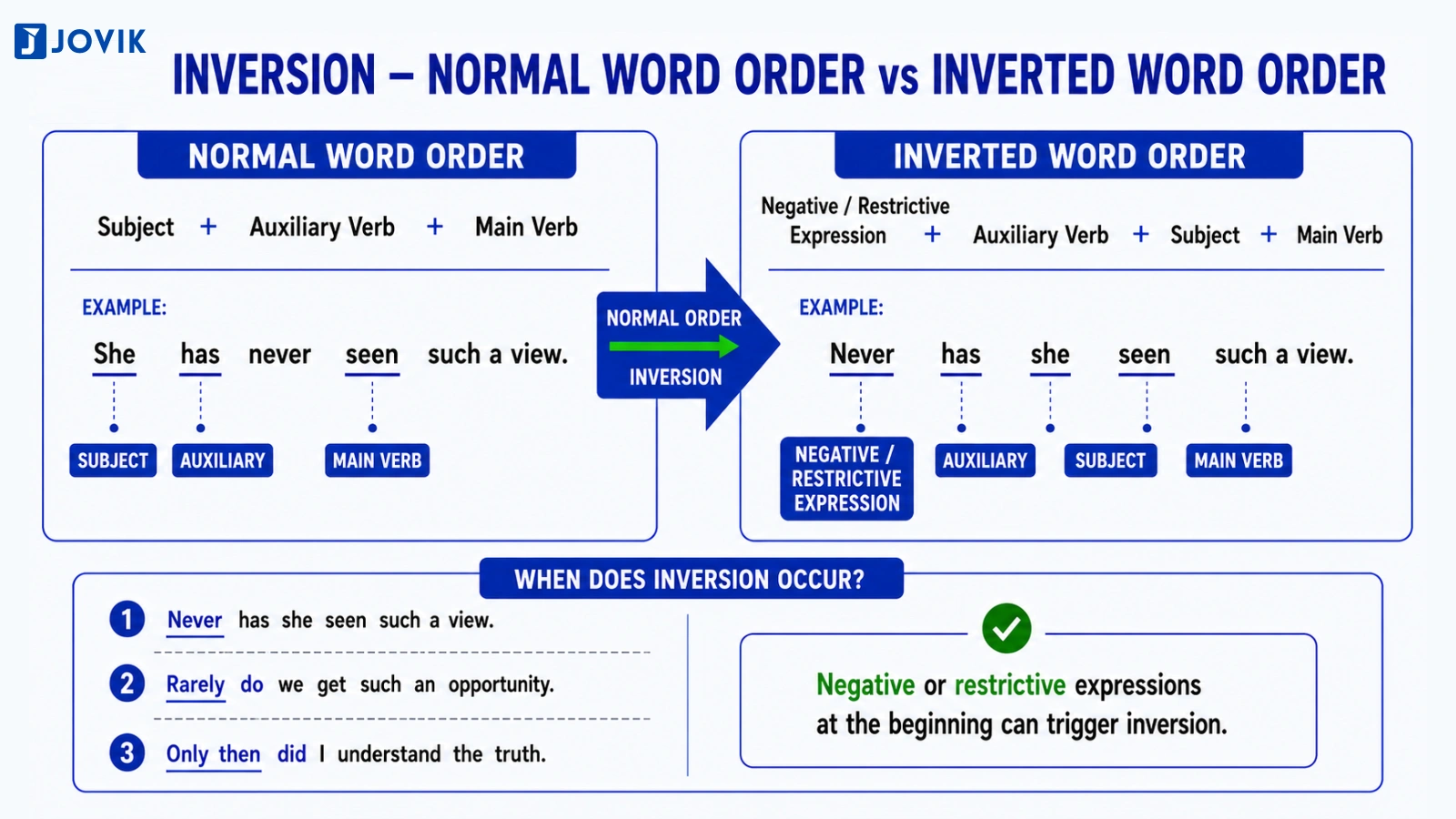
When a negative or limiting adverbial expression is placed at the beginning of a sentence for emphasis, the subject and auxiliary invert, as in a question. This inversion is obligatory; omitting it is a grammatical error.
| ★ IMPORTANT After a negative or limiting adverbial at the beginning of a sentence, the auxiliary must precede the subject (inverted order). This is mandatory, not optional. |
| Adverbial Expression | Example (Inverted) | PYQs |
| Never | “Never have I seen such courage.” | — |
| Rarely / Seldom | “Seldom do we witness such events.” | — |
| Not only…but also | “Not only did he win, but he also broke the record.” | — |
| No sooner…than | “No sooner had she left than the phone rang.” | [NDA 2015-II] |
| Hardly/Scarcely…when | “Hardly had we started when the rain began.” | [NDA 2019-I] |
| Only after / Only when | “Only after the guests left did she relax.” | — |
5. Tag Questions
A tag question is a short question appended to the end of a declarative statement. It asks the listener to confirm or deny the statement. Tag questions are constructed according to strict grammatical rules, and their formation has been tested in five separate NDA papers, making them one of the highest-priority concepts in this chapter.
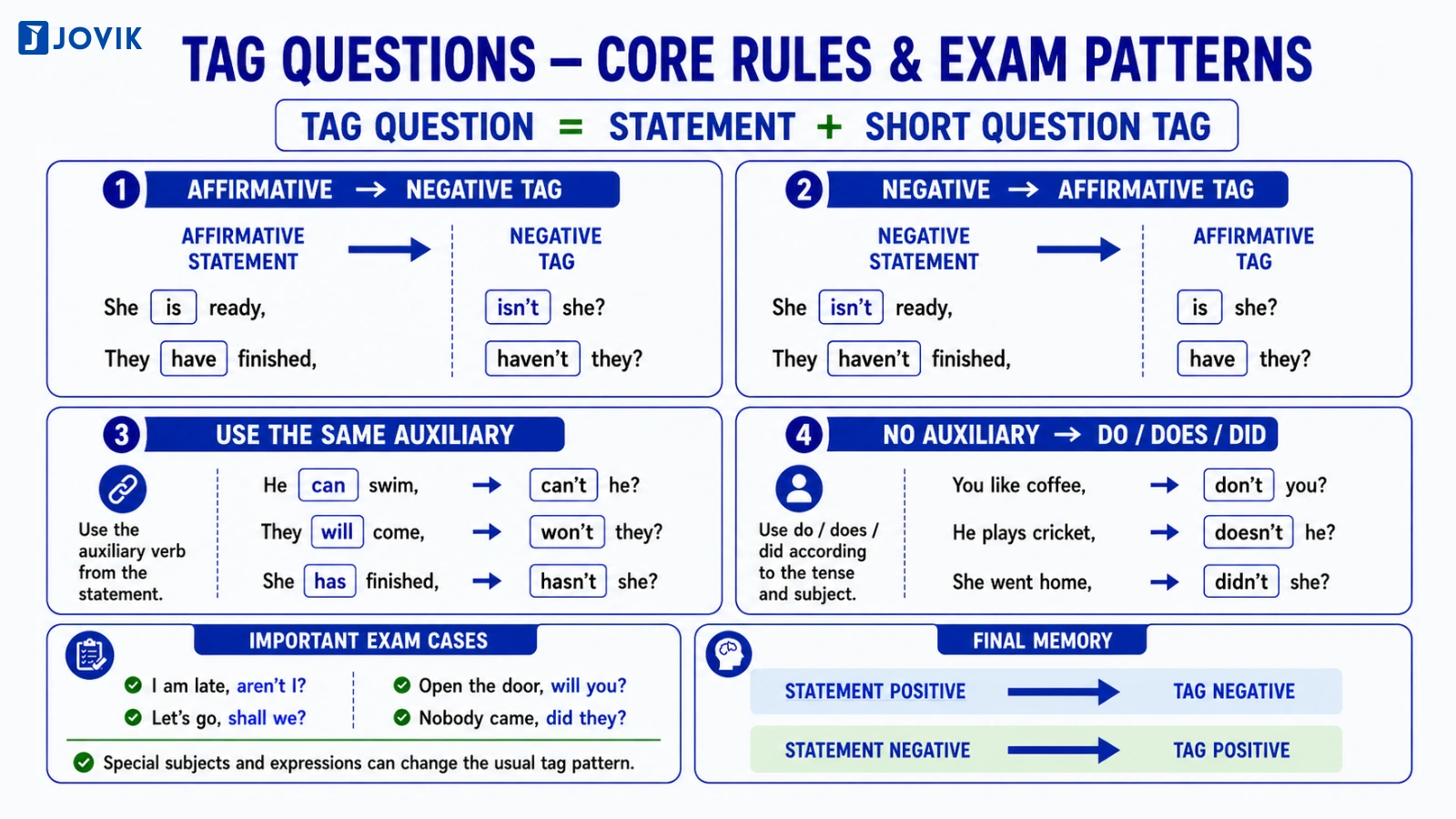
The formation rules work as a system of three opposites:
| ★ IMPORTANT Tag question rule: positive statement → negative tag. Negative statement → positive tag. The auxiliary in the tag must match the auxiliary (or be formed from the main verb) in the main clause. The pronoun in the tag must match the subject of the main clause. |
The Three Rules
| Rule | Main Clause | Tag | NDA PYQS |
| Positive → Negative tag | “She is coming to the party,” | “isn’t she?” | [NDA 2009-II] |
| Negative → Positive tag | “He isn’t feeling well,” | “is he?” | [NDA 2011-II] |
| Auxiliary matches main clause | “They will attend,” | “won’t they?” (not “will they?”) | [NDA 2012-I] |
When the main clause has no auxiliary verb (when it uses only a main verb in simple present or simple past) the tag is formed using “do”, “does”, or “did” to carry the tense:
“She works in Delhi, doesn’t she?” (simple present → doesn’t)
“They visited yesterday, didn’t they?” (simple past → didn’t)
“He runs every morning, doesn’t he?” (simple present + third person singular → doesn’t)
Special Cases That NDA Tests
| Special Case | Correct Tag | Explanation |
| “I am right,” | “aren’t I?” | “Am I not?” is formal; “aren’t I?” is the standard contracted form. |
| “Let’s go,” | “shall we?” | Invitations using “let’s” take “shall we?” as the tag. |
| “Everyone came,” | “didn’t they?” | “Everyone” and “someone” are singular but use “they” in the tag (informal standard). |
| “Nothing was said,” | “was it?” | Negative indefinite subject (“nothing”) → positive tag, pronoun “it”. |
| “I’m late,” | “aren’t I?” | “Am I not?” is the formal equivalent; “aren’t I?” is the examined standard. |
The five NDA confirmations of tag question errors span 2009-II, 2011-II, 2012-I, 2015-I, and 2015-II. The examiner has tested both Spotting Errors (identifying a wrong tag) and Sentence Improvement (selecting the correct tag from four options). Every tag question in the confirmed corpus involves one of the three core rules: wrong polarity, wrong auxiliary, or wrong pronoun.
6. Subject–Auxiliary Inversion After Negative Adverbials
This section develops the inversion rule introduced in Section 4 into a full examined concept. When a sentence begins with a negative or limiting adverbial (“No sooner”, “Hardly”, “Scarcely”, “Never”, “Not only”), the subject and auxiliary must invert. Two specific constructions have confirmed NDA PYQs.
“No Sooner…Than” and “Hardly/Scarcely…When”
These are the most confirmed negative adverbial inversion structures in the NDA corpus. Each has a two-part structure: the negative adverbial triggers inversion in the first clause, and the second clause is introduced by a specific conjunction.
| ★ IMPORTANT “No sooner…than”: inversion required after “no sooner”. “Hardly/Scarcely…when”: inversion required after “hardly” or “scarcely”. The past perfect is used in the first clause; simple past in the second. NO SOONER: RIGHT: “No sooner had she left than the phone rang.” WRONG: “No sooner she had left than the phone rang.” (no inversion) WRONG: “No sooner had she left when the phone rang.” (wrong conjunction: must be “than”) HARDLY: RIGHT: “Hardly had we started when the rain began.” WRONG: “Hardly we had started when the rain began.” (no inversion) WRONG: “Hardly had we started than the rain began.” (wrong conjunction: must be “when”) |
Two common errors appear together in the NDA corpus. First, students omit the required inversion (writing “No sooner she had” instead of “No sooner had she”). Second, students confuse the conjunction: “no sooner…than” (not “when”) and “hardly/scarcely…when” (not “than”). Both error types have been confirmed in NDA 2015-II and NDA 2019-I.
7. Correlative Structures
Correlative conjunctions are pairs of linking words that work together to connect two balanced sentence elements. The most commonly tested correlatives in NDA are “the more…the more” (and similar comparative constructions) and “such…as / so…that”. Each correlative pair has a fixed grammatical structure that cannot be altered.
“The More…The More” — Comparative Correlatives
This construction expresses a proportional relationship between two variables: as one increases, the other increases correspondingly. The structure requires: the + comparative, the + comparative.
RIGHT: “The more you practise, the better you will become.”
RIGHT: “The faster the wind, the higher the waves.” [NDA 2015-I]
WRONG: “More you practise, more you will improve.” (articles “the” missing)
WRONG: “The more you practise, the more better you become.” (double comparative)
The construction is not “more…more” (which appears in some Indian English usage) but specifically “the + comparative…the + comparative”. The article “the” is obligatory. Both halves of the structure must use a comparative form: either a one-word comparative (faster, better, higher) or “more + adjective/adverb” (more rapidly, more carefully).
“Such…As” and “So…That”
“Such…as” and “so…that” are correlative pairs that introduce a result or purpose clause. They have different grammatical requirements depending on what follows them.
| Correlative | Structure | Example |
| “Such…as” | such + noun phrase + as | “She is such a talented singer as to deserve recognition.” |
| “Such…that” | such + noun phrase + that + clause | “It was such a heavy rain that the road flooded.” |
| “So…that” | so + adjective/adverb + that + clause | “He ran so fast that no one could catch him.” |
| “So…as to” | so + adjective/adverb + as to + infinitive | “She was so kind as to offer help.” |
A common error is using “so” where “such” is required, or vice versa. “So” qualifies adjectives and adverbs; “such” qualifies nouns. “It was so a heavy rain” is wrong because “a heavy rain” is a noun phrase, requiring “such”. “It was such heavy that…” is wrong because “heavy” alone is an adjective, requiring “so”.
8. Complement-taking Verbs
Some verbs require a specific type of complement (a that-clause, a to-infinitive, or a gerund) and will not accept other structures. Using the wrong complement type after a complement-taking verb is a grammatical error, even if the meaning is clear.
The NDA examiner has specifically tested the behaviour of verbs that take a that-clause complement but that students may incorrectly complete with a to-infinitive or an object alone. This was confirmed in NDA 2009-II, where a verb requiring a that-clause was used with a wrong complementation structure.
Key Complement Patterns
| Pattern | Verbs | Example |
| Verb + that-clause | believe, think, know, say, suggest, claim, insist, feel | “She insisted that he apologise.” |
| Verb + to-infinitive | want, wish, hope, expect, decide, agree, refuse, plan | “He decided to leave early.” |
| Verb + gerund (-ing) | enjoy, avoid, consider, suggest, recommend, deny | “They suggested postponing the meeting.” |
| Verb + object + to-infinitive | tell, ask, want, expect, advise, order | “She told him to report immediately.” |
| Verb + object + bare infinitive | make, let, hear, see, watch, feel | “She made him apologise.” (no “to”) |
The most frequently tested error type in this area is the incorrect use of the bare infinitive (without “to”) after verbs that require “to + infinitive”, or the incorrect use of “to + infinitive” after verbs like “make” and “let” that require the bare infinitive. “She made him to apologise” is a confirmed error type: “to” must not appear after causative “make”.
Suggest: A Frequently Misused Complement Verb
“Suggest” deserves special attention because it is misused systematically. “Suggest” cannot be followed by a simple object (“He suggested me an idea” — wrong). It must be followed by a gerund, a that-clause, or a noun phrase that is genuinely the thing suggested.
RIGHT: “She suggested postponing the meeting.” (gerund)
RIGHT: “She suggested that we postpone the meeting.” (that-clause)
RIGHT: “She suggested a different approach.” (noun phrase)
WRONG: “She suggested me to stay.” (object + infinitive – not standard)
WRONG: “She suggested me a better solution.” (indirect object structure)
9. Parallel Structure
When two or more elements in a sentence are joined by a coordinating conjunction (and, or, but, nor) or a correlative conjunction (both…and, either…or, neither…nor, not only…but also), those elements must be grammatically parallel: they must belong to the same grammatical category and have the same form.
| ★ IMPORTANT Parallel structure: elements joined by coordinating or correlative conjunctions must have the same grammatical form. Noun with noun. Adjective with adjective. Infinitive with infinitive. Gerund with gerund. |
The violation of parallel structure (combining a noun with an adjective, or a gerund with an infinitive, in a coordinate construction) is one of the most consistently confirmed errors across NDA English papers.
Common Parallel Structure Errors
| Error (Non-parallel) | Correction (Parallel) | What changed |
| “She enjoys reading, to paint, and cook.” | “She enjoys reading, painting, and cooking.” | All three changed to gerunds |
| “He is tall, intelligent, and has ambition.” | “He is tall, intelligent, and ambitious.” | Noun changed to adjective |
| “She likes both dancing and to sing.” | “She likes both dancing and singing.” | Infinitive changed to gerund after “both…and” |
| “Not only is she talented but also works hard.” | “Not only is she talented but she is also hardworking.” | Restructured for parallel predicate |
| “To prepare well and studying regularly are both essential.” | “Preparing well and studying regularly are both essential.” | Infinitive changed to gerund |
With correlative conjunctions, parallelism must be maintained across both halves of the pair: “either…or”, “neither…nor”, “not only…but also”, “both…and”. Each of these pairs must be followed by grammatically equivalent elements. “Either you leave or staying” is wrong. “Either you leave or you stay” is correct.
10. Conditional Sentences
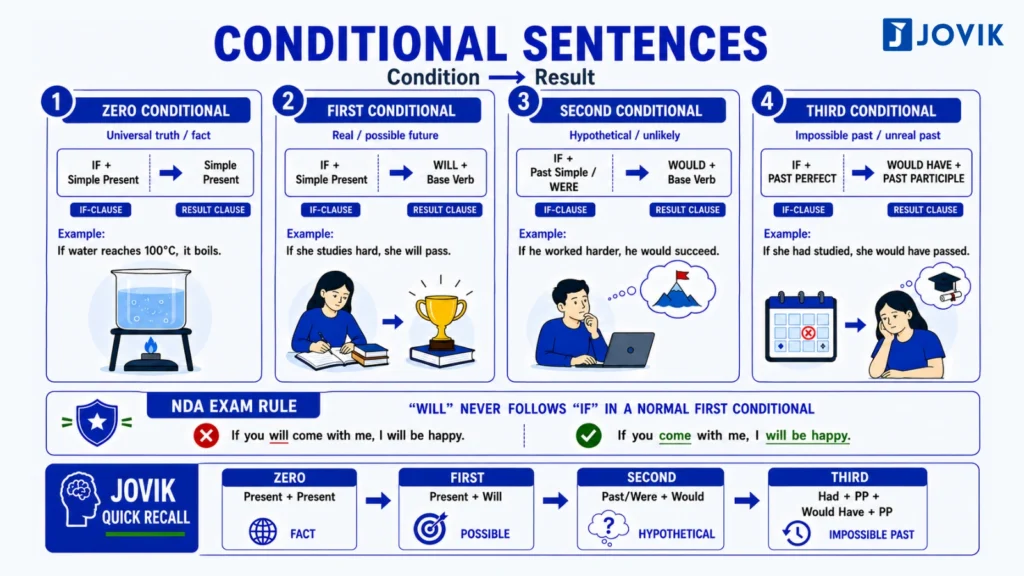
Conditional sentences express a relationship between a condition and a result. Whether the condition is real, hypothetical, or impossible determines the tense pairing used in the sentence. NDA has tested conditional sentence errors across multiple papers and all three major conditional types.
The full treatment of conditionals (with all confirmed PYQs, the “will never follows if” rule, and the second and third conditional errors) belongs to the Tenses chapter (Chapter 11), which is the primary home for this concept. This section presents the structural framework and the most confirmed rule, and cross-references Chapter 11 for complete coverage.
The Three Main Conditional Types
| Type | Condition (If-clause) | Result (Main clause) | Meaning |
| Zero (universal truth) | Simple present | Simple present | “If water reaches 100°C, it boils.” |
| First (real, possible) | Simple present | Will + base verb | “If she studies hard, she will pass.” |
| Second (hypothetical) | Past simple / were | Would + base verb | “If he worked harder, he would succeed.” |
| Third (impossible past) | Past perfect (had + pp) | Would have + past participle | “If she had studied, she would have passed.” |
| ★ IMPORTANT “WILL” must never follow “IF” in the if-clause of a real (first) conditional. This is the single most confirmed rule in the Tenses chapter. “If you will come with me” — wrong. “If you come with me” — correct. See Chapter 11 for full PYQ analysis. |
Mixing conditional types (using the if-clause form of the second conditional with the main clause form of the third conditional, or vice versa) is another confirmed error type. “If I were a millionaire, I would have helped the poor” mixes second conditional (“were”) with third conditional main clause (“would have helped”). This error is analysed in full in Chapter 11, Section 5.4.
JOVIK Quick Recall
| Concept | Rule | Confirmed Error |
| Tag Questions | Positive → negative tag. Negative → positive tag. Auxiliary matches main clause. | “She is here, is she?” (wrong polarity) |
| Inversion after negative adverbials | Auxiliary precedes subject after sentence-initial “Never / Seldom / No sooner / Hardly”. | “No sooner she left” (no inversion) |
| “No sooner…than” | “No sooner” takes “than” (not “when”). Past perfect + inversion in first clause. | “No sooner…when” (wrong conjunction) |
| “Hardly/Scarcely…when” | “Hardly” and “scarcely” take “when” (not “than”). Past perfect + inversion in first clause. | “Hardly…than” (wrong conjunction) |
| Correlative “the more…the more” | Both halves: the + comparative. Article “the” is obligatory. | “More…more” (articles missing) |
| Parallel structure | Coordinate elements must be the same grammatical category and form. | “Reading, to paint, and cook” (mixed forms) |
| Complement-taking verbs | “Make/let” + bare infinitive. “Tell/ask/want” + object + to-infinitive. “Suggest” + gerund or that-clause. | “She made him to apologise” (unwanted “to”) |
| Conditional type mixing | Second conditional: if + past/were → would + base. Third: if + had + pp → would have + pp. | “If I were…I would have helped” (mixed) |
| Will in if-clause | Present simple in if-clause of first conditional. “Will” never follows “if”. | “If you will come” (See Ch. 11) |
| Embedded question word order | Indirect questions use statement order (subject + verb), not question order. | “I don’t know where is she going” |