Free NDA 2026 Preparation Guide
View Strategy

Cell Biology – NDA Biology Notes
Exam Relevance: High Frequency | Prokaryote vs Eukaryote, Cell Organelles, Osmosis, DNA Structure, Cell Division, Genetics, Biotechnology
Reading Time: 45–50 minutes | Last Updated: 2026
A cell is the smallest unit of life. Every living thing is made of cells. Some organisms have just one cell. Others (like humans) have trillions. The cell is not just a bag of chemicals. It is a highly organised unit in which each part has a specific job. Understanding those jobs, and the distinctions between them, is what this chapter is about.
For the NDA exam, cell biology is one of the most consistently asked topics in General Science. Questions come from organelle functions, the distinction between prokaryotic and eukaryotic cells, osmosis behaviour, DNA structure, and the steps of gene expression. Several of these have appeared in five or more papers and must be known precisely.
1. What is a Cell?
A cell is the structural and functional unit of life. All living organisms, from bacteria to blue whales, are composed of cells. Some organisms, like bacteria and Amoeba, consist of a single cell that carries out all life functions. Others, like humans, are multicellular organisms with trillions of specialised cells working together.
The cell carries out metabolism, responds to the environment, grows, reproduces, and passes genetic information to the next generation. Each part of the cell (each organelle) performs one or more of these functions. The organelles do not operate in isolation. They form an integrated system.
2. Prokaryotic and Eukaryotic Cells
All cells in the world belong to one of two fundamental categories. This distinction, prokaryote versus eukaryote, is the most important classification in cell biology and appears repeatedly in the NDA exam.
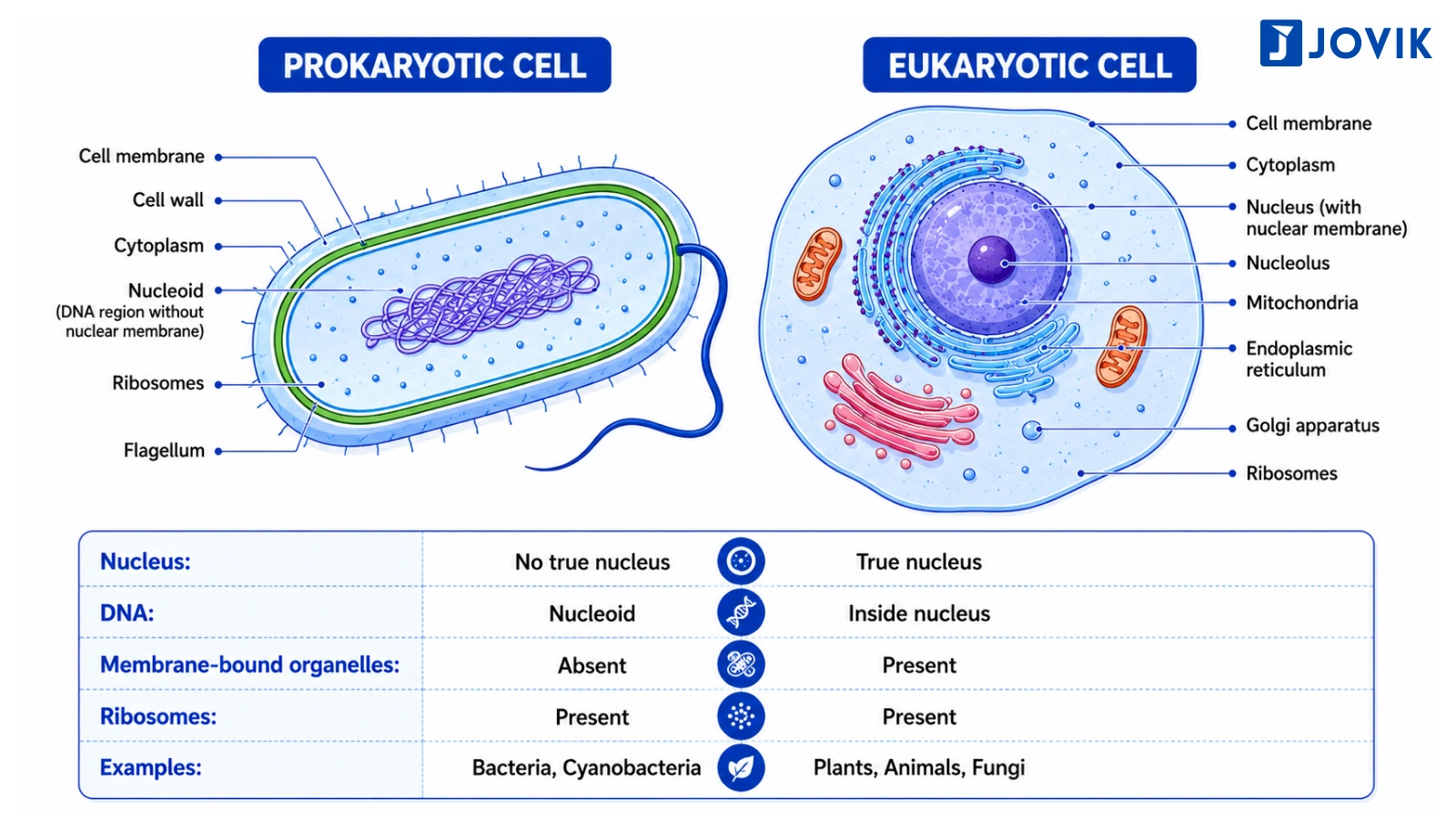
Prokaryotic Cells
The word prokaryote means “before nucleus.” These cells have no membrane-bound nucleus. Their genetic material, DNA, floats freely in the cytoplasm. The region where DNA is concentrated is called the nucleoid. The nucleoid is not a nucleus. It has no membrane around it. It is not a nucleolus. It is not a nucleosome. [NDA 2020-I]
Prokaryotic cells have no membrane-bound organelles at all. No mitochondria. No Golgi bodies. No endoplasmic reticulum. No chloroplasts. The only organelle present in prokaryotic cells is the ribosome. Ribosomes have no membrane, which is precisely why they are the one exception.
In photosynthetic prokaryotic bacteria, chlorophyll is not housed in chloroplasts. Instead, it is associated with membranous vesicles in the cytoplasm. Chloroplasts are exclusively eukaryotic structures.
Prokaryotes divide by binary fission, not by mitosis or meiosis. [NDA 2024-I]
Examples of prokaryotes: bacteria and blue-green algae (cyanobacteria).
Eukaryotic Cells
The word eukaryote means “true nucleus.” These cells have a well-defined nucleus enclosed by a nuclear membrane. DNA is safely contained inside the nucleus. Eukaryotic cells have many membrane-bound organelles: mitochondria, Golgi bodies, endoplasmic reticulum, lysosomes, and (in plants) chloroplasts.
Eukaryotes divide by mitosis for growth and repair, or by meiosis for gamete production. Examples: plants, animals, fungi, and protists.
Prokaryote vs Eukaryote: Comparison
| Feature | Prokaryotic Cell | Eukaryotic Cell |
| Nucleus | Absent (nucleoid only) | Present (membrane-bound) |
| Nuclear membrane | Absent | Present |
| DNA location | Nucleoid (free in cytoplasm) | Nucleus (+ mitochondria + chloroplast) |
| Membrane-bound organelles | Absent | Present |
| Ribosomes | Present (only organelle) | Present |
| Cell division | Binary fission | Mitosis or meiosis |
| Examples | Bacteria, Cyanobacteria | Plants, Animals, Fungi |
3. Protoplasm: The Living Content of a Cell
The total living content of a cell is called protoplasm. It includes the cytoplasm, the nucleoplasm, and all organelles embedded within them.
Protoplasm is not just the cytoplasm. It is not just the nucleus. It is everything living inside the cell taken together.
The most abundant inorganic constituent of protoplasm in an animal cell is water. Water makes up the majority of cellular mass. Sodium and potassium salts, iron, and phosphate are also present, but in far smaller amounts. [NDA 2014-I]
4. The Cell Membrane
Every cell, plant and animal, has a cell membrane. It is the universal boundary of all cells, present without exception. [NDA 2024-I]
Structure. The cell membrane is made of phospholipids, proteins, and cholesterol. It is not made of phospholipids alone. It is not made of proteins alone. All three components are present. It is not made of cellulose. Cellulose is found in the plant cell wall, not in the membrane.
Function. The cell membrane is selectively permeable: it allows certain substances in and keeps others out. Gases like oxygen and carbon dioxide can diffuse freely across it. Larger molecules need special channels or carriers. The membrane is also flexible, which allows cells to engulf particles through a process called phagocytosis, important for white blood cells that engulf and destroy pathogens.
5. Osmosis: Water Movement Across Membranes
Osmosis is the movement of water molecules from a region of higher water concentration (higher water potential) to a region of lower water concentration (lower water potential) through a semi-permeable membrane. A fully permeable membrane allows all substances to pass and does not drive osmosis. Osmosis specifically requires a semi-permeable membrane.
Three scenarios determine what happens to an animal cell placed in different solutions. All three are directly tested.
| Solution Type | Water Potential | Water Movement | Effect on Cell |
| Hypotonic (more water outside) | Higher outside | INTO the cell | Cell swells: may burst [NDA 2013-I] |
| Isotonic (equal water concentration) | Equal | No net movement | Cell unchanged |
| Hypertonic (less water outside) | Lower outside | OUT of the cell | Cell shrinks |
The single most common mistake here is reversing the hypotonic and hypertonic effects. High surrounding water potential (a hypotonic external solution) causes swelling and bursting, not shrinkage.
6. The Cell Wall
The cell wall is an additional rigid outer layer found outside the cell membrane. It is present in bacteria, plants, and fungi. It is completely absent in animal cells.
Every human cell lacks a cell wall. Tapeworms are animals. They also have no cell wall.
The cell membrane and cell wall are not the same structure. The cell membrane is universal: every cell has one. The cell wall is additional. Only bacteria, plants, and fungi have it. Animal cells have a membrane but no wall.
7. Plant Cell vs Animal Cell
Some structures are found in both plant and animal cells. Some are exclusive to one type.
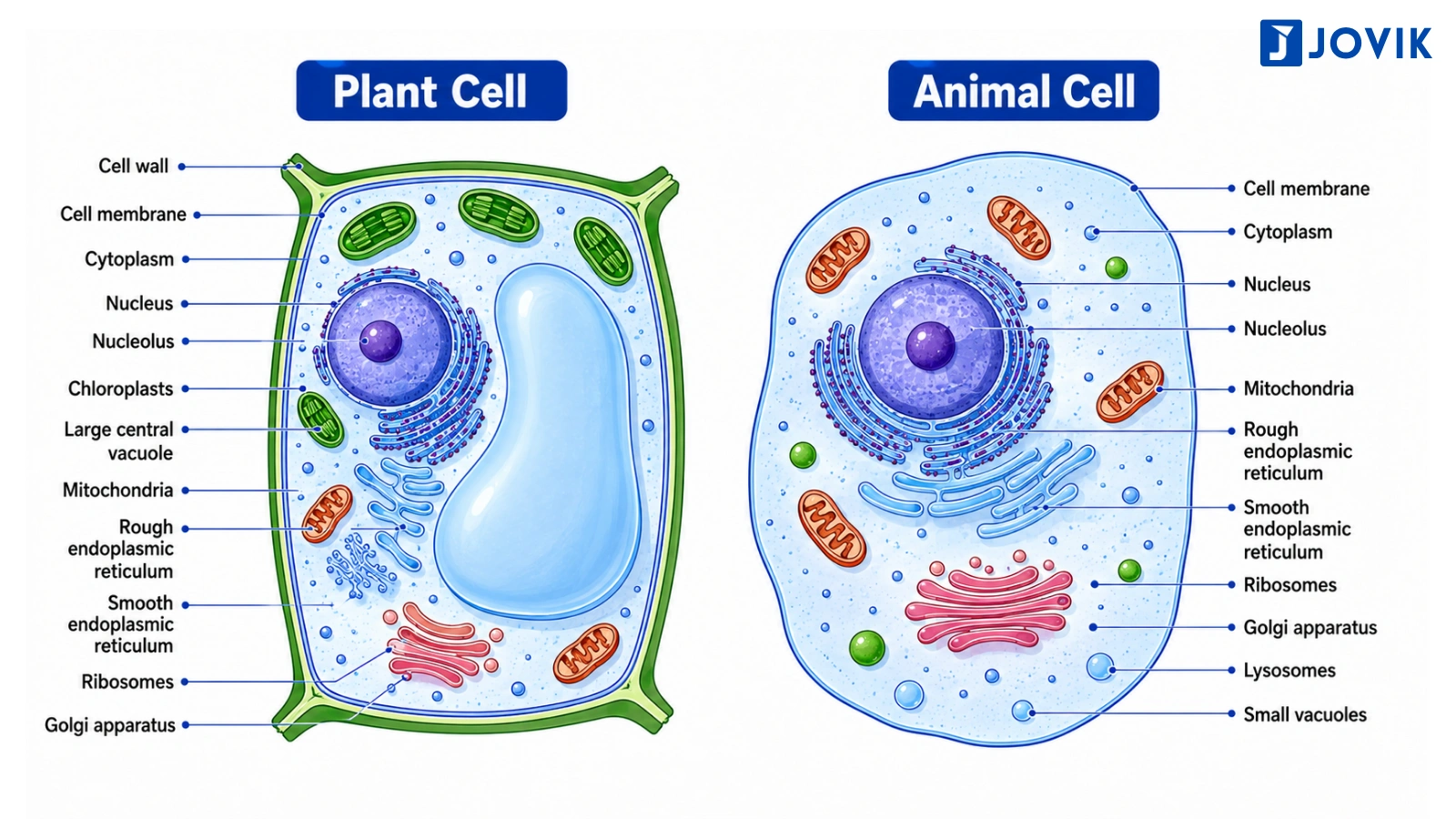
| Structure | Plant Cell | Animal Cell |
| Cell membrane | Present | Present |
| Cytoplasm | Present | Present |
| Nucleus | Present | Present |
| Mitochondria | Present | Present |
| Ribosomes | Present | Present |
| Endoplasmic reticulum | Present | Present |
| Cell wall | Present | Absent |
| Chloroplasts | Present | Absent |
| Large central vacuole | Present | Absent (small vacuoles only) |
[NDA 2012-II]
Cell wall and chloroplasts must never appear in any answer about animal cell components.
Carbohydrate storage differs. Plants store carbohydrates as starch. Animals store carbohydrates as glycogen. These are not interchangeable.
Both the nucleus and chloroplasts in plant cells are enclosed by their own double membranes.
8. Cell Organelles
Mitochondria: The Powerhouse
Mitochondria produce energy for the cell. The energy is stored in a molecule called ATP (Adenosine Triphosphate). ATP is synthesised specifically in the inner mitochondrial membrane, not the outer membrane, not the matrix, not the mitochondrial DNA. [NDA 2021-I | NDA 2014-II]
Mitochondria are semi-autonomous organelles. They contain their own DNA and their own ribosomes. This means they can make some of their own proteins without help from the nucleus. [NDA 2018-II | NDA 2019-III | NDA 2025-I] This is also why mitochondria are said to have bacterial ancestry. The endosymbiotic theory proposes that an ancient bacterium was engulfed by a larger cell and, over time, became the mitochondrion.
Mitochondria are absent in mature red blood cells. RBCs shed all their organelles during maturation, including the nucleus, mitochondria, and endoplasmic reticulum, to maximise space for haemoglobin. [NDA 2017-II]
Chloroplasts: The Photosynthesis Factory
Chloroplasts are found only in plant and algal cells. They contain chlorophyll, the green pigment that absorbs sunlight, and convert light energy into chemical energy stored as glucose. This process is photosynthesis.
Like mitochondria, chloroplasts contain their own DNA and ribosomes. They too had bacterial ancestors. [NDA 2025-I]Chloroplasts are absent in animal cells and in all prokaryotic cells.
Ribosomes: Protein Factories
Ribosomes are where protein synthesis occurs. They are the most universally distributed organelle, present in all cells, prokaryotic and eukaryotic alike. Ribosomes have no membrane, which makes them unique among organelles.
Ribosomes are studded on the outer surface of the Rough Endoplasmic Reticulum, which is why the Rough ER appears rough under a microscope.
Endoplasmic Reticulum: The Internal Transport Network
The endoplasmic reticulum (ER) is a network of membranes running through the cytoplasm. It transports materials to different parts of the cell and to the nucleus. [NDA 2021-II] Two distinct types exist with entirely different functions.
Rough Endoplasmic Reticulum (RER): Has ribosomes on its surface. Involved in protein synthesis and transport. The ribosomes give it a rough appearance under the microscope.
Smooth Endoplasmic Reticulum (SER): Has no ribosomes. Involved in lipid synthesis, steroid hormone synthesis, and detoxification of toxic substances. [NDA 2018-II | NDA 2022-I]
Smooth ER does not synthesise proteins. It has no ribosomes, and without ribosomes, protein synthesis is impossible. Protein synthesis happens only at ribosomes, either on the Rough ER surface or free in the cytoplasm. This is the sharpest functional distinction in this chapter: Smooth ER = lipids; Rough ER = proteins. These cannot be swapped. [NDA 2018-II | NDA 2022-I]
Golgi Bodies: The Packaging and Dispatch Centre
The Golgi apparatus receives proteins from the Rough ER, modifies them, packages them, and dispatches them to their destinations: the cell surface, secretory vesicles, or lysosomes. The Golgi also produces lysosomes by packaging hydrolytic enzymes into lysosomal vesicles. The Golgi does not contain DNA.
Lysosomes: The Suicide Bags
Lysosomes are membrane-bound sacs filled with hydrolytic (digestive) enzymes. They break down foreign materials, worn-out organelles, and cellular debris. [NDA 2019-II]
Lysosomes are called “suicide bags”. If their membrane ruptures, the digestive enzymes spill into the cell and digest everything, killing the cell itself.
Lysosomes are produced by the Golgi bodies, not by the nucleus, not by the ER, not by ribosomes. White blood cells have the highest concentration of lysosomes among all body cell types. They need them to destroy the pathogens they engulf.
Vacuoles: Storage and Waste Management
Vacuoles are fluid-filled sacs. In plant cells, a large central vacuole stores water and chemicals and helps maintain cell shape. In unicellular organisms like Amoeba and Paramecium, contractile vacuoles expel excess water and waste, regulating internal osmotic pressure. [NDA 2020-I]
Microbodies
Microbodies are small, membrane-bound organelles found in both plant and animal cells. They contain enzymes for specialised metabolic functions. Peroxisomes, for example, break down hydrogen peroxide, a toxic byproduct of metabolism.
9. Organelles That Contain DNA: The Locked Set
This is the single most asked concept in the chapter, appearing many times across NDA papers:
| ★ IMPORTANT Only three organelles contain DNA: Nucleus, Mitochondria, and Chloroplasts. The following do NOT contain DNA: Golgi bodies, plasma membrane (cell membrane), ribosomes, and endoplasmic reticulum. [NDA 2018-II | NDA 2025-I] This set must be memorised as a complete, closed list. If an exam option adds Golgi or ER to this set, it is wrong. If it removes any of the three, it is also wrong. |
10. DNA: Structure and Properties
The Double Helix
DNA is a double helix: two strands wound around each other like a twisted ladder. [NDA 2016-I] The two strands run in opposite directions. They are antiparallel, one running 5’→3′ and the other 3’→5′. The two strands are held together by hydrogen bonds between the nitrogenous bases, not covalent bonds, not electrostatic bonds, not Van der Waals bonds. [NDA 2016-I]
Base Pairing Rules
The bases pair with strict specificity. Adenine (A) pairs with Thymine (T) and Guanine (G) pairs with Cytosine (C). These rules are absolute. Adenine never pairs with Guanine or Cytosine. Thymine never pairs with Guanine. [NDA 2025-I]
What a Nucleotide Contains
Each unit of DNA is called a nucleotide. Every nucleotide has three components: a nitrogenous base, a deoxyribose sugar, and a phosphate group. RNA uses ribose sugar instead of deoxyribose. This is the key structural difference between DNA and RNA.
Chromosomes and Histones
Chromosomes are the condensed, visible form of DNA during cell division. They are composed of DNA and histone proteins, not lipids, not vitamins, not carbohydrates. Histone proteins are the structural scaffolding proteins around which DNA coils to form chromatin. They are found in the nucleus, not in the cytoplasm, not in mitochondrial membranes.
When the cell is not dividing, DNA exists as loosely coiled chromatin. When cell division begins, chromatin condenses into compact, visible chromosomes. [NDA 2024-I] Not every segment of DNA codes for a protein. A large portion of the genome consists of non-coding sequences that do not produce any protein. [NDA 2016-I]
11. Gene Expression: Transcription, Translation, Replication
Three processes involving DNA must be clearly distinguished. Each produces a different product.
| Process | Starting Material | Product |
| Replication | DNA | More DNA |
| Transcription | DNA | RNA |
| Translation | RNA | Protein |
Transcription is the process of copying DNA into RNA. It is not translation, not replication, not mutation. Translation is the process of using RNA to build a protein at the ribosome. Mutation is a permanent change in the DNA sequence, not a copying process.
The primary structure of a protein is a linear chain of amino acids linked by peptide bonds. This is the most basic level of protein organisation. Secondary, tertiary, and quaternary structures involve progressively more complex folding. [NDA 2025-I]
12. Cell Division
Mitosis produces two identical daughter cells from one parent cell. It is used for growth and repair of body tissues and maintains the same chromosome number in both daughter cells. [NDA 2014-II]
Meiosis produces four daughter cells, each with half the chromosome number. It is used exclusively for producing gametes (sex cells: sperm and eggs). Meiosis does not contribute to tissue growth or repair. [NDA 2014-II]
Syngamy is the fusion of two gametes (sperm and egg) to form a zygote. Each gamete is haploid (half chromosome set). Their fusion produces a diploid zygote with the full chromosome number.
Sex Determination
The sex of a baby is determined by the father, not the mother. [NDA 2013-I] The mother’s eggs always carry an X chromosome. That is all a mother can contribute. The father’s sperm carries either an X or a Y chromosome.
• Father contributes X → baby is XX → female
• Father contributes Y → baby is XY → male
The mother has no role in determining whether the baby is male or female. The father’s contribution decides it entirely.
13. Genetics
Alleles
Different variants of the same gene are called alleles. For example, the gene for height in pea plants has a tall allele (T) and a short allele (t). T and t are alleles of each other. [NDA 2022-I] Alleles are not genotypes, not isomers, and not sib pairs.
Mendelian Cross: F₂ Generation
When a pure tall plant (TT) is crossed with a short plant (tt), all F₁ offspring are Tt (tall, due to dominance). An F₂ cross (Tt × Tt) gives the genotypic ratio 1 TT : 2 Tt : 1 tt. The ratio of pure tall (TT) to short (tt) in F₂ = 1:1. This is not the same as 3:1. That is the phenotypic ratio of tall to short. The 1:1 is specifically for pure tall to short genotypes.
Sources of Genetic Variation
Genetic variation in a species comes from three sources: sexual reproduction (which combines genetic material from two parents through meiosis and fertilisation), mutations (spontaneous or induced changes in DNA sequence), and epigenetic changes (heritable changes in gene expression without altering the DNA sequence).
Asexual reproduction does not produce significant genetic variation. Offspring from asexual reproduction are genetically identical (clones) to the parent.
Honey Bee Genetics
Male honey bees (drones) are haploid. They develop from unfertilised eggs through parthenogenesis. Worker bees are sterile and diploid. The queen develops from a diploid larva fed royal jelly. [NDA 2016-I]
14. Biotechnology
DNA fingerprinting identifies individuals using unique DNA profiles. The technique used is Southern Blotting. Not ELISA (which tests for antigens and antibodies). Not RIA (which detects hormones). Not Northern Blotting (which detects RNA). Only Southern Blotting is used for DNA fingerprinting.
Genetic screening is the analysis of an individual’s DNA to determine the presence or absence of a specific gene or genetic variant. It is used to detect genetic diseases before symptoms appear.
Genetically modified (GM) crops have their genetic material altered through the introduction of new DNA sequences, the removal of existing DNA sequences, or the introduction of new traits. The modification works at the DNA level, not by introducing RNA as the primary mechanism.
Paul Berg is the father of genetic engineering. He pioneered recombinant DNA technology in the early 1970s.
Germplasm refers to the genetic resources of a species: seeds, tissues, egg and sperm repositories. It is the raw biological material from which new varieties are developed.
JOVIK Quick Recall
Two Types of Cells
| Prokaryote | Eukaryote | |
| Nucleus | Absent (nucleoid only) | Present (membrane-bound) |
| Organelles | None except ribosomes | Many (mitochondria, ER, Golgi, etc.) |
| Cell division | Binary fission | Mitosis or meiosis |
| Examples | Bacteria, Cyanobacteria | Plants, Animals, Fungi |
- Nucleoid = DNA region in prokaryotes: NOT nucleus, NOT nucleolus, NOT nucleosome [NDA 2020-I]
- Ribosomes = only organelle present in both prokaryotes and eukaryotes
- Chlorophyll in photosynthetic bacteria = membranous vesicles: NOT chloroplasts
Protoplasm and Cell Membrane
- Protoplasm = total living content of cell (cytoplasm + nucleoplasm + organelles)
- Most abundant inorganic constituent = water [NDA 2014-I]
- Cell membrane present in ALL cells: Composition: phospholipids + proteins + cholesterol
- NOT cellulose (cellulose = plant cell wall) | Selectively permeable
Osmosis
- Water moves from high to low water potential
- Hypotonic (high water potential outside): cell swells/bursts [NDA 2013-I]
- Isotonic: no net movement | Hypertonic (low water potential outside): cell shrinks
Organelle Functions: Important Points
| Organelle | Function | Key Fact |
| Mitochondria | ATP synthesis | Inner membrane; own DNA + ribosomes; absent in mature RBCs |
| Chloroplasts | Photosynthesis | Plant/algal cells only; own DNA + ribosomes |
| Ribosomes | Protein synthesis | Only membrane-free organelle; present in ALL cells |
| Rough ER | Protein synthesis + transport | Has ribosomes on surface |
| Smooth ER | Lipid/steroid synthesis, detoxification | NO ribosomes: does NOT make proteins |
| Golgi bodies | Packaging and dispatch | Receives from Rough ER; produces lysosomes; no DNA |
| Lysosomes | Digestion of cellular debris | “Suicide bags”; hydrolytic enzymes; made by Golgi; highest in WBCs |
| Vacuoles | Storage; osmotic regulation | Large central vacuole in plants; contractile vacuoles in unicellular organisms |
| Peroxisomes | Break down H₂O₂ | Present in plant and animal cells |
Organelles Containing DNA: The Locked Set
- Nucleus: Present | Mitochondria: Present | Chloroplasts: Present | Golgi: Absent | Plasma membrane Absent | Ribosomes Absent | ER Absent [NDA 2018-II | NDA 2025-I]
DNA Structure
- Double helix, antiparallel strands [NDA 2016-I]
- Held by hydrogen bonds: NOT covalent bonds [NDA 2016-I]
- Base pairing: A–T and G–C (absolute rule) [NDA 2025-I]
- Nucleotide = nitrogenous base + deoxyribose + phosphate | RNA uses ribose (not deoxyribose)
- Chromosomes = DNA + histone proteins | Not all DNA codes for protein [NDA 2016-I]
Gene Expression
- Replication: DNA → DNA | Transcription: DNA → RNA | Translation: RNA → Protein
- Mutation: permanent change in DNA: not a copying process
- Primary protein structure = amino acids linked by peptide bonds [NDA 2025-I]
Cell Division and Genetics
- Mitosis = growth and repair (same chromosome number) [NDA 2014-II]
- Meiosis = gamete production (half chromosome number)
- Syngamy = gamete fusion → diploid zygote
- Sex determined by father [NDA 2013-I] | Father X → female (XX); Father Y → male (XY)
- Alleles = different variants of the same gene [NDA 2022-I]
- TT × tt → all Tt (F₁); F₂ pure tall: short = 1:1
- Genetic variation from: sexual reproduction + mutations + epigenetic changes
- Asexual reproduction = NO genetic variation | Drones (male honey bees) = haploid [NDA 2016-I]
Biotechnology
- DNA fingerprinting = Southern Blotting | Northern Blotting = RNA detection
- Genetic screening = DNA analysis for specific gene
- GM crops = new DNA introduced/removed + new traits
- Father of genetic engineering = Paul Berg
- Germplasm = genetic resources of a species