NDA Current Affairs | 13 Sep Exam
Practice Now

Binary Numbers – NDA Maths Notes
Exam Relevance: Topics: Positional Value · Binary↔Decimal Conversion · Fractional Conversion · Binary Arithmetic · Unknown Binary Digits · Algebraic Identities in Binary
Reading Time: 20–25 minutes │ Last Updated: 2026
You have been counting in base 10 all your life: ten digits, zero through nine, and then you start over with a new column. Binary numbers work on exactly the same idea, but with only two digits: 0 and 1. Every number you have ever known can be written using just these two symbols, provided you understand what position each digit occupies.
This is the chapter’s foundation. There is no new algebra here, no new type of equation, no unfamiliar structure, only a shift in the base you are counting in. A student who understands place value in ordinary arithmetic already understands ninety per cent of what this chapter requires. The remaining ten per cent is practice with the conversion procedures, which are mechanical and fully learnable in a single sitting.
Binary numbers are also the language of every computer and digital system ever built, which means this is not an abstract topic; it is the arithmetic of the modern world, expressed in its simplest possible form.
1. Positional Value in Base 2
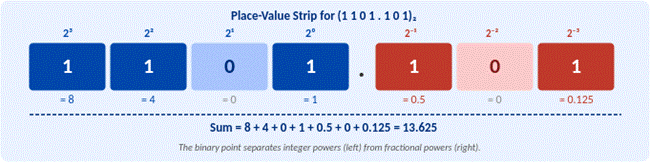
In base 10, each digit position represents a power of 10. In base 2, each position represents a power of 2. A binary numeral is a sum of powers of 2, one for each position where a 1 appears.
(1 0 1 1)₂ = 1×2³ + 0×2² + 1×2¹ + 1×2⁰ = 8 + 0 + 2 + 1 = 11
The powers of 2 table is the chapter’s single most important reference. Learn it before anything else.
| Power | 2⁰ | 2¹ | 2² | 2³ | 2⁴ | 2⁵ | 2⁶ | 2⁷ | 2⁸ | 2⁹ | 2¹⁰ |
| Value | 1 | 2 | 4 | 8 | 16 | 32 | 64 | 128 | 256 | 512 | 1024 |
| Power | 2⁻¹ | 2⁻² | 2⁻³ | 2⁻⁴ | 2⁻⁵ |
| Value | 0.5 | 0.25 | 0.125 | 0.0625 | 0.03125 |
2. Binary → Decimal Conversion
Read each bit from left to right. Multiply each 1-bit by its power of 2 (from the table). Add the results.
(11101011)₂: bits set at positions 7,6,5,3,1,0. Values: 128+64+32+8+2+1 = 235. [NDA 2015-I]
(10101111)₂: 128+0+32+0+8+4+2+1 = 175. [NDA 2011-I]
(110001)₂: 32+16+0+0+0+1 = 49. [NDA 2013-II]
(1011)₂: 8+0+2+1 = 11. [NDA 2012-II, NDA 2014-II]
| IMPORTANT Drill these small powers until they are automatic: 2⁷=128, 2⁸=256, 2⁹=512. These appear most often as the MSB in 8-bit and 9-bit numerals. |
| NDA Worked Example 1 Binary → Decimal (Integer) [NDA 2015-I] |
| Question (NDA 2015-I) If (11101011)₂ is converted to decimal system, then the resulting number is: (a) 235 (b) 175 (c) 160 (d) 126 |
| Solution Read each 1-bit and its power of 2: Bit 7 = 1 → 128 Bit 6 = 1 → 64 Bit 5 = 1 → 32 Bit 4 = 0 → 0 Bit 3 = 1 → 8 Bit 2 = 0 → 0 Bit 1 = 1 → 2 Bit 0 = 1 → 1 128 + 64 + 32 + 8 + 2 + 1 = 235 |
| Answer: (a) 235 |
| Important: The reversed numeral (11010111)₂ = 215 is not among the options here, but in many questions the reverse appears as a trap. Always check bit positions from left (MSB) to right (LSB). |
Symbolic variant: when the numeral contains letter symbols, determine which symbol is 1 and which is 0 before converting.
(cdccddc ccddd)₂ where c > d: since only 0 and 1 exist in binary and c > d, c = 1 and d = 0. The numeral becomes (101100111000)₂. Positions set: 11,9,8,5,4,3. Sum = 2048+512+256+32+16+8 = 2872. [NDA 2019-II]
3. Decimal → Binary Conversion
Divide the decimal integer repeatedly by 2. At each step, record the remainder (0 or 1). When the quotient reaches 0, stop. Read the remainders from bottom to top: the last remainder is the most significant bit.
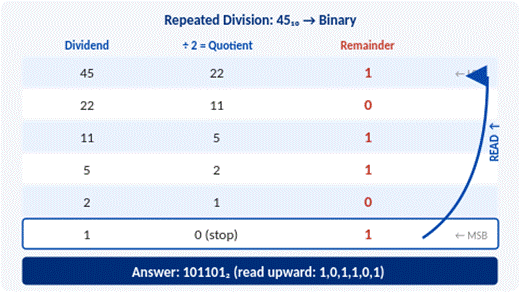
| IMPORTANT The reversal step is the most common source of errors. The first remainder (from dividing the original number) is the LEAST significant bit: the rightmost digit. The last remainder is the MOST significant bit: the leftmost digit. Always read upward. |
| NDA Worked Example 2 Decimal → Binary (Integer) [NDA 2013-I] |
| Question (NDA 2013-I) The binary representation of the decimal number 45 is: (a) 110011 (b) 101010 (c) 1101101 (d) 101101 |
| Solution 45 ÷ 2 = 22 remainder 1 22 ÷ 2 = 11 remainder 0 11 ÷ 2 = 5 remainder 1 5 ÷ 2 = 2 remainder 1 2 ÷ 2 = 1 remainder 0 1 ÷ 2 = 0 remainder 1 ← stop Reading remainders bottom to top: 1, 0, 1, 1, 0, 1 |
| Answer: (d) 101101 |
| Option (a) 110011 is 51 in decimal. Option (b) 101010 is 42. The correct numeral 101101 uses the upward reading. Always verify: 32+8+4+1=45 |
Further examples: 251₁₀ = 11111011₂ (7-bit: 128+64+32+16+8+2+1). [NDA 2014-I]
83₁₀ = 1010011₂ (64+16+2+1=83). [NDA 2013-II]
235₁₀ = 11101011₂: the reverse of the NDA-2015-I question, asked in the following paper. [NDA 2016-II]
31₁₀ = 11111₂. [NDA 2018-I]
292₁₀: 256+32+4 = 292. Binary: 100100100. [NDA 2012-I]
| IMPORTANT The same eight-bit numeral (11101011)₂ = 235 appeared in NDA-2015-I as a Binary→Decimal question and in NDA-2016-II as a Decimal→Binary question. Both algorithms must be equally fluent. Drilling only one direction can leave the other unpractised. |
4. Fractional and Mixed Conversion
| IMPORTANT This was 42% of the classical chapter (2009–2013) and has not appeared since 2016-I: eighteen consecutive papers. It is covered fully because it remains in scope. Size your revision time to this history. |
4.1 The Two-Algorithm Comparison
| Decimal → Binary (INTEGER) | Decimal → Binary (FRACTION) |
| Method: Divide the integer repeatedly by 2 | Method: Multiply the fraction repeatedly by 2 |
| Collect: the remainders (0 or 1) | Collect: the integer part of each product (0 or 1) |
| Read: BOTTOM TO TOP ↑ (reversal required) | Read: TOP TO BOTTOM ↓ (no reversal) |
| Binary → Decimal: expand each bit × its power of 2, then sum | Binary → Decimal: expand each fractional bit × negative power of 2, then sum |
4.2 Decimal Fraction → Binary Fraction
Multiply the fractional part by 2. Record the integer part (0 or 1). Repeat with the new fractional remainder. Stop when the fraction becomes 0 (terminating) or a pattern repeats (non-terminating). Read the integer parts top to bottom: no reversal.
Convert 0.8125 to binary: 0.8125×2=1.625→1; 0.625×2=1.25→1; 0.25×2=0.5→0; 0.5×2=1.0→1. Stop. Result: 0.1101₂. [NDA 2009-I]
Convert 0.3125: 0.3125×2=0.625→0; 0.625×2=1.25→1; 0.25×2=0.5→0; 0.5×2=1.0→1. Stop. Result: 0.0101₂. [NDA 2016-I]
4.3 Mixed Conversion (integer and fraction together)
Separate the integer and fractional parts. Convert each independently. Reassemble with the binary point between them.
| NDA Worked Example 3 Mixed Conversion: Decimal → Binary [NDA 2012-II] |
| Question (NDA 2012-II) The decimal number (57.375)₁₀ when converted to binary takes the form: (a) (111001.011)₂ (b) (100111.110)₂ (c) (110011.101)₂ (d) (111011.011)₂ |
| Solution Integer part: 57 by repeated division: 57 ÷ 2 = 28 r 1 28 ÷ 2 = 14 r 0 14 ÷ 2 = 7 r 0 7 ÷ 2 = 3 r 1 3 ÷ 2 = 1 r 1 1 ÷ 2 = 0 r 1 ← stop. Read upward: 111001 Fractional part: 0.375 by repeated multiplication: 0.375 × 2 = 0.75 → integer part 0 0.750 × 2 = 1.50 → integer part 1 0.500 × 2 = 1.00 → integer part 1. Stop. Read downward: 011 Reassemble: 111001.011 |
| Answer: (a) (111001.011)₂ |
| Important: Apply division to the integer part and multiplication to the fractional part. Never swap them. The fractional digits are read top to bottom: no reversal. |
13.625₁₀: integer 13=1101₂; fraction 0.625: 0.625×2=1.25→1; 0.25×2=0.5→0; 0.5×2=1.0→1. Result: 1101.101₂. [NDA 2010-I]
32.25₁₀: 32=100000₂; 0.25=0.01₂. Result: 100000.01₂. [NDA 2010-II]
127.25₁₀: 127=1111111₂; 0.25=0.01₂. Result: 1111111.01₂. [NDA 2015-I]
(11101.001)₂: 16+8+4+0+1+0.125 = 29.125₁₀. [NDA 2012-I]
4.4 Non-Terminating Expansions
A decimal fraction terminates in binary only if its denominator (in lowest terms) is a power of 2. Fractions such as 1/3, 1/5, 1/6, 3/10 have other prime factors in the denominator and produce recurring binary sequences.
| Decimal fraction | Denominator (lowest terms) | Power of 2? | Binary expansion |
| 1/8 = 0.125 | 8 = 2³ | Yes | 0.001 (terminates) |
| 3/16 = 0.1875 | 16 = 2⁴ | Yes | 0.0011 (terminates) |
| 1/3 ≈ 0.333… | 3 (not a power of 2) | No | 0.0101… (recurring) |
| 3/10 = 0.3 | 10 = 2×5 (factor 5) | No | 0.01001… (recurring) |
For example, 0.3 = 3/10; the denominator 10 = 2 × 5 contains the factor 5, which is not a power of 2. Repeated multiplication by 2 does not terminate: (0.3)₁₀ = (0.01001…)₂. [NDA 2011-II]
(0.0011)₂ as a rational: 0×2⁻¹+0×2⁻²+1×2⁻³+1×2⁻⁴ = 1/8+1/16 = 3/16. [NDA 2009-II]
5. Binary Addition and Subtraction
Binary arithmetic uses the same positional rules as decimal, but the carry threshold is 2 instead of 10.
| Operation | Inputs | Result |
| Addition | 0 + 0 | 0 |
| Addition | 0 + 1 or 1 + 0 | 1 |
| Addition | 1 + 1 | 10 (write 0, carry 1) |
| Addition | 1 + 1 + 1 (with carry) | 11 (write 1, carry 1) |
| Subtraction | 0 − 0 or 1 − 0 | 0 or 1 |
| Subtraction | 1 − 1 | 0 |
| Subtraction | 0 − 1 (borrow) | Borrow: treat as 10 − 1 = 1 |
| NDA Worked Example 4 Binary Addition [NDA 2014-I] |
| Question (NDA 2014-I) What is the sum of the two numbers (11110)₂ and (1010)₂? (a) (101000)₂ (b) (110000)₂ (c) (100100)₂ (d) (101100)₂ |
| Solution Align by the least significant bit and add column by column from right: 1 1 1 1 0 + 1 0 1 0 ————————— Col 0: 0+0 = 0 Col 1: 1+1 = 10 → write 0, carry 1 Col 2: 1+0+1(carry) = 10 → write 0, carry 1 Col 3: 1+1+1(carry) = 11 → write 1, carry 1 Col 4: 1+0+1(carry) = 10 → write 0, carry 1 Col 5: carry = 1 → write 1 Result: 101000 |
| Answer: (a) (101000)₂ |
| Verify: 30 + 10 = 40. (101000)₂ = 32+8 = 40. Converting both sides to decimal is the quickest check on binary arithmetic questions. |
(1111)₂+(1001)₂−(1010)₂ = 15+9−10 = 14 = (1110)₂. [NDA 2010-II-Q089]
(1101101)₂+(1011011)₂ = 109+91 = 200₁₀. Answer in decimal: 200. [NDA 2020-I & II]
(101101101)₂+(100011)₂ = 365+35 = 400. 400 = 256+128+16 = (110010000)₂. [NDA 2025-II]
(1000000001)₂−(0.0101)₂ = 513−0.3125 = 512.6875₁₀. Answer is requested in decimal. [NDA 2015-II]
6. Binary Multiplication and Division
Binary long division follows the same structure as decimal long division but uses binary subtraction at each step.
| NDA Worked Example 5 Binary Division [NDA 2017-II] |
| Question (NDA 2017-II) The remainder and the quotient of the binary division (101110)₂ ÷ (110)₂ are respectively: (a) (111)₂ and (100)₂ (b) (100)₂ and (111)₂ (c) (101)₂ and (101)₂ (d) (100)₂ and (100)₂ |
| Solution: using the decimal escape route: Convert both numerals to decimal: (101110)₂ = 46. (110)₂ = 6. 46 ÷ 6 = 7 remainder 4 Convert back: 7 = (111)₂. 4 = (100)₂. The question asks for remainder first, then quotient. Remainder = (100)₂, quotient = (111)₂. |
| Answer: (b) (100)₂ and (111)₂ |
| Important: Check which comes first in the question: “remainder and the quotient” means remainder is the first part of the answer. Reversing these is the main trap here. |
b/a where a=00111=7 and b=01110=14. 14÷7=2. Answer in decimal: 2. [NDA 2011-I-Q044]
(1110011)₂÷(10111)₂ = 115÷23 = 5 = (101)₂. [NDA 2022-I-Q053]
7. Unknown Binary Digits
Some questions replace specific bit positions with letter symbols and require the reader to reconstruct the digits from the equation. The method is column-by-column carry reasoning, working from the rightmost bit (LSB) toward the left.
| NDA Worked Example 6 Unknown Binary Digits [NDA 2017-I] |
| Question (NDA 2017-I) In the binary equation (1p101)₂ + (10q1)₂ = (100r00)₂, what are the values of p, q and r respectively? (a) 0, 1, 0 (b) 1, 1, 0 (c) 0, 0, 1 (d) 1, 0, 1 |
| Solution Col 0 (LSB): 1 + 1 = 10. Write 0 (target 0), carry 1. Col 1: 0 + 0 + 1(carry) = 1. But target is 0. Need q in col 1 to contribute 1: set q = 1. Then 0 + 1 + 1 = 10. Write 0 ✓, carry 1. Col 2: 1 + 0 + 1(carry) = 10. Write 0, carry 1. Target col 2 = r. So r = 0. Col 3: p + 1 + 1(carry) = p + 2. Target col 3 = 0. If p = 0: 0+2 = 10 → write 0, carry 1 If p = 1: 1+2 = 11 → write 1 → p = 0. Col 4: 1 + 0 + 1(carry) = 10. Write 0 , carry 1. Col 5: carry = 1 = target. p = 0, q = 1, r = 0 |
| Answer: (a) 0, 1, 0 |
| Important: Never guess. Work every column from right to left. A wrong carry in one column changes every subsequent digit. |
(10×010)₂−(11y1)₂=(10z11)₂: carry reasoning gives x=0, y=0, z=1. [NDA 2009-II]
(11011)₂+(10110110)₂+(10011x0y)₂=(101101101)₂: 27+182+(148+x·4+y)=365. 4x+y=8. x=1,y=0. [NDA 2018-II]
8. Algebraic Identities Evaluated in Binary
Four questions present binary numerals inside algebraic expressions. The right approach is always to recognise the identity first: then convert only the minimal values needed.
- a² − b² = (a+b)(a−b) [NDA 2009-II]
- (a³+b³)/(a²−ab+b²) = a+b [NDA 2010-I-Q120]
- (x−y)²+xy = x²−xy+y² : follows from x³+y³=(x+y)(x²−xy+y²) [NDA 2022-I]
- x³−y³−z³−3xyz = 0 when x = y+z [NDA 2025-I]
| NDA Worked Example 7 Algebraic Identity in Binary [NDA 2022-I] |
| Question (NDA 2022-I) If x³+y³ = (100010111)₂ and x+y = (11111)₂, then what is (x−y)²+xy equal to? (a) (1101)₂ (b) (1001)₂ (c) (1011)₂ (d) (1111)₂ |
| Solution Step 1: Recognise the identity: Observe that (x−y)²+xy = x²−2xy+y²+xy = x²−xy+y². Step 2: Use the sum-of-cubes identity: x³+y³ = (x+y)(x²−xy+y²). Therefore x²−xy+y² = (x³+y³)÷(x+y). Step 3: Convert and divide: (100010111)₂ = 256+16+4+2+1 = 279 (11111)₂ = 16+8+4+2+1 = 31 279 ÷ 31 = 9 Step 4: Convert the answer: 9 = 8+1 = (1001)₂. |
| Answer: (b) (1001)₂ |
| Important: A student who tries to cube binary numerals directly will spend several minutes on arithmetic that the identity collapses to one division. Identity first, base second. |
x=(1111)₂=15, y=(1001)₂=9, z=(110)₂=6. Note x=y+z. Identity: x³−y³−z³−3xyz=0 when x=y+z. Answer: (0)₂. [NDA 2025-I]
x²−y² where x=(1101)₂=13, y=(110)₂=6. Identity: (13+6)(13−6)=19×7=133=(10000101)₂. [NDA 2009-II]
(a³+b³)/(a²−ab+b²) = a+b. a=(0.101)₂=5/8, b=(0.011)₂=3/8. a+b=1=(1)₂. [NDA 2010-I]
9. The Decimal Escape Route
Every binary arithmetic and identity question in the repository can be solved by:
- Convert all binary inputs to decimal.
- Perform the arithmetic or algebra in decimal.
- Convert the result back to binary if the answer is required in binary.
This route is longer but uses only the conversion procedures from Sections 2 and 3. It applies to all 15 questions in the arithmetic, multiplication/division, unknown-digit and identity sections: 39.5% of the chapter.
| IMPORTANT Use it as a safety net, not a default. The identity shortcut (Section 8) and carry reasoning (Section 7) are faster when the technique is secure. The decimal route is the right choice when those techniques are uncertain. |
10. Important Distinctions
Integers divide; fractions multiply. These are mirror-image algorithms. Applying the wrong one to either part is the chapter’s most common error target.
Read remainders upward; read fractional digits downward. The reversal applies only to the repeated-division algorithm. The repeated-multiplication results are collected in order, top to bottom.
Check the required base before computing. Three questions perform binary arithmetic and request a decimal answer. Presenting a binary result for a decimal question loses the mark.
Identity before base. When a binary expression contains recognisable algebraic structure, recognise the identity first and convert only the values needed.
Terminating vs non-terminating fractions. A decimal fraction terminates in binary only if its denominator (in lowest terms) is a power of 2.