NDA Current Affairs | 13 Sep Exam
Practice Now

Functions – NDA Maths Notes
Exam Relevance: NDA Topics: Function-hood · Evaluation · Domain · Range · Composition · Injectivity & Surjectivity · Inverse · Even / Odd / Periodic · Functional Equations · Greatest Integer & Piecewise · Graphs
Reading Time: 40–45 minutes │ Last Updated: 2026
Relations tell us how elements are connected. Functions are a special kind of relation: one where every input produces exactly one output. That single condition is what makes functions so powerful. It is also what the NDA tests.
Two signals dominate the modern paper. First, functional equations (a technique not named anywhere in the official syllabus) now outrank four of the seven listed syllabus topics. Second, nearly six in ten modern-regime questions sit inside shared reading passages called clusters. In 2025-I, all eight Functions questions were cluster members. Reading a shared passage carefully before answering any of its questions is a skill this chapter must build.
1. What Is a Function?
A function f from set A to set B is a relation from A to B in which every element of A is paired with exactly one element of B.
Two conditions must both hold:
- Totality: every element of A must appear as a first element in at least one pair.
- Uniqueness: no element of A may appear as the first element in two pairs with different second elements.
A function fails the moment one input maps to two outputs.
f : A → B means f is a function from A to B
Domain is the set A: the set of all valid inputs. Codomain is the set B: the set from which outputs are drawn. Range is the set of outputs that actually appear. Range ⊆ Codomain always. They are equal only when every element of B is actually hit.
| Important Range and codomain are different. Codomain is declared in advance. Range is derived from the pairs in f. This distinction drives many NDA questions on surjectivity. |
1.1 Is This a Function?
To test whether a given rule or set of pairs defines a function, check uniqueness first: does any input appear with two different outputs?
{(1,2),(2,3),(3,2)} is a function: each input appears once. {(1,2),(1,3),(2,4)} is NOT: input 1 maps to both 2 and 3. [NDA 2014-I]
1.2 Piecewise Functions and the Overlap Trap
A piecewise function assigns different rules to different parts of the domain. It is a function only if the sub-domains cover all of A without giving conflicting outputs at any shared boundary point.
If one boundary point receives two different values under two overlapping rules, the relation is not a function. [NDA 2023-II]
1.3 Subset-of-Product Form
A relation f on Z×Z defined as {(xy, x−y) : x,y∈Z} is a function from Z to Z only if every first element in the pairs is produced by a unique second element. The pair (0,0) comes from (x,y)=(1,1) giving output 0; the pair (0,0) also comes from (x,y)=(−1,−1) giving output 0. That is the same first element with the same second element, so there is no conflict. But (0,2) from (1,−1) and (0,−2) from (−1,1) both have first element 0 and different second elements. So this is NOT a function. Each case must be checked explicitly.
[NDA 2022-II]
2. Evaluation and Algebra of Functions
Evaluation means substituting a given value into the rule of the function. This is the foundation of every higher concept in this chapter. It must be fast and automatic.
Basic evaluation: to find f(3), replace every x in the rule of f with the number 3.
If f(x)=x²−2x+1, then f(3)=9−6+1=4. If f(x+1)=x²−3x+2, substitute u=x+1 (so x=u−1) to get f(u)=(u−1)²−3(u−1)+2=u²−5u+6. So f(x)=x²−5x+6. [NDA 2021-I]
2.1 Algebra of Functions
When f and g are both defined at x, we can combine them:
(f+g)(x) = f(x)+g(x) · (f−g)(x) = f(x)−g(x)
(fg)(x) = f(x)·g(x) · (f/g)(x) = f(x)/g(x), provided g(x) ≠ 0
If f(x)=x²+2 and g(x)=2x−3, then (fg)(1) = f(1)·g(1) = (1+2)·(2−3) = 3·(−1) = −3. [NDA 2023-I]
If f(x)=x/(x−1), then f(a)/f(a+1) = [a/(a−1)] / [(a+1)/a] = a²/((a−1)(a+1)) = a²/(a²−1). [NDA 2017-I]
2.2 Evaluating Expressions Involving f
Some questions ask for f(x+h), f(2x), or f(x+2)+f(x−2). Simply substitute the given argument.
If f(x)=x²−x+1, then f(x+2)+f(x−2) at x=0 gives f(2)+f(−2)=(4−2+1)+(4+2+1)=3+7=10. [NDA 2020-I & II]
Determining a linear function from a roster {(1,1),(2,4),(3,7),(4,10)}: the differences are constant at 3, so f(x)=3x−2. Check: f(1)=1 , f(2)=4 . Then p=3, q=−2, p+q=1. [NDA 2025-I]
If f(x)=x/(1−x) for x>0, x≠1: f(x)/f(x+1) = [x/(1−x)] / [(x+1)/(1−(x+1))] = [x/(1−x)] / [(x+1)/(−x)] = −x²/((1−x)(x+1)). This equals f(x²)=x²/(1−x²). [NDA 2025-II]
3. Domain of a Function
The domain is the set of all values of x for which f(x) is defined. Find it by imposing conditions on x so that the expression is real and finite.
3.1 Domain Rules
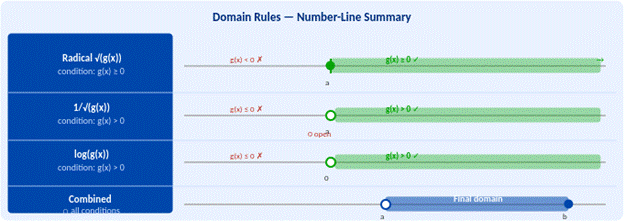
3.2 The 1/√(|x|−x) Form — Asked Four Times
This is the most-tested domain form in the chapter. Work through it once to understand it permanently.
Need: |x| − x > 0 (strict, because of the reciprocal radical).
Case x ≥ 0: |x| = x, so |x| − x = 0. This is NOT > 0. Fails.
Case x < 0: |x| = −x, so |x| − x = −x − x = −2x. Since x < 0, we have −2x > 0. Passes.
Domain of 1/√(|x|−x) = (−∞, 0)
[NDA 2015-II, NDA 2016-II, NDA 2018-I, NDA 2024-I]
3.3 The 1/√(x−|x|) Form
Case x ≥ 0: x − |x| = 0. Fails (need > 0).
Case x < 0: x − |x| = x − (−x) = 2x < 0. Also fails.
Domain of 1/√(x−|x|) = ∅ (empty — no real x satisfies the condition)
[NDA 2024-I]
3.4 The Variable-Base Logarithm
When the base of a logarithm contains the variable, two conditions must hold simultaneously: the base must be positive, and it must not equal 1.
Domain of log_x 10 (base is x): need x > 0 AND x ≠ 1. Domain = (0,1) ∪ (1,∞). [NDA 2019-I]
Domain of √(1−(x−1)²): need 1−(x−1)² ≥ 0, i.e. (x−1)² ≤ 1, i.e. 0 ≤ x ≤ 2. Domain = [0,2]. [NDA 2022-I]
Domain of 3ˣ: the exponential function is defined for all real x. Domain = ℝ. [NDA 2021-I]
Domain of f(x)=1−∛((x−1)²): the cube root is defined for all real values. Domain = ℝ. [NDA 2025-II]
Domain of f(x)=|x−3|: the modulus is defined for all real x. Domain = ℝ. [NDA 2025-I]
| NDA Worked Example 3 Domain — Paired Comparison and Variable-Base Log |
| Question Question A (NDA 2024-I) Which one of the following is correct in respect of f(x) = 1/√(|x|−x) and g(x) = 1/√(x−|x|)? (a) f(x) has some domain and g(x) has no domain (b) f(x) has no domain and g(x) has some domain (c) f(x) and g(x) have the same domain (d) f(x) and g(x) do not have any domain |
| Solution For f(x): Need |x|−x > 0. For x ≥ 0: |x|=x, so |x|−x=0 — fails. For x < 0: |x|=−x, so |x|−x=−2x>0 — passes. Domain of f = (−∞, 0). For g(x): Need x−|x| > 0. For x ≥ 0: x−|x|=0 — fails. For x < 0: x−|x|=2x<0 — fails. Domain of g = ∅. f has a domain (all negative reals); g has no domain. Question B (NDA 2019-I) Find the domain of f(x) = log_x 10. Condition 1: x > 0. Condition 2: x ≠ 1. Intersecting: x ∈ (0,∞) and x ≠ 1 → Domain = (0,1) ∪ (1,∞) |
| Answer: (a) for Question A | (0,1)∪(1,∞) for Question B |
| The domain form 1/√(|x|−x) has appeared in NDA-2015-II, NDA-2016-II, NDA-2018-I and NDA-2024-I. The answer is always (−∞,0). The paired version with 1/√(x−|x|) appeared in 2024-I — its domain is always empty. |
4. Range of a Function
The range is the set of all values that f actually produces. Two methods cover all NDA range questions.
4.1 Solve for x and Impose Reality
Set y = f(x). Rearrange to express x in terms of y. Impose the condition that x must be real (or that x belongs to the given domain). Read off the allowed values of y.
This method works for rational functions and algebraic expressions.
4.2 Bounding Method
When f involves sin, cos or |·|, use known bounds to constrain the range directly.
sin²x ∈ [0,1] for all x. So f(x) = π + sin²x has range [π, π+1]. [NDA 2023-II]
For (1−cos x)⁻¹ with x ≠ 2nπ: cos x ∈ [−1,1) (since cos x ≠ 1 when x ≠ 2nπ). So 1−cos x ∈ (0,2]. The reciprocal then takes values in [1/2, ∞). [NDA 2025-I]
Range of |x|/x with f(0)=2: for x>0 the value is 1; for x<0 the value is −1; at x=0 the value is 2. Range = {−1, 1, 2}. [NDA 2009-II, NDA 2013-I, NDA 2015-I]
Range of x+|x|: for x≥0, f(x)=2x≥0; for x<0, f(x)=0. Range = [0,∞). [NDA 2023-I]
Range of x/(x²+1): let y=x/(x²+1). Then yx²−x+y=0. For real x, discriminant 1−4y²≥0, so |y|≤1/2. Range = [−1/2, 1/2]. [NDA 2010-I]
Range of √(2−x)+√(2+x) on [−2,2]: at x=0, value is 2√2; at x=±2, value is √4=2. Maximum is 2√2 = √8. [NDA 2023-II]
Range of f(x)=x²+2 is [2,∞) since x²≥0. If g(x)=2x−3, then (fg)(1)=f(1)·g(1)=(1+2)(2−3)=3·(−1)=−3. [NDA 2023-I]
| NDA Worked Example 4 Range — Solve for x and Impose Reality |
| Question Question (NDA 2016-I, NDA 2018-I) Find the range of f(x) = x²/(1+x²) from ℝ to ℝ. |
| Solution Let y = x²/(1+x²). Rearrange to find x in terms of y. y(1+x²) = x² y + yx² = x² y = x²(1−y) x² = y/(1−y) For x to be real, we need x² ≥ 0. So y/(1−y) ≥ 0. Analyse the sign: If y ≥ 0 and 1−y > 0 (i.e. y < 1): both positive, fraction ≥ 0. If y ≤ 0 and 1−y < 0 (i.e. y > 1): both negative, fraction ≥ 0. But y ≤ 0 AND y > 1 is impossible. So we need y ≥ 0 and y < 1. Verification: x=0 gives y=0. As x→∞, y→1 (never reached). y=1 gives x²=1/0, undefined. |
| Answer: Range = [0, 1) |
| This exact form appears twice in the repository. The second time (NDA-2018-I) asks the same question with a slightly different presentation. The method and answer are identical. |
5. Composition of Functions
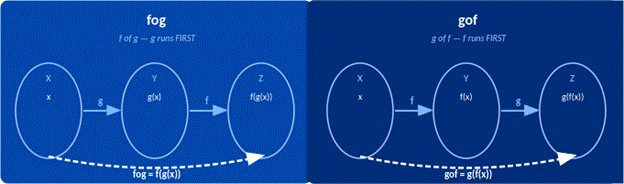
The composition fog (read “f of g”) is defined as:
(fog)(x) = f(g(x))
In fog, g runs first. Take the output of g and feed it into f. The notation says fog but the execution goes right to left.
In gof, f runs first. (gof)(x) = g(f(x)). Evaluate f first, then feed the result into g.
fog and gof are generally different. The NDA explicitly tests their difference. Always write out each composition step by step.
5.1 Evaluating a Composition
To evaluate (fog)(a): compute g(a) first, then substitute that result into f.
g(x)=x+3. fog(x)=(x+3)². Then (fog)(−3)=(−3+3)²=0. [NDA 2010-I]
f(x)=4x+3. fofof(−1): f(−1)=−1, f(f(−1))=f(−1)=−1, fofof(−1)=−1. [NDA 2022-I]
f(x)=x²−3 on [−6,6]. fofof(−1)=fofof(1) because f(−1)=f(1)=−2. Both equal f(f(−2))=f(1)=−2. [NDA 2017-I]
f=[x] (greatest integer), g=|x|. (gof)(−5/3) = g(f(−5/3)) = g([−5/3]) = g(−2) = |−2| = 2. (fog)(−5/3) = f(g(−5/3)) = f(5/3) = [5/3] = 1. [NDA 2016-I]
f([x]), g(sin x). (fof)(x) = [[x]] = [x] since [x] is already an integer. So (fof)(x)=f(x). (gog)(x)=sin(sin x)=g(x) only when sin x=x, i.e. x=0. [NDA 2016-II]
5.2 When fog = gof: The Linear Condition
For linear functions f(x) = px+q and g(x) = mx+n:
fog(x) = f(mx+n) = p(mx+n)+q = pmx + pn + q
gof(x) = g(px+q) = m(px+q)+n = mpx + mq + n
These are equal when pn+q = mq+n, which is the same as f(n) = g(q).
fog = gof ⟺ f(n) = g(q)
f(x)=px+q, g(x)=mx+n, fog=gof: equivalent to f(n)=g(q). [NDA 2017-I, NDA 2022-II, NDA 2024-I, NDA 2024-II]
f(x)=4x+1, g(x)=kx+2, fog=gof: use f(n)=g(q): n=2, q=1. f(2)=9, g(1)=k+2. So k+2=9, k=7. [NDA 2022-II-Q071/Q072, NDA 2024-II-Q071/Q072 — verbatim repeat]
5.3 Finding f Given fog: The Reverse Problem
If you know fog and g, find f by substituting u = g(x) and reading off what f does to u.
| NDA Worked Example 1 Composition in Both Orders — fog ≠ gof |
| Question Question (NDA 2016-I) Let f(x) = [x] (greatest integer function) and g(x) = |x| (modulus function). What is (gof)(−5/3) − (fog)(−5/3) equal to? (a) −1 (b) 0 (c) 1 (d) 2 |
| Solution Step 1 — Compute (fog)(−5/3): In fog, g runs first. g(−5/3) = |−5/3| = 5/3 f(5/3) = [5/3] = 1 (greatest integer not exceeding 5/3) (fog)(−5/3) = 1 Step 2 — Compute (gof)(−5/3): In gof, f runs first. [−5/3] = −2 (the greatest integer not exceeding −5/3 is −2, not −1) g(−2) = |−2| = 2 (gof)(−5/3) = 2 Step 3: (gof)(−5/3) − (fog)(−5/3) = 2 − 1 = 1. |
| Answer: (c) 1 |
| The most common error is computing [−5/3]=−1 by rounding. The floor function always rounds DOWN. −5/3 ≈ −1.667, and the greatest integer not exceeding −1.667 is −2, not −1. |
| [NDA 2016-I-, NDA 2022-I, NDA 2025-II] |
| NDA Worked Example 2 Finding f Given fog — Reverse Composition |
| Question Question (NDA 2010-I) If g: R → R, g(x) = x+3 and (fog)(x) = (x+3)², what is f(−3)? (a) −9 (b) 0 (c) 9 (d) 3 |
| Solution Let u = g(x) = x+3. Then (fog)(x) = f(g(x)) = f(u) = (x+3)² = u². So f(u) = u², which means f(x) = x² for all x. f(−3) = (−3)² = 9 |
| Answer: (c) 9 |
| The confusion here is to read f(x)=(x+3)² from (fog)(x)=(x+3)². That is fog, not f. Let u=g(x) first, then read off what f does to u. |
| [NDA 2019-II, NDA 2025-II] |
| Property | Statement |
| Definition | (fog)(x) = f(g(x)) — evaluate g first, feed into f |
| Order matters | fog ≠ gof in general. Always write out both if asked. |
| Iterated composition | (fofof)(x) = f(f(f(x))) — apply f three times from the inside out |
| Reverse problem | Given fog and g, let u=g(x); then f(u) = (fog)(x) expressed in u |
| Linear fog = gof | f(x)=px+q, g(x)=mx+n: fog=gof iff f(n)=g(q), i.e. pn+q = mq+n |
fog(x)=cos²√x and gof(x)=|cos x|: let f(x)=cos²x and g(x)=√x. Then fog(x)=cos²(√x) and gof(x)=√(cos²x)=|cos x| . [NDA 2024-II-Q081/Q082]
g(x)=x−1/x and fog(x)=x³−1/x³: see Cluster Walkthrough 1. [NDA 2024-I-Q085]
f(x)=2x+7, g(x)=x²+7: fog(x)=2(x²+7)+7=2x²+21=25 gives x²=2, x=±√2. [NDA 2010-II]
fofof at (e−1)/(e+1) with f=gof type structure. [NDA 2015-I-Q066, NDA 2017-II-Q095]
f(x)=5^(lnx): inverse is x=y^(1/ln5) or equivalently y^(log_5 e), y>0. [NDA 2017-II]
6. Injectivity, Surjectivity and Bijectivity
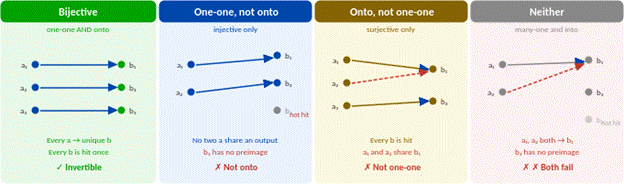
A function f: A → B can be classified by how its inputs and outputs relate.
6.1 One-One (Injective)
f is one-one if no two different inputs produce the same output.
f(a) = f(b) implies a = b
To test: assume f(a) = f(b) and show a = b must follow. Alternatively, find one example where f(a) = f(b) but a ≠ b. That single counterexample proves f is NOT one-one.
6.2 Onto (Surjective)
f is onto if its range equals its codomain. Every element of B is hit by at least one element of A.
| Important “Onto” is not a property of the rule alone. It depends on the stated codomain. The same rule can be onto for one codomain and not onto for another. |
6.3 Bijective
f is bijective if it is both one-one and onto. Bijections are exactly the functions that have an inverse.
cos x on [0,π]: restricted to [0,π], cos x is strictly decreasing, so one-one. Its range is [−1,1] which equals the stated codomain. Bijection. [NDA 2017-I]
6.4 Standard Function Classification (Algebraic Tests)
f(x) = x|x|: For x>0: f(x)=x²>0. For x<0: f(x)=−x²<0. At x=0: f(0)=0. Different inputs always give different outputs: one-one. Every real number y is attained: onto. Bijection. [NDA 2009-I, NDA 2024-I]
f(x)=x/(x²+1): f(2)=2/5 and f(1/2)=(1/2)/(5/4)=2/5. Two different inputs give the same output. NOT one-one. Range=[−1/2,1/2]≠ℝ, NOT onto. [NDA 2010-I]
f(x)=cos x from ℝ→ℝ: cos(0)=cos(2π)=1, not one-one. Range=[−1,1]≠ℝ, not onto. [NDA 2009-II]
f(x)=eˣ from ℝ→ℝ: one-one (eˣ is strictly increasing). Range=(0,∞)≠ℝ, NOT onto. One-one but not onto. [NDA 2010-I]
f(x)=|x| from ℝ→ℝ: f(1)=f(−1)=1, NOT one-one. f(x)=11 (constant): NOT one-one. f(x)=−x: f(a)=f(b)⟹−a=−b⟹a=b, one-one. [NDA 2009-II]
f: ℝ→{0,1}, f(x)=1 if rational, 0 if irrational: two different rationals map to same output: many-one. Range={0,1}=codomain: onto. Many-one onto. [NDA 2010-II]
For f(x)=(2x+3)/(3x+5), domain is ℝ\{−5/3}. Range is ℝ\{2/3}. When codomain is ℝ\{2/3}, the function is both one-one and onto. [NDA 2023-I]
f(x)=x|x|, g(x)=cos(πx) on A=(−1,1)? f: strictly increasing, bijection . g: on (−1,1), g(−1/2)=cos(−π/2)=0 and g(1/2)=cos(π/2)=0: NOT one-one. [NDA 2024-I-Q022]
f(x+1)=x²−3x+2: substitute u=x+1, x=u−1. f(u)=(u−1)²−3(u−1)+2=u²−5u+6. [NDA 2021-I]
| NDA Worked Example 5 Injectivity and Surjectivity — The Codomain Trap |
| Question Question (NDA 2021-I, NDA 2013-I) Consider the following statements: 1. A function f: ℤ → ℤ defined by f(x) = x+1 is one-one as well as onto. 2. A function f: ℕ → ℕ defined by f(x) = x+1 is one-one but not onto. Which is/are correct? |
| Solution Statement 1 (f: ℤ → ℤ, f(x)=x+1): One-one: Suppose f(a)=f(b). Then a+1=b+1, so a=b. Onto: For any z ∈ ℤ, we need x ∈ ℤ with x+1=z. So x=z−1, and z−1 ∈ ℤ always. Statement 1 is TRUE. Statement 2 (f: ℕ → ℕ, f(x)=x+1): One-one: Same argument — f(a)=f(b) implies a=b. Onto: Is 1 ∈ ℕ in the range? We need x ∈ ℕ with x+1=1, i.e. x=0. But 0 ∉ ℕ. So 1 is not hit. Statement 2 is TRUE. |
| Answer: Both 1 and 2 are correct. |
| The rule x+1 is unchanged. What changes is the codomain. On ℤ, every integer z has a preimage z−1 in ℤ. On ℕ, the element 1 has no preimage in ℕ. Onto-ness is a statement about the codomain, not the rule. |
| [NDA 2013-I, NDA 2021-I, NDA 2025-I] |
| Function | Domain | Range | One-one? | Onto ℝ? | Even/Odd |
| x|x| | ℝ | ℝ | Yes | Yes | Odd |
| |x|/x (x≠0) | ℝ\{0} | {−1, 1} | No | No | Odd |
| x²/(1+x²) | ℝ | [0, 1) | No | No | Even |
| x/(x²+1) | ℝ | [−1/2, 1/2] | No | No | Odd |
| 1/√(|x|−x) | (−∞, 0) | (0, ∞) | No | No | — |
| ln(x+√(1+x²)) | ℝ | ℝ | Yes | Yes | Odd |
| eˣ | ℝ | (0, ∞) | Yes | No | Neither |
| cos x (on ℝ) | ℝ | [−1, 1] | No | No | Even |
| cos x on [0,π] | [0,π] | [−1, 1] | Yes | Yes (→[−1,1]) | — |
| f(x)=x+1 on ℕ | ℕ | {2,3,4,…} | Yes | No | — |
| f(x)=x+1 on ℤ | ℤ | ℤ | Yes | Yes | — |
7. Inverse Functions
An inverse function f⁻¹ exists if and only if f is bijective. The inverse undoes what f does:
f⁻¹(f(x)) = x and f(f⁻¹(x)) = x
7.1 Finding the Inverse
Write y = f(x). Solve for x in terms of y. Replace y with x to get the formula for f⁻¹.
f(x)=(2/3)x+(3/2): set y=(2/3)x+(3/2). Then x=(3/2)(y−3/2)=(3/2)y−9/4. So f⁻¹(x)=(3/2)x−9/4. [NDA 2010-II]
f(x)=5^(lnx) for x>0: set y=5^(lnx). Take log base 5: log₅y=lnx. So x=e^(log₅y)=y^(1/ln5). Thus f⁻¹(x)=x^(1/ln5)=x^(log_5 e). [NDA 2017-II]
f(x)=(10ˣ−10⁻ˣ)/(10ˣ+10⁻ˣ): set y=(10ˣ−10⁻ˣ)/(10ˣ+10⁻ˣ). Let u=10ˣ. Then y=(u²−1)/(u²+1). Solve: u²=(1+y)/(1−y). So 2x=log₁₀((1+y)/(1−y)), x=(1/2)log₁₀((1+x)/(1−x)) replacing y by x. [NDA 2025-II]
7.2 Invertibility
For NDA-2015-I: a bijection on its range is invertible. Identifying which mappings are bijections from the given options uses the standard classification table. [NDA 2015-I]
fofofof(0) for f(x)=(10ˣ−10⁻ˣ)/(10ˣ+10⁻ˣ): f(0)=(1−1)/(1+1)=0. So f(0)=0 and any iterated composition at 0 stays at 0. [NDA 2025-II]
8. Even, Odd and Periodic Functions
These properties tell you about the symmetry of a function. The test is always a computation. Never guess from the appearance of the expression.
8.1 Even, Odd, Neither
Even: f(−x) = f(x) for all x in the domain. The graph is symmetric about the y-axis.
Odd: f(−x) = −f(x) for all x in the domain. The graph is symmetric about the origin.
Neither: f(−x) is neither equal to f(x) nor to −f(x).
Method: compute f(−x), simplify, compare to f(x) and −f(x)
f(x)=x²−1: f(−x)=(−x)²−1=x²−1=f(x). Even. [NDA 2017-I]
f(x)=x+3/x: f(−x)=−x−3/x=−(x+3/x)=−f(x). Odd. [NDA 2017-I]
f(x)=|x|: f(−x)=|−x|=|x|=f(x). Even. [NDA 2017-I]
f(x)=x²(x−3): f(−x)=(−x)²(−x−3)=x²(−x−3)=−x²(x+3). Neither −f(x) nor f(x). Neither. [NDA 2017-I]
f(x)=|x|−x³: f(−x)=|x|+x³. Neither |x|−x³ nor −(|x|−x³)=−|x|+x³. Neither even nor odd. [NDA 2017-II]
8.2 The Standard Odd Function: ln(x+√(1+x²))
This form has been asked three times. The computation is always three lines.
Let f(x) = ln(x+√(1+x²)). Compute f(−x):
f(−x) = ln(−x + √(1+x²))
Now multiply (x+√(1+x²)) by (−x+√(1+x²)):
(x+√(1+x²))(−x+√(1+x²)) = (√(1+x²))² − x² = 1+x²−x² = 1
So −x+√(1+x²) = 1/(x+√(1+x²)).
f(−x) = ln(1/(x+√(1+x²))) = −ln(x+√(1+x²)) = −f(x)
f(x) = ln(x+√(1+x²)) is ODD. f(x)+f(−x) = 0. [NDA 2019-I, NDA 2022-II, NDA 2024-II]
8.3 Periodic Functions
Period T is the smallest positive value for which f(x+T) = f(x) for all x in the domain.
sin x has period 2π. sin²x has period π, because squaring halves the period: sin²(x+π)=sin²x. [NDA 2023-II]
f(x)=π+sin²x has range [π,π+1] and period π. [NDA 2023-II]
| NDA Worked Example 7 Even/Odd Classification — ln(x+√(1+x²)) |
| Question Question A (NDA 2022-II) If f(x) = ln(x+√(1+x²)), which is correct? (a) f(x)+f(−x)=0 (b) f(x)−f(−x)=0 (c) 2f(x)=f(−x) (d) f(x)=2f(−x) |
| Solution Compute f(−x): f(−x) = ln(−x+√(1+x²)) Use the conjugate product identity: (x+√(1+x²))(−x+√(1+x²)) = 1+x²−x² = 1 So: −x+√(1+x²) = 1/(x+√(1+x²)) f(−x) = ln(1/(x+√(1+x²))) = −ln(x+√(1+x²)) = −f(x) Therefore f(x)+f(−x) = 0. Question B (NDA 2024-II — two-statement block) Let f(t) = ln(t+√(1+t²)) and g(t) = tan(f(t)). Statement I: f(t) is an odd function. Statement II: g(t) is an odd function. Statement I: f(−t)=−f(t) as shown above. TRUE. Statement II: g(−t)=tan(f(−t))=tan(−f(t))=−tan(f(t))=−g(t). So g is also odd. TRUE. |
| Answer: (a) for Question A | Both I and II are correct for Question B |
| Do not guess the classification. The conjugate product step (x+√(1+x²))(−x+√(1+x²))=1 is the key. Once you see this product equals 1, f(−x)=−f(x) follows in one line. |
| [NDA 2019-I, NDA 2022-II, NDA 2024-II] |
9. Functional Equations
A functional equation gives a relationship that f satisfies, not a formula for f. The task is to find f(x) or specific values of f, using that relationship.
This is the fastest-growing concept in the chapter. From 0.10 questions per paper in 2009–2013 to 1.25 per paper in 2022–2026. It is not named anywhere in the official NDA syllabus, yet it now outranks four of the seven syllabus topics in frequency.
General workflow: given equation → appropriate substitution → resulting equations → solve.
9.1 Pattern A: Reciprocal Substitution (x → 1/x)
Use when the equation involves both f(x) and f(1/x).
Write the given equation. Substitute x → 1/x throughout the entire equation: every x becomes 1/x. This gives a second equation. Solve the two-equation system.
| NDA Worked Example 6 Functional Equation — Reciprocal Substitution |
| Question Question (NDA 2024-I) Let 3f(x) + f(1/x) = 1/x + 1. What is f(x) equal to? (a) 1/(8x) − x/8 + 1/4 (b) 3/(8x) − x/8 + 3/4 (c) 3/(8x) + x/8 + 1/4 (d) 3/(8x) − x/8 + ¼ |
| Solution Label the given equation: Equation (1): 3f(x) + f(1/x) = 1/x + 1 Substitute x → 1/x throughout Equation (1). Every x becomes 1/x: Equation (2): 3f(1/x) + f(x) = x + 1 Multiply Equation (1) by 3: 9f(x) + 3f(1/x) = 3/x + 3 Subtract Equation (2): (9f(x) + 3f(1/x)) − (3f(1/x) + f(x)) = (3/x + 3) − (x + 1) 8f(x) = 3/x − x + 2 f(x) = 3/(8x) − x/8 + 1/4 Verification: 3f(x)+f(1/x) = 3(3/(8x)−x/8+1/4)+(3x/8−1/(8x)+1/4) = 9/(8x)−3x/8+3/4+3x/8−1/(8x)+1/4 = 8/(8x)+4/4 = 1/x+1 |
| Answer: (d) 3/(8x) − x/8 + 1/4 |
| Never try to read f(x) directly from 3f(x)+f(1/x)=1/x+1. That gives you an equation in two unknowns. The substitution x→1/x creates the second equation. The two together form a 2×2 system that can be solved. |
| [NDA 2022-I, NDA 2023-II, NDA 2024-I] |
9.2 Pattern B — Complementary Substitution (x → 1−x)
Use when the equation involves both f(x) and f(1−x).
Write the given equation. Substitute x → 1−x throughout. This gives the second equation. Solve the system.
| NDA Worked Example 6 (Supplement) Functional Equation — Complementary Substitution |
| Question Question (NDA 2026-I) If 2f(x) + f(1−x) = x, what is f(x) equal to? (a) x−1 (b) x−1/3 (c) 2x (d) 2x−1 |
| Solution Label the given equation: Equation (1): 2f(x) + f(1−x) = x Substitute x → 1−x throughout: Equation (2): 2f(1−x) + f(x) = 1−x Multiply Equation (2) by 2: 4f(1−x) + 2f(x) = 2 − 2x Subtract Equation (1): (4f(1−x) + 2f(x)) − (2f(x) + f(1−x)) = (2−2x) − x 3f(1−x) = 2 − 3x f(1−x) = (2−3x)/3 Substitute x → 1−x to convert to f(x): f(x) = (2−3(1−x))/3 = (2−3+3x)/3 = (3x−1)/3 = x − 1/3 |
| Answer: (b) x − 1/3 |
| The substitution here is x→1−x, not x→1/x. The choice depends on what the equation contains: if f(1−x) appears, use x→1−x; if f(1/x) appears, use x→1/x. Do not apply the reciprocal substitution by habit when the complementary one is needed. |
9.3 Pattern C: Multiplicative and Quotient Forms
Forms like f(xy)=f(x)f(y) or f(x/y)=f(x)/f(y) are handled by substituting convenient specific values.
If f(x)f(y)=f(xy) and f(2)=4, find f(1/2). Set x=2, y=1/2: f(2)·f(1/2)=f(1). First find f(1): set x=y=1: f(1)²=f(1), so f(1)=1. Then f(2)·f(1/2)=1, so f(1/2)=1/4. [NDA 2024-II-Q080]
[See Cluster Walkthrough 2 for NDA-2025-I-Q095/Q096, the full four-question cluster on f(x/y)=f(x)/f(y) with f(2)=3.]
9.4 Pattern D: Specialised Substitutions
If 4f(x)−f(1/x)=(2x+1/x)(2x−1/x)=4x²−1/x². Substitute x=2: 4f(2)−f(1/2)=4(4)−1/4=63/4. Then x=1/2: 4f(1/2)−f(2)=4(1/4)−4=−3. Solve: from first, 4f(2)−f(1/2)=63/4 and 4f(1/2)−f(2)=−3. Multiply second by 4: 16f(1/2)−4f(2)=−12. Add to first: 15f(1/2)=63/4−12=15/4, f(1/2)=1/4. Then 4f(2)=1/4+63/4=16, f(2)=4. [NDA 2022-I-Q067]
If f(x+1)=x²−3x+2, substitute u=x+1: f(u)=(u−1)²−3(u−1)+2=u²−5u+6. [NDA 2021-I]
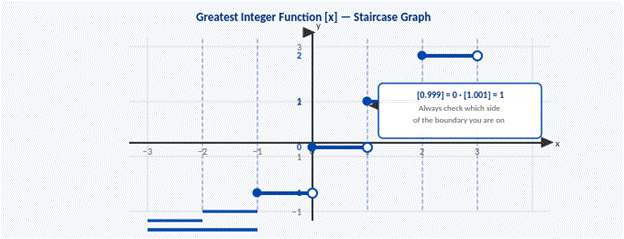
| Important Recent GIF questions frequently exploit values immediately below or above integer boundaries. Always substitute the given x-value explicitly and compute [·] by the floor definition. Never round. |
10.2 The Nested Form [[x]−x]
For positive non-integer x: [x] is an integer, x is not an integer, so [x]−x is in (−1,0). The greatest integer of any value in (−1,0) is −1.
[[x] − x] = −1 for all positive non-integer x
This result appeared verbatim in NDA-2022-II-Q071 and again in NDA-2024-II-Q071 — same question, same question number, two years apart. Drill the paper itself. [NDA 2022-II-Q071, NDA 2024-II-Q071 — verbatim repeat]
10.3 Summation of [·]
f(n)=[1/4+n/1000] for n=1,2,…,1000. The value changes from 0 to 1 when 1/4+n/1000≥1, i.e. n≥750. So [f(n)]=0 for n=1 to 749 and =1 for n=750 to 1000. Sum = 251. [NDA 2017-II]
| NDA Worked Example 8 Greatest Integer at Integer Boundaries |
| Question Question (NDA 2024-II) Let f(x) = [x]² − [x²], where [·] is the greatest integer function. What is f(0.999)+f(1.001) equal to? (a) −1 (b) 0 (c) 1 (d) 2 |
| Solution Evaluate at x = 0.999: [0.999] = 0 (the floor of 0.999 is 0, not 1) [0.999²] = [0.998001] = 0 f(0.999) = 0² − 0 = 0 Evaluate at x = 1.001: [1.001] = 1 [1.001²] = [1.002001] = 1 f(1.001) = 1² − 1 = 0 f(0.999) + f(1.001) = 0 + 0 = 0 |
| Answer: (b) 0 |
| Important: The most common error is computing [0.999]=1 by rounding. The floor function rounds DOWN. 0.999 lies in [0,1), so its floor is 0. 1.001 lies in [1,2), so its floor is 1. |
| [NDA 2024-II] |
NDA-2022-II and NDA-2024-II: nested GIF [[x]−x] for positive non-integer x. Answer: −1 (see Section 10.2 above). [NDA 2022-II, NDA 2024-II]
11. Graphs and Curve Intersection
This concept is dormant. Four questions appeared between 2016-I and 2020-C, none since. Cover it concisely.
Reading a graph: domain is the set of x-values for which the graph exists. Range is the set of y-values the graph reaches.
f(x)=1/(x−1): domain = {x : x≠1}, range = {y : y≠0}. Graph intersects y-axis at (0,−1). The excluded domain value is x=1, and the excluded range value is y=0. [NDA 2020-I & II]
f(x)=x/x for x≠0: this equals 1 for all x≠0. The graph is the horizontal line y=1 with a hole at x=0. [NDA 2017-II]
Graph questions in NDA 2016-I-Q012 and NDA 2017-II-Q086 present multiple curve images. Identify the domain and range from each image to match with the function rule. [NDA 2016-I, NDA 2017-II]
12. Important Distinctions
Function vs Relation. A relation is any subset of A×B. A function is a relation in which every element of the domain is related to exactly one element of the codomain. Every function is a relation; not every relation is a function.
fog vs gof. fog means apply g first, then f. gof means apply f first, then g. These are generally different. Never evaluate fog by applying f to x first.
One-one vs Onto. “One-one” is a statement about inputs: no two inputs share an output. “Onto” is a statement about the codomain: every element of the codomain is hit. They are independent. A function can be one without the other, both, or neither.
Codomain vs Range. Codomain is declared when the function is defined. Range is derived from the actual outputs. Range ⊆ Codomain always. They are equal only when every codomain element is actually attained.
Reciprocal substitution vs Complementary substitution. For a functional equation involving f(1/x), substitute x → 1/x. For one involving f(1−x), substitute x → 1−x. These are different substitutions for different equation forms.
Cluster members vs standalone questions. A cluster member shares a passage (stem) with the questions around it. Read the stem fully before attempting any member. In NDA-2025-I, all eight Functions questions were cluster members. A wrong stem calculation loses all dependent marks.
| Cluster Walkthrough 1: Two-Item Composition Cluster |
| Cluster Stem Cluster stem (NDA 2024-I) Let g(x) = x − 1/x and fog(x) = x³ − 1/x³. |
| Q: What is g[f(x) − 3x] equal to? (a) x³ − 1/x³ (b) x³ + 1/x³ (c) x² − 1/x² (d) x² + 1/x² Step 1 — Establish f from the stem. We know g(x)=x−1/x and fog(x)=x³−1/x³. Let u = g(x) = x−1/x and express fog(x)=f(u) in terms of u. u³ = (x−1/x)³ = x³ − 3x + 3/x − 1/x³ = (x³−1/x³) − 3(x−1/x) = fog(x) − 3u So: fog(x) = u³ + 3u → f(u) = u³ + 3u → f(x) = x³ + 3x Step 2 — Evaluate g[f(x)−3x]. f(x) − 3x = x³ + 3x − 3x = x³ g[f(x)−3x] = g(x³) = x³ − 1/x³ = fog(x) Answer: (a) x³ − 1/x³ |
| Always read the stem fully and derive all available facts (including f) before touching any cluster question. Here f is not given directly; it must be derived from the stem before the question can be answered. |
| [NDA 2024-I] |
| Cluster Walkthrough 2: Four-Item Functional Equation Cluster |
| Cluster Stem Cluster A stem (NDA 2025-I, Q095–Q096) The function f(x) satisfies f(x/y) = f(x)/f(y) for all positive real x and y, and f(2) = 3. Cluster B stem (NDA 2025-I, Q097–Q098) A function f is such that f(xy) = f(x+y) for all real x and y, and f(5) = 10. |
| Solution — Cluster A Find f(1): Set x=y: f(x/x)=f(x)/f(x) → f(1)=1 Find f(4): Set x=4, y=2: f(2)=f(4)/f(2) → f(4)=f(2)²=9 Find f(16): Set x=16, y=4: f(4)=f(16)/f(4) → f(16)=f(4)²=81 QAnswer: (d) 81 | Q096: f(1)·f(4) = 1 × 9 = 9. Answer: (c) 9 Solution — Cluster B Set y=0: f(x·0)=f(x+0) → f(0)=f(x) for all x. So f is constant. Since f(5)=10, we have f(x)=10 for all real x. Q097 Answer: (d) f(0) = 10 | Q098: f(20)+f(−20) = 10+10 = 20. Answer: (c) 20 |
| For Cluster A, derive each new value by applying the functional equation at chosen pairs, not by invoking any general theorem. For Cluster B, the y=0 substitution immediately shows f is constant. In both cases, read the stem to establish everything before touching any cluster question. |
| [NDA 2025-I, NDA 2025-I, NDA 2025-I, NDA 2025-I] |
Quick Revision
1. Composition (25 PYQs)
- (fog)(x) = f(g(x)): evaluate g first, feed into f. fog ≠ gof in general. [NDA 2016-I]
- f(g(x)) = g(f(x)) for linear functions f(x)=px+q, g(x)=mx+n: equivalent to f(n)=g(q), i.e. pn+q=mq+n. [NDA 2017-I, NDA 2022-II, NDA 2024-I, NDA 2024-II]
- In 2025-I, every Functions question was inside a cluster. Read the stem fully before any member.
2. Functional Equations (16 PYQs — 1.25 per paper in modern regime)
- Reciprocal substitution (x→1/x): for af(x)+bf(1/x)=g(x), substitute x→1/x, solve the 2×2 system. [NDA 2022-I, NDA 2023-II, NDA 2024-I]
- Complementary substitution (x→1−x): for af(x)+bf(1−x)=g(x), substitute x→1−x, solve the 2×2 system. [NDA 2026-I]
- Multiplicative form f(xy)=f(x)f(y): use direct substitution to find f at required points. f(16)=f(4)²=81 from f(2)=3 via the functional equation. [NDA 2025-I]
- Constant form f(xy)=f(x+y): set y=0 to show f is constant. [NDA 2025-I]
3. Domain Rules (12 PYQs)
- Radical √(g(x)): g(x)≥0. Reciprocal radical 1/√(g(x)): g(x)>0 (strict).
- Denominator ≠ 0. Log argument > 0. Log base: > 0 AND ≠ 1.
- 1/√(|x|−x): domain = (−∞, 0). Asked 4 times. [NDA 2015-II, NDA 2016-II, NDA 2018-I, NDA 2024-I]
- 1/√(x−|x|): domain = ∅. [NDA 2024-I]
4. Standard Functions Classification
- See the Standard Functions Classification Table (Section 6). It answers most range and injectivity questions on sight.
5. One-One / Onto (20 PYQs)
- One-one: f(a)=f(b) implies a=b. Test algebraically. No calculus.
- Onto: range = codomain. This depends on the stated codomain, not just the rule.
- f(x)=x+1 on ℤ: bijection. On ℕ: one-one, NOT onto — 1 has no preimage. [NDA 2013-I, NDA 2021-I, NDA 2025-I]
6. Greatest Integer (4 PYQs)
- [x] = floor of x. [x] ≤ x < [x]+1.
- [[x]−x] = −1 for positive non-integer x. [NDA 2022-II-Q071, NDA 2024-II-Q071 — verbatim repeat]
- f=[x]²−[x²]: compute by explicit case analysis at the given values, never by formula. [NDA 2024-II]
7. Even / Odd / Periodic
- f(−x)=f(x): even. f(−x)=−f(x): odd. Neither otherwise.
- ln(x+√(1+x²)) is ODD: compute f(−x) using the conjugate product identity (x+√(1+x²))(−x+√(1+x²))=1. [NDA 2019-I, NDA 2022-II, NDA 2024-II]
- Period of sin²x is π (not 2π). Period of π+sin²x is also π. [NDA 2023-II]