Free NDA 2026 Preparation Guide
View Strategy

Units, Dimensions & Measurements – NDA Physics Notes
Exam Relevance: High Frequency | SI Units · Dimensional Formulae · kWh · Light Year · Gravitational Constant G · Precision
Reading Time: 20–25 minutes | Last Updated: 2026
Everything in Physics begins with measurement. A soldier reports the distance to a target. A doctor checks a patient’s temperature. An engineer tests the strength of a bridge. All three are making measurements.
A measurement has two parts: a number and a unit. The number alone means nothing. If you say the distance is 5, nobody can act on it. If you say the distance is 5 kilometres, everyone understands. The unit gives the number its meaning.
Now imagine every country used different units. Calculations done in one laboratory would give different numbers than the same calculations done elsewhere. This causes confusion, and in engineering it causes disasters.
To solve this, the world agreed on one universal system of units. This system is called the International System of Units, abbreviated SI from the French Système International d’Unités. This chapter teaches you SI units, dimensions, and how measurement works. It is the foundation of all Physics. NDA has tested this chapter consistently since 2010. Master it, and the marks are guaranteed.
1. Measurement and Units
A physical quantity is anything that can be measured. Length, mass, time, temperature, electric current: these are all physical quantities. Every physical quantity has a number and a unit.
Not all physical quantities are the same kind. Some are fundamental: they stand on their own. Others are derived: they are combinations of fundamental quantities. Speed, for example, is distance divided by time. It is derived from two fundamentals: length and time.
Every unit you use in Physics traces back to a small set of base units. Learn those base units and the rest follows.
2. Systems of Units and SI
Before SI was adopted worldwide, scientists used different systems. The most common was the CGS system: Centimetre, Gram, Second. Its unit of length was the centimetre, its unit of mass was the gram, and its unit of time was the second.
The SI system replaced CGS for most scientific work. It uses the metre for length, the kilogram for mass, and the second for time. SI is more consistent, more precise, and accepted everywhere in the world.
The advantage of SI is coherence. Derived units come out cleanly without conversion factors. When you multiply mass in kilograms by acceleration in metres per second squared, you get force in Newtons, with no conversion factor needed.
3. The Seven Fundamental SI Quantities
The SI system is built on seven independent base quantities. Everything else in Physics is derived from these seven. Learn them once, and you have the foundation for the entire subject.
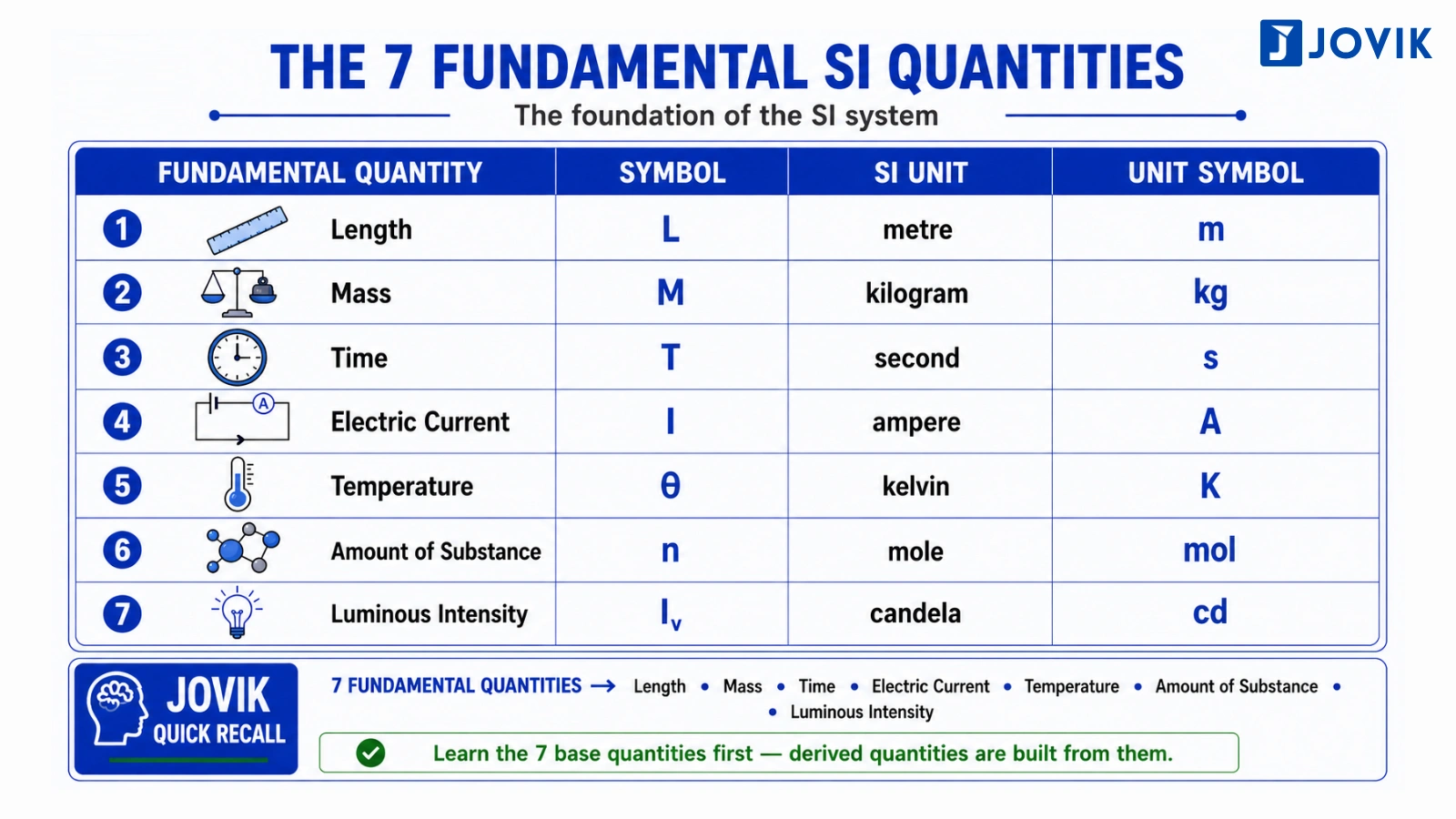
| Fundamental Quantity | Symbol | SI Unit Name | SI Unit Symbol |
| Length | L | Metre | m |
| Mass | M | Kilogram | kg |
| Time | T | Second | s |
| Electric Current | I | Ampere | A |
| Temperature | θ | Kelvin | K |
| Amount of Substance | n | Mole | mol |
| Luminous Intensity | Iᵥ | Candela | cd |
Notice two common points of confusion. The unit of temperature in SI is the Kelvin, not Celsius. And the unit of electric charge is the coulomb. The coulomb is a derived unit, not one of the seven fundamentals. The fundamental unit for electricity is the ampere (electric current). [NDA 2015-I]
Distance can be measured in light years, energy in watt-hours, amount of substance in moles, and electric charge in coulombs. Each of these maps to a specific quantity. [NDA 2015-I]
4. Derived Quantities and Units
Most physical quantities are derived from the seven fundamentals. A derived quantity is formed by multiplying or dividing fundamental quantities.
Speed is length divided by time. Acceleration is change in speed divided by time. Force is mass multiplied by acceleration. Each step builds on the previous one, and each has a derived SI unit.
| Derived Quantity | How It Is Built | SI Unit | Symbol |
| Speed / Velocity | Length ÷ Time | Metre per second | m s⁻¹ |
| Acceleration | Speed ÷ Time | Metre per second squared | m s⁻² |
| Force | Mass × Acceleration | Newton | N = kg m s⁻² |
| Energy / Work | Force × Distance | Joule | J = kg m² s⁻² |
| Power | Energy ÷ Time | Watt | W = kg m² s⁻³ |
| Pressure | Force ÷ Area | Pascal | Pa = kg m⁻¹ s⁻² |
| Electric Charge | Current × Time | Coulomb | C = A s |
| Frequency | 1 ÷ Time Period | Hertz | Hz = s⁻¹ |
SI Unit of Acceleration
An object accelerates when its speed changes over time. Acceleration is the change in speed divided by the time taken. Speed is measured in metres per second (m s⁻¹). Dividing by time in seconds gives the SI unit of acceleration:
Acceleration = Change in Speed ÷ Time = m s⁻¹ ÷ s = m s⁻²
The SI unit of acceleration is m s⁻² (metres per second squared). [NDA 2016-I] The CGS unit cm s⁻² and the informal km s⁻² are not accepted SI units. Only m s⁻² is correct in SI.
SI Unit of Force: The Newton
A force is needed to change an object’s state of motion. The greater the mass of an object, the more force is needed to produce the same acceleration. Newton’s Second Law expresses this relationship:
F = m × a
F = Force, measured in Newtons (N). m = mass, measured in kilograms (kg). a = acceleration, measured in m s⁻². Substituting units: 1 N = 1 kg m s⁻². [NDA 2015-II]
One Newton is the force that gives a mass of 1 kg an acceleration of 1 m s⁻². The Newton is a derived unit built from the three fundamentals: kilogram, metre, and second.
SI Unit of Inductance: The Henry
Inductance is the property of an electrical coil to oppose changes in the electric current flowing through it. When the current changes, the coil produces a voltage that resists that change. The SI unit of inductance is the Henry (H), named after scientist Joseph Henry. [NDA 2017-II]
The symbol H stands for Henry. Students sometimes confuse it with Hertz (Hz), the unit of frequency. These are completely different quantities. Henry measures inductance. Hertz measures frequency. [NDA 2017-II]
SI Unit of Resistivity
Resistivity describes how strongly a material opposes the flow of electric current. It is a fixed property of the material itself, independent of the object’s shape or size.
R = ρ × L / A
Rearranging: ρ = R × A / L = Ω × m² / m = Ω m. The SI unit of resistivity is Ω m (ohm-metre). [NDA 2022-I] Expressions such as Ω/m or Ω cm are dimensionally incorrect for resistivity.
SI Unit of Thermal Conductivity
Thermal conductivity measures how well a material transmits heat. The SI unit of thermal conductivity is W m⁻¹ K⁻¹ (Watts per metre per Kelvin). [NDA 2015-II] Common errors include Wm⁻K⁻¹ (missing exponent on m) or Wm/K (inconsistent notation). Only W m⁻¹ K⁻¹ is the accepted SI expression.
5. Dimensions
The dimension of a physical quantity tells you which fundamental quantities it is made of. We write dimensions using square brackets: [M] for mass, [L] for length, [T] for time. The dimension of speed, for example, is [L T⁻¹], meaning length divided by time.
Dimensions are more general than units. Speed can be measured in m s⁻¹, km h⁻¹, or cm s⁻¹. All of these have the same dimension [L T⁻¹]. The dimension describes the nature of the quantity; the unit describes the scale.
Both sides of any Physics equation must have identical dimensions. This rule is called dimensional homogeneity. If dimensions do not match, the formula is wrong. This check is one of the most useful tools in Physics.
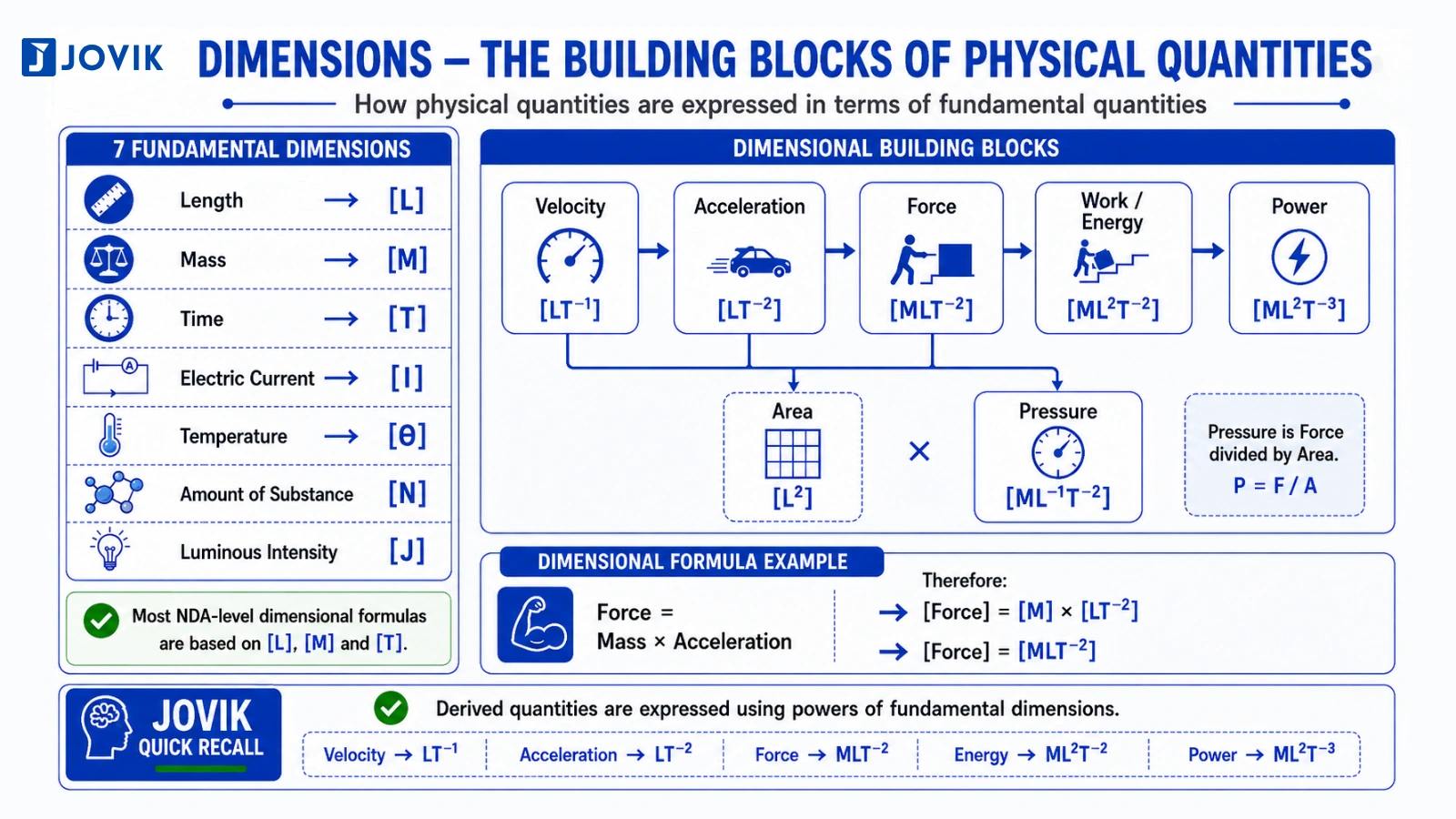
Dimensional Formulae of Key Quantities
| Physical Quantity | Dimensional Formula | SI Unit |
| Length | [L] | m |
| Mass | [M] | kg |
| Time | [T] | s |
| Speed / Velocity | [L T⁻¹] | m s⁻¹ |
| Acceleration | [L T⁻²] | m s⁻² |
| Force | [M L T⁻²] | N |
| Work / Energy | [M L² T⁻²] | J |
| Power | [M L² T⁻³] | W |
| Pressure / Stress | [M L⁻¹ T⁻²] | Pa |
| Impulse / Linear Momentum | [M L T⁻¹] | kg m s⁻¹ |
| Angular Momentum | [M L² T⁻¹] | kg m² s⁻¹ |
| Gravitational Constant G | [M⁻¹ L³ T⁻²] | N m² kg⁻² |
| Planck’s Constant h | [M L² T⁻¹] | J s |
| Frequency | [T⁻¹] | Hz |
| Strain | Dimensionless [1] | No unit |
Impulse and Linear Momentum: Same Dimensions
Impulse is force applied over a period of time. Linear momentum is mass multiplied by velocity. Examine their dimensions carefully:
Impulse = Force × Time = [M L T⁻²] × [T] = [M L T⁻¹]
Momentum = Mass × Velocity = [M] × [L T⁻¹] = [M L T⁻¹]
Both impulse and linear momentum have exactly the same dimension [M L T⁻¹]. [NDA 2014-II] This identity reflects the impulse-momentum theorem: impulse equals the change in momentum.
Stress and Pressure: Same Dimensions
Stress is the internal force per unit area within a solid material. Pressure is the external force per unit area on a surface. Both are defined as force divided by area:
Stress = Pressure = Force / Area = [M L T⁻²] / [L²] = [M L⁻¹ T⁻²]
Stress and pressure share the same dimensions [M L⁻¹ T⁻²] and the same SI unit, the Pascal. [NDA 2017-I | NDA 2025-I]
Strain: A Dimensionless Quantity
Strain is the change in dimension of a material divided by its original dimension. For example, if a rod stretches by 2 mm from an original length of 1 m, the strain is 2/1000 = 0.002.
Strain = Change in Length / Original Length = [L] / [L] = [1]
Because the same unit appears in both numerator and denominator, they cancel. Strain is a dimensionless quantity. It has no unit and no dimension. [NDA 2025-I] Stress has dimensions [M L⁻¹ T⁻²] with unit Pascal. Strain is dimensionless. Never interchange them.
Gravitational Constant G
Newton’s Law of Gravitation states that every mass attracts every other mass. The force of attraction depends on both masses and the distance between them.
F = G × m₁ × m₂ / r²
Rearranging to find G: G = F × r² / (m₁ × m₂). Substituting units: G = N × m² / kg² = N m² kg⁻². Finding dimensions: G = [M L T⁻²] × [L²] / [M²] = [M⁻¹ L³ T⁻²].
| ★ IMPORTANT SI unit of G: N m² kg⁻² | Dimensional formula of G: [M⁻¹ L³ T⁻²] [NDA 2025-I | NDA 2022-I] |
Planck’s Constant h and Angular Momentum
In quantum physics, the energy of a photon is directly proportional to its frequency. The proportionality constant is Planck’s constant h.
E = h × f
Finding the dimension of h: h = E / f = [M L² T⁻²] / [T⁻¹] = [M L² T⁻¹]. Angular momentum = mass × velocity × radius = [M] × [L T⁻¹] × [L] = [M L² T⁻¹]. Both share the same dimensional formula [M L² T⁻¹]. [NDA 2025-II]
Thrust-to-Impulse Ratio and Frequency
Thrust is simply another word for force. Impulse is force multiplied by time. The ratio of thrust to impulse therefore has dimensions of one divided by time:
Thrust / Impulse = Force / (Force × Time) = [M L T⁻²] / [M L T⁻¹] = [T⁻¹]
Frequency also has dimensions [T⁻¹]. The ratio of thrust to impulse has the same unit as frequency. [NDA 2021-II]
Density vs Specific Gravity: A Non-Equivalent Pair
Not all seemingly related quantities share the same dimensions. NDA asked which pair does not have the same dimensions.
| Pair | Quantity A Dimensions | Quantity B Dimensions | Same? |
| Potential energy & kinetic energy | [M L² T⁻²] | [M L² T⁻²] | YES |
| Focal length & height | [L] | [L] | YES |
| Gravitational force & frictional force | [M L T⁻²] | [M L T⁻²] | YES |
| Density & specific gravity | [M L⁻³] | Dimensionless [1] | NO ★ |
Density is mass per unit volume: [M L⁻³]. Specific gravity is the ratio of a substance’s density to the density of water. All units cancel, making it dimensionless. Density and specific gravity do not have the same dimensions. [NDA 2010-I]
6. Dimensional Analysis
Dimensional analysis uses the dimensions of physical quantities to check, derive, or convert formulae. It is one of the most powerful problem-solving tools in Physics.
Checking a Formula
Both sides of any Physics formula must have identical dimensions. If they do not match, the formula is wrong. Example: check whether v = u + at is dimensionally consistent.
LHS: v = [L T⁻¹]
RHS: u = [L T⁻¹], at = [L T⁻²] × [T] = [L T⁻¹]
LHS = RHS
The formula is dimensionally consistent. Dimensional analysis does not guarantee a formula is physically correct. It only checks that the dimensions balance. A dimensionally consistent formula could still have the wrong numerical constant.
Limitations of Dimensional Analysis
Dimensional analysis cannot determine the value of dimensionless constants. It cannot distinguish between sin θ and cos θ in a formula. It cannot handle formulae where multiple variables share the same dimensions. It checks form, not physical derivation.
7. Units of Energy
Energy is the ability to do work. Work is done when a force moves an object through a distance. The SI unit of energy is the Joule (J).
Work = Force × Distance = N × m = kg m² s⁻²
One Joule is the work done by a force of 1 Newton moving through 1 metre. The Newton-metre (N m) is therefore another way to express energy. 1 N m = 1 J.
The Watt: SI Unit of Power
Power is the rate at which energy is transferred or consumed. A machine that uses energy quickly has high power.
Power = Energy / Time = J / s = Watt (W)
Power tells you how fast energy is used. Energy tells you how much has been used in total. This distinction is important for NDA.
The Kilowatt-Hour: Commercial Unit of Electrical Energy
Electricity companies charge customers for the electrical energy they consume. The Joule is too small a unit for household electricity bills, so a larger unit is used: the kilowatt-hour (kWh).
One kilowatt-hour is the energy consumed by a 1-kilowatt appliance running continuously for 1 hour. Deriving its value in Joules:
1 kWh = 1 kilowatt × 1 hour
1 kilowatt = 1000 watts = 1000 J s⁻¹
1 hour = 60 × 60 seconds = 3600 s
1 kWh = 1000 J s⁻¹ × 3600 s = 3,600,000 J = 3.6 × 10⁶ J
| ★ IMPORTANT 1 kWh = 3.6 × 10⁶ J [NDA 2011-II | NDA 2018-I | NDA 2022-II] This conversion is the most tested numerical fact in this chapter. Know it without hesitation. The kilowatt-hour is the commercial unit of electrical energy, not power, not potential difference. |
[NDA 2020-I & II] The unit kg m s⁻² (or kg m/s²) is the Newton, a unit of force, not energy. Energy requires kg m² s⁻². Note the squared metre.
| Unit | What It Measures | Notes |
| Joule (J) | Energy: SI unit | 1 J = 1 kg m² s⁻² |
| Watt-hour (Wh) | Energy | 1 Wh = 3600 J |
| Kilowatt-hour (kWh) | Energy: commercial unit | 1 kWh = 3.6 × 10⁶ J |
| Newton-metre (N m) | Energy | 1 N m = 1 J |
| Watt (W) | Power: NOT energy | Rate of energy use |
| kg m/s² = Newton (N) | Force: NOT energy | Energy needs kg m² s⁻² |
8. Astronomical Distance Units
The universe is so vast that ordinary units become impractical. The distance to the nearest star is about 40 trillion kilometres. Astronomers use specially defined large-distance units instead.
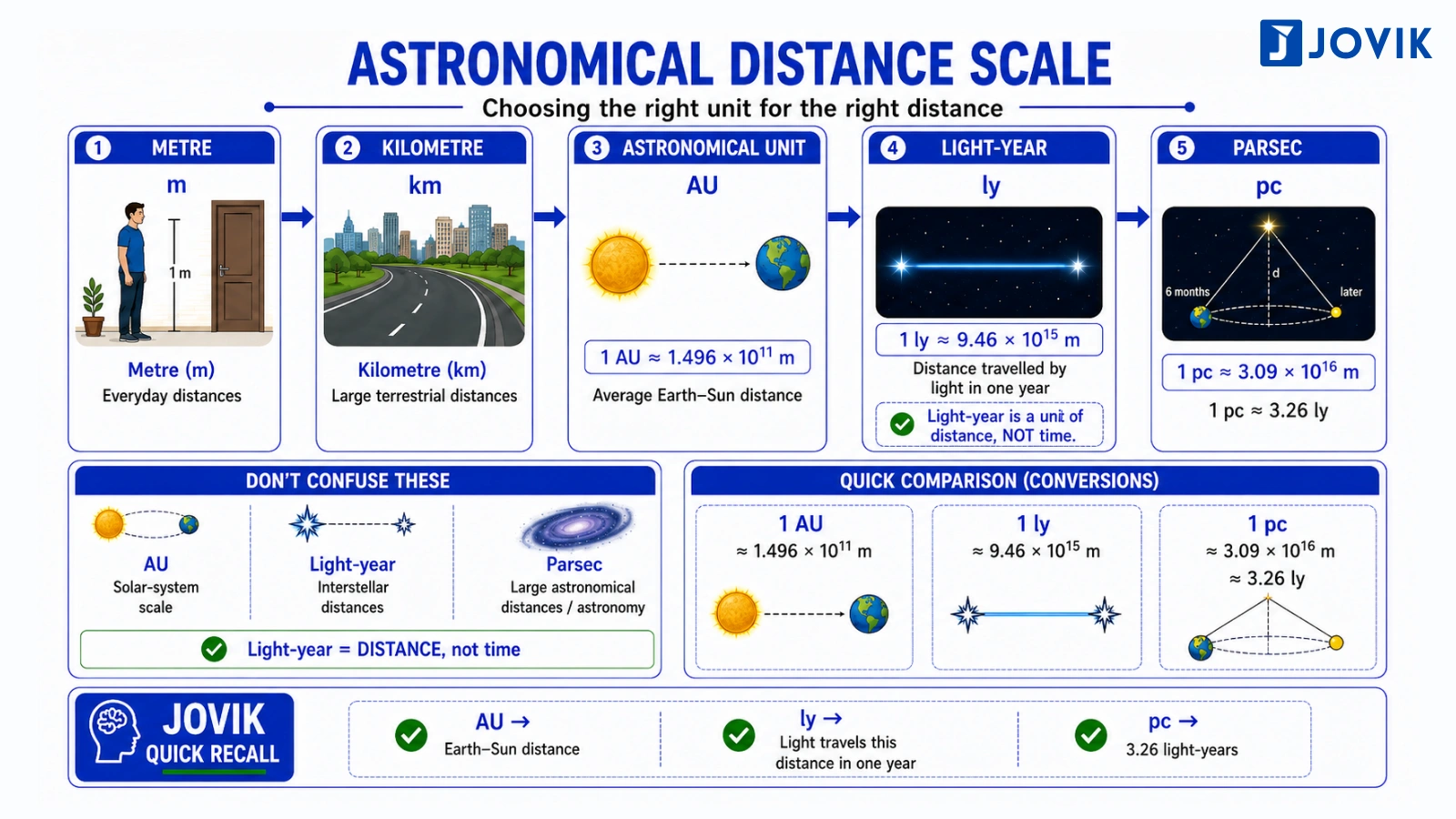
The Astronomical Unit (AU)
One astronomical unit (AU) is the average distance from Earth to the Sun: approximately 1.5 × 10⁸ km. It is used for measuring distances within our solar system and is also the reference length used to define the parsec.
The Light Year
Light travels through vacuum at approximately 3 × 10⁸ metres per second, the fastest possible speed in the universe. In one full year, light covers an enormous distance. That distance is called one light year.
1 Light Year = Speed of Light × 1 Year (in seconds)
= 3 × 10⁸ m s⁻¹ × 3.15 × 10⁷ s ≈ 9.46 × 10¹⁵ m = 9.46 × 10¹² km
A light year is a unit of distance, not time. [NDA 2017-II | NDA 2018-I | NDA 2019-I | NDA 2021-I] It does not measure time. It does not measure the age of the universe. It does not measure light intensity or the amount of light received on Earth.
The word “year” in the name causes persistent confusion. The light year is named by describing how light travels in one year, but the result is a measurement of distance, not of the year itself. NDA has tested this exact misconception in four separate examinations. [NDA 2017-II | NDA 2018-I | NDA 2019-I | NDA 2021-I]
The Parsec
The parsec is a larger unit used for distances between stars and galaxies. It is defined geometrically: one parsec is the distance at which one astronomical unit (AU) subtends an angle of one arcsecond.
1 Parsec ≈ 3.26 light years ≈ 2 × 10⁵ AU
One parsec equals approximately 2 × 10⁵ astronomical units. [NDA 2025-II] The parsec is larger than a light year, which is larger than an AU. All three units measure distance, not time, not brightness.
| Unit | Used For | Approximate Value |
| Kilometre (km) | Earth-scale distances | 1000 m |
| Astronomical Unit (AU) | Solar system distances | ≈ 1.5 × 10⁸ km |
| Light Year (ly) | Interstellar distances | ≈ 9.46 × 10¹² km |
| Parsec (pc) | Galactic distances | ≈ 3.26 ly ≈ 2 × 10⁵ AU |
9. CGS to SI Conversions
The CGS unit of force is the dyne. In CGS, 1 dyne is the force that gives a mass of 1 gram an acceleration of 1 cm s⁻². To convert to SI:
1 dyne = 1 g × 1 cm s⁻²
= 10⁻³ kg × 10⁻² m s⁻²
= 10⁻⁵ kg m s⁻²
= 10⁻⁵ N
1 dyne = 10⁻⁵ N. [NDA 2019-I] The dyne is five orders of magnitude smaller than the Newton. 1 N = 100,000 dynes.
10. Precision, Least Count, and Measurement
Least Count
Every measuring instrument has a smallest readable division. This smallest division is the least count of the instrument. A metre scale with millimetre markings has a least count of 1 mm. No reading taken with that scale can be more precise than 1 mm.
Precision depends on the least count, not on the size of the number. When measuring with a metre scale of least count 1 mm, the most precise reading is the one expressed directly in the unit of the least count.
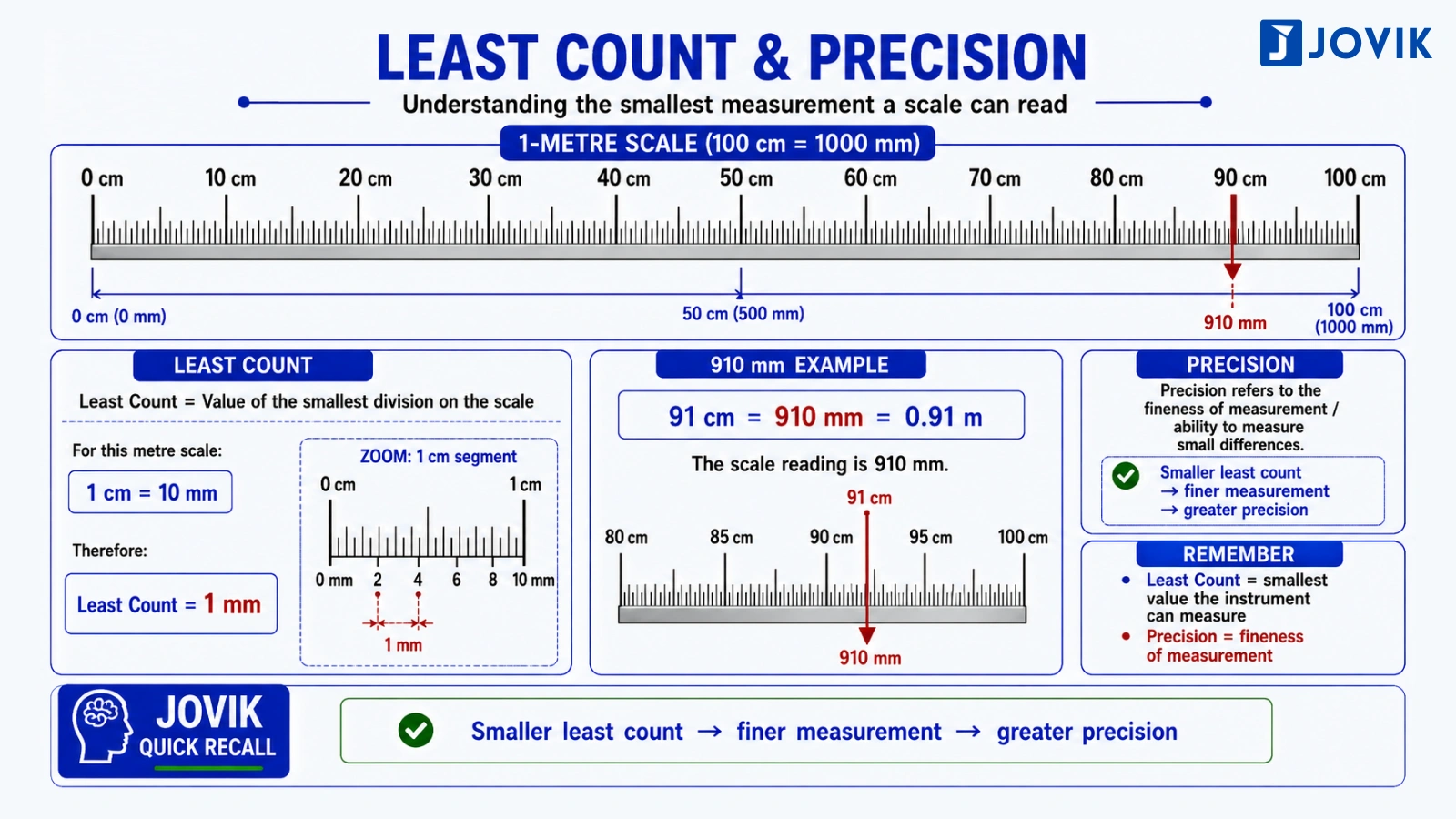
Compare these four readings: 0.50 mm, 29.07 cm, 0.925 m, and 910 mm, all taken with a 1 mm least-count scale. The reading 910 mm is the most precise. It is expressed directly in millimetres, the unit of the instrument’s least count, with no ambiguity from unit conversion. [NDA 2019-II]
Precision vs Accuracy
Precision describes how consistently repeated measurements agree with each other. Accuracy describes how close a measurement is to the true value. A well-calibrated instrument is both precise and accurate. An instrument can be precise but inaccurate if it consistently gives the same wrong reading. For example, a scale that always reads 0.5 kg too high.
The Spring Balance: Measures Weight, Not Mass
Mass is the amount of matter in an object. It does not change with location. Weight is the gravitational pull on that mass. It varies with the local acceleration due to gravity (g).
On a mountain top, g is slightly weaker than at sea level. A spring balance there gives a lower reading for the same object. The measurement of mass taken by a spring balance is accurate only at locations where g is the same as at the place of calibration. [NDA 2016-II]
To measure true mass reliably at any location, use a beam balance. A beam balance compares two masses. Gravity acts equally on both sides, so the reading is unaffected by changes in g.
Significant Figures
| Rule | Example | Significant Figures |
| All non-zero digits are significant | 324.5 | 4 |
| Zeros between non-zero digits count | 3005 | 4 |
| Leading zeros are NOT significant | 0.005 | 1 |
| Trailing zeros after decimal point count | 2.500 | 4 |
| Trailing zeros without decimal: ambiguous | 1500 | 2 or 4 |
Types of Errors
| Type | Definition | Example |
| Absolute Error | Direct difference between measured and true value | True = 5.0 cm, Measured = 5.2 cm → Error = 0.2 cm |
| Relative Error | Absolute error divided by true value | 0.2 / 5.0 = 0.04 |
| Percentage Error | Relative error × 100 | 0.04 × 100 = 4% |
11. Important Distinctions
Mass vs Weight: Mass is the amount of matter in an object, measured in kilograms, and does not change with location. Weight is the gravitational force on that mass, measured in Newtons, and changes with location. On the Moon, your mass is unchanged but your weight is about one-sixth of what it is on Earth.
Precision vs Accuracy: Precision is about consistency between repeated readings. Accuracy is about closeness to the true value. A set of readings can be precise but inaccurate if they are all consistently wrong in the same direction.
kWh vs Power: The kilowatt-hour is a unit of energy. The kilowatt is a unit of power. They are not interchangeable. Power tells you how fast energy is being used. The kWh tells you the total energy consumed over a period of time.
Light Year vs Time: A light year is a unit of distance. Despite containing the word “year”, it has nothing to do with time measurement. It is named for the distance light covers in one year, not for the year itself. NDA has tested this distinction in four papers. Treat it as a near-certain question.
Quick Revision
Fundamental SI Units
| Quantity | SI Unit | Symbol |
| Length | Metre | M |
| Mass | Kilogram | Kg |
| Time | Second | S |
| Electric Current | Ampere | A |
| Temperature | Kelvin | K |
| Amount of Substance | Mole | Mol |
| Luminous Intensity | Candela | Cd |
Important Derived Units
| Derived Unit | Value / Relation | PYQs |
| Acceleration | m s⁻² | [NDA 2016-I] |
| Force (Newton) | 1 N = 1 kg m s⁻² | [NDA 2015-II] |
| Energy (Joule) | 1 J = kg m² s⁻² | — |
| Power (Watt) | 1 W = 1 J s⁻¹ | — |
| Pressure / Stress (Pascal) | Pa = kg m⁻¹ s⁻² | [NDA 2017-I | NDA 2025-I] |
| Inductance (Henry) | H | [NDA 2017-II] |
| Resistivity | Ω m | [NDA 2022-I] |
| Thermal Conductivity | W m⁻¹ K⁻¹ | [NDA 2015-II] |
| Gravitational Constant G | N m² kg⁻² | [NDA 2025-I | NDA 2022-I] |
| Frequency | Hz = s⁻¹ | — |
Key Dimensional Formulae
| Quantity | Dimensional Formula | PYQs |
| Force | [M L T⁻²] | — |
| Energy | [M L² T⁻²] | — |
| Impulse = Linear Momentum | [M L T⁻¹] | [NDA 2014-II] |
| Pressure = Stress | [M L⁻¹ T⁻²] | [NDA 2017-I | NDA 2025-I] |
| Gravitational Constant G | [M⁻¹ L³ T⁻²] | [NDA 2022-I | NDA 2025-I] |
| Planck’s Constant h = Angular Momentum | [M L² T⁻¹] | [NDA 2025-II] |
| Thrust / Impulse = Frequency | [T⁻¹] | [NDA 2021-II] |
| Strain | Dimensionless [1] | [NDA 2025-I] |
| Density | [M L⁻³] | — |
| Specific Gravity | Dimensionless [1] | [NDA 2010-I] |
Energy Unit Conversions
- 1 kWh = 3.6 × 10⁶ J [NDA 2011-II | NDA 2018-I | NDA 2022-II]
- 1 Wh = 3600 J | 1 N m = 1 J (valid energy unit)
- kg m/s² = Newton (force): NOT an energy unit [NDA 2020-I & II]
- kWh = ENERGY only: not power, not potential difference [NDA 2011-II]
Astronomical Distance Units
- Light Year ≈ 9.46 × 10¹² km: unit of DISTANCE, not time [NDA 2017-II | NDA 2018-I | NDA 2019-I | NDA 2021-I]
- 1 AU ≈ 1.5 × 10⁸ km (Earth–Sun average distance)
- 1 Parsec ≈ 3.26 light years ≈ 2 × 10⁵ AU [NDA 2025-II]
- All three units measure DISTANCE: not time, not brightness
CGS Conversions
- 1 dyne = 10⁻⁵ N [NDA 2019-I]
- 1 dyne = 1 g cm s⁻² = 10⁻³ kg × 10⁻² m s⁻² = 10⁻⁵ kg m s⁻²
Measurement
- Least count = smallest readable division of an instrument
- 910 mm is most precise on a 1 mm least-count scale [NDA 2019-II]
- Spring balance → measures WEIGHT (gravitational force), not mass directly [NDA 2016-II]
- Spring balance accurate only where g = g at calibration point
- dB = sound intensity level: NOT a unit of frequency [NDA 2021-I]
- Hz, s⁻¹, min⁻¹ are all valid units of frequency
Common Mistakes
| Wrong Answer | Correct Answer |
| Light year = unit of time | Light year = DISTANCE ≈ 9.46 × 10¹² km (4 PYQs) |
| kWh = electric power or potential difference | kWh = ENERGY only (3 PYQs) |
| Strain has dimensions | Strain is DIMENSIONLESS: stress is not |
| Specific gravity has dimensions | Specific gravity is DIMENSIONLESS: density is not |
| H = Hertz (frequency) | H = Henry (inductance) |
| dB can express frequency | dB measures sound intensity: not frequency |
| kg m/s² = unit of energy | kg m/s² = Newton (force): NOT energy |
| Spring balance reads correctly everywhere | Spring balance reads WEIGHT: varies with location of g |
| 1 dyne = 10⁻³ N or 10⁵ N | 1 dyne = 10⁻⁵ N |
| 1 parsec = 2 × 10³ or 2 × 10⁶ AU | 1 parsec ≈ 2 × 10⁵ AU |
| 1 kWh = 3.6 × 10³ J | 1 kWh = 3.6 × 10⁶ J |